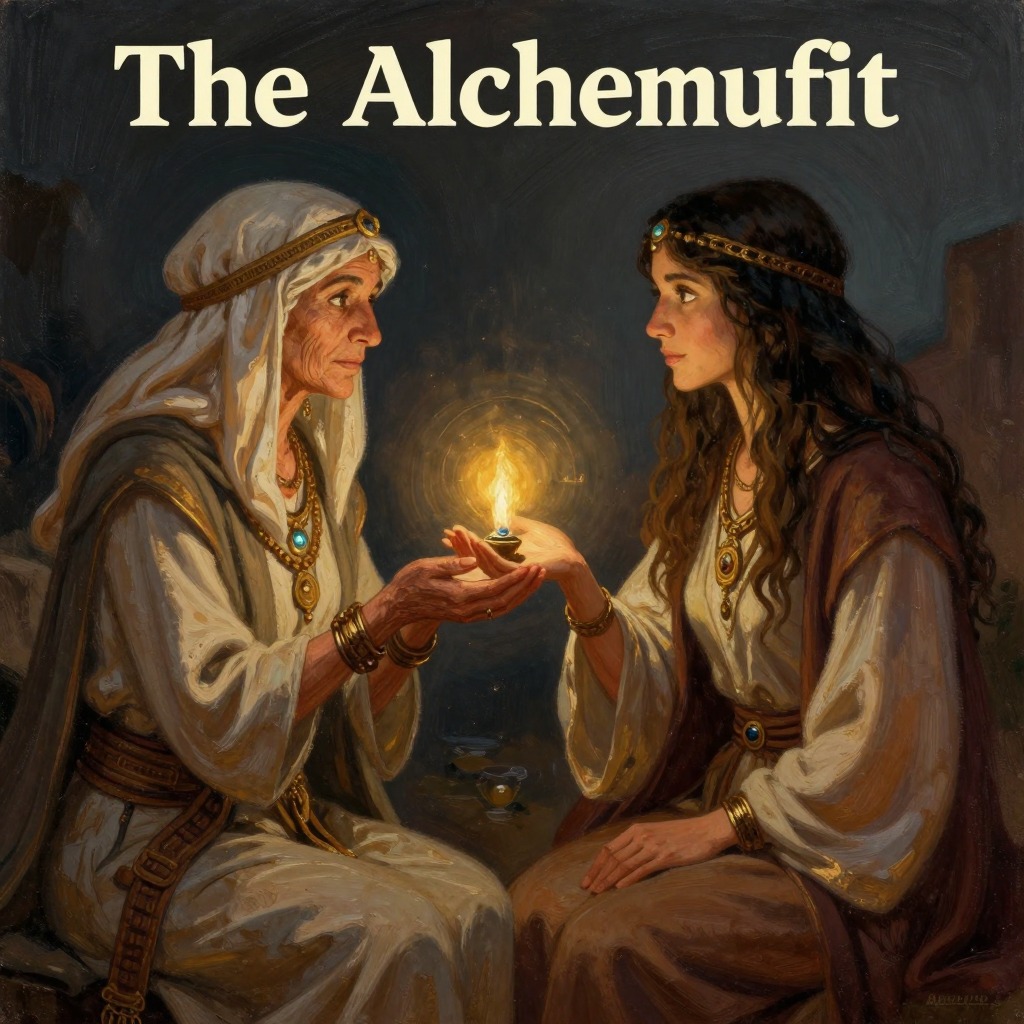
the old woman
The AlchemistThe old woman is a Gypsy dream interpreter living in Tarifa, the southernmost Spanish town from which Africa is visible across the strait. Santiago, a shepherd who has had the same dream twice—a child transports him to the Egyptian Pyramids and speaks of a hidden treasure—seeks her out after hearing that she interprets dreams. She leads him to a room at the back of her house, separated from her living quarters by a curtain of colored beads, furnished only with a table, an image of the Sacred Heart of Jesus, and two chairs. She takes both of his hands in hers and begins to pray in what sounds like a Gypsy prayer, a practice that reawakens Santiago's childhood fear of Gypsies, whom he has heard kidnap children and make them slaves. He recites an Our Father silently to steady himself.
Interpretation and Demand
The old woman studies Santiago's hands carefully and declares the dream "very interesting," then falls silent, making the boy nervous. When his hands tremble, he pulls them away and says he did not come to have his palm read, already regretting the visit. She responds that dreams are the language of God, and that when God speaks in the language of the soul, only the dreamer can understand—but she will still charge for the consultation. Santiago decides to take a chance, reasoning that a shepherd always takes chances with wolves and drought. He describes the dream: a child plays with his sheep, then takes him by both hands and transports him to the Egyptian Pyramids, where the child says, "If you come here, you will find a hidden treasure." The old woman is silent for some time, then takes his hands again and studies them carefully. She announces that she will not charge him now but wants one-tenth of the treasure if he finds it. Santiago laughs, happy to save his money because of a dream about hidden treasure. She insists he swear while looking at the image of the Sacred Heart of Jesus, and he does.
The Interpretation and Its Limits
She interprets the dream as a command: "You must go to the Pyramids in Egypt. I have never heard of them, but, if it was a child who showed them to you, they exist. There you will find a treasure that will make you a rich man." Santiago is surprised and then irritated, feeling he wasted his time. She replies that simple things are the most extraordinary and that only wise men understand them; since she is not wise, she has had to learn arts like palm reading. When he asks how to get to Egypt, she says, "I only interpret dreams. I don't know how to turn them into reality. That's why I have to live off what my daughters provide me with." She tells him to leave, saying she has already wasted too much time with him. Santiago leaves disappointed, deciding never again to believe in dreams.
Narrative Role and Significance
The old woman appears only in this single episode, yet her interpretation is the catalyst that sends Santiago toward his destiny. She is the first figure to name the Pyramids as the location of the treasure, a detail that Melchizedek later confirms. Santiago later remembers his promise to give her one-tenth of the treasure, and in the epilogue, after finding the chest of gold coins and jewels at the abandoned church, he thinks, "Those Gypsies are really smart," and resolves to return to Tarifa to fulfill his vow. Her role is that of the initial, imperfect messenger: she provides the essential direction but no means, no omens, and no spiritual framework. That deeper guidance comes from Melchizedek, who criticizes Gypsies as "experts at getting people to do that"—promising a share of what they do not yet have. The old woman thus occupies a liminal position: she is the first to articulate the call to adventure, but her interpretation is purely literal and transactional, lacking the philosophical depth that later mentors will supply. Her presence also introduces the motif of the dream as a divine language, a theme that the alchemist and the Soul of the World will develop into the central epistemology of the novel.