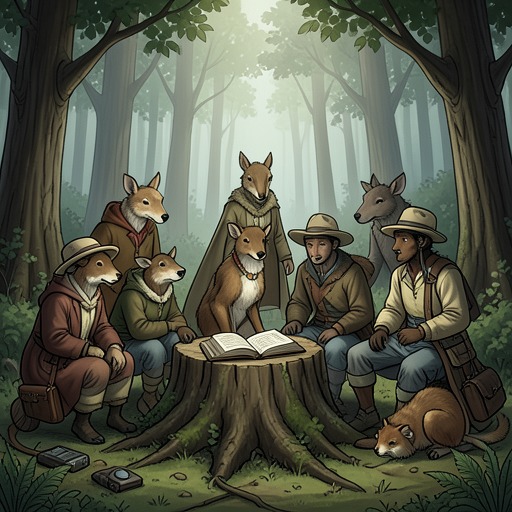
“the Dark Wood”
The Amazing Maurice and His Educated Rodents“the Dark Wood” is both a frightening unknown and a name the Clan learns to claim. The image begins as a story about facing darkness; in the tunnels, Darktan turns it into a rallying idea that makes the rats’ fear, danger, and solidarity part of a common identity. Its force lies in that reversal: what once threatened to scatter them becomes a place and a state of mind they face together.
From darkness to identity
The image’s early foundation is Dangerous Beans’s insistence that the rats can make a statement to darkness. Speaking in defense of controlled fire, he says that a flame declares they are separate, not merely rats, but The Clan. Hamnpork objects that darkness was good enough for their parents and regards a candle as wasted food; his distrust sets inherited caution against Dangerous Beans’s attempt to give the rats a new account of themselves. Although this exchange does not yet name the Dark Wood, it establishes the key association: darkness is something that can be faced, and a shared response to it can affirm collective identity.
The image acquires a more immediate urgency when fear disrupts that identity. In a moment of alarm, rats run past Peaches and Dangerous Beans, one squealing and gibbering; Dangerous Beans realizes that they have forgotten how to talk. Peaches suspects that something terrible has frightened them and gathers her notes. The episode gives the Dark Wood’s menace a social dimension: fear does not remain an individual feeling but spreads through a crowd until language and deliberation collapse. Against that breakdown, the later image of rats who can think and hold together becomes more than a boast.
A story tested against collective behavior
Maurice supplies a blunt account of what can happen when rats are caught in a group panic. Describing rat-coursing, he explains to Darktan that the animals in the ring mostly run around rather than fight the terriers. When Darktan asks why they do not resist, Maurice distinguishes an individual rat from a frightened mass: many rats, each exposed to the others’ fear, can behave like a mob rather than a set of thinking individuals. His description sharpens the contrast the Dark Wood later carries. The central danger is not only an external enemy or the physical darkness of the tunnels, but the possibility that fear will erase the judgment and coordination that make collective action possible.
Darktan’s appeal deliberately answers that danger with a story. Facing a worried squad, he first admits that something new is below, then recasts the rats themselves as the thing that is new: thinking rats who do not turn and run, and who are not afraid of darkness, fire, noises, traps, or poisons. He tells them they are in the Dark Wood from the Book, where a terrible thing hides behind their fear. The story gives an unseen threat a shape without pretending it is harmless; it also changes the squad’s place in the story, from creatures hunted by danger to a force that will seek it out.
The mark and the transformation of fear
Darktan’s speech makes the image communal through an action rather than words alone. He invokes the Bone Rat, who waits for those who break and run but nods and passes on if they stare into his eyes. As the rats look at the livid wound across his chest, Darktan touches it; the badly healing wound will leave a scar. He then walks along the row, marking each rat above the eyes with his own blood. His promised account of their return from the Dark Wood turns that shared mark into a sign by which they will know their own. The ritual binds the story to visible bodies and a common risk.
The squad’s response is not simply fear disappearing. Darktan senses their excitement and the brave identity forming in their minds, and he tries to hold that thought there. Sardines’s raised hat breaks the spell, but the narration notes that something of it remains in the rats’ eyes and movements. The language of the Dark Wood thus works as a temporary concentration of feeling: it gathers individuals into a unit ready to act, while the blood marks give that unity a physical expression.
From imagined wood to the tunnels
The rallying cry becomes practice when the Clan attacks its enemies. The rats move together in a slowly advancing line; when one is attacked, the line closes around it like a fist, and the attacker is killed. When surviving enemies panic and flee, the formation breaks into pairs that pursue them. The brief battle shows, in concrete terms, the difference between the panicked mass Maurice described and a group capable of coordinated action. The Clan’s discipline does not make the violence disappear; it makes the rats’ collective force organized and purposeful.
Afterward, Darktan vows to continue until the tunnels are safe from end to end and then to do it again until they are the Clan’s. He says they are in the heart of the Dark Wood and have found it in their hearts, calling themselves, for that night, something terrible. The words connect an actual underground struggle with an inward encounter: danger occupies the tunnels, but the rats have also discovered their capacity to become frightening together. Darktan’s final admission that they have nowhere else to go gives the triumph an edge of necessity. When he earlier declares, “We love the Dark Wood! It belongs to us!”, the claim is therefore neither a denial of danger nor a simple celebration of it. It is an attempt to turn a place that could overwhelm them into ground they can face, name, and defend as a Clan.