Bad Blintz rat-human agreement
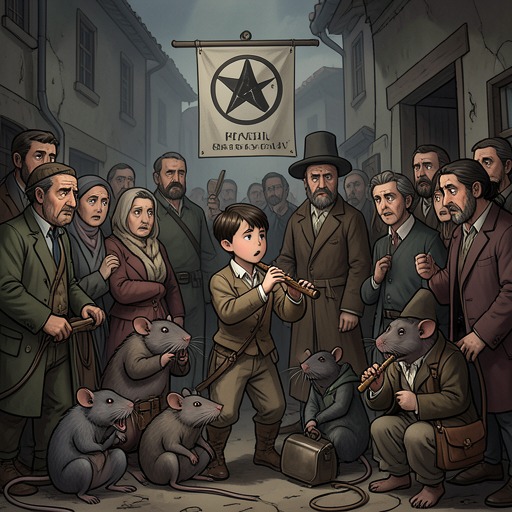
The Amazing Maurice and His Educated RodentsThe Bad Blintz rat-human agreement is the framework negotiated between the town and The Clan after the conflict over the rats gives way to a harder question: how can two communities share a town without returning to threats, poison, and flight? Rather than treating a hopeful story or a moment of goodwill as sufficient, the participants begin building a contract through rules, legal procedures, and representation. Its importance lies not in a sudden reconciliation but in the attempt to make coexistence concrete—and answerable to both sides.
From imagined harmony to a contract
The agreement takes shape against a contrast between the future Dangerous Beans can imagine and the one the characters actually have to make. Earlier, he resists Spider’s promise of cooperation because the proposed alliance would leave one side ruling and millions of rats dying. His conclusion that the arrangement would not work expresses a resistance to domination, not merely a refusal of one offer. The later agreement gives that principle a practical form: cooperation must be negotiated among participants whose interests and judgments count.
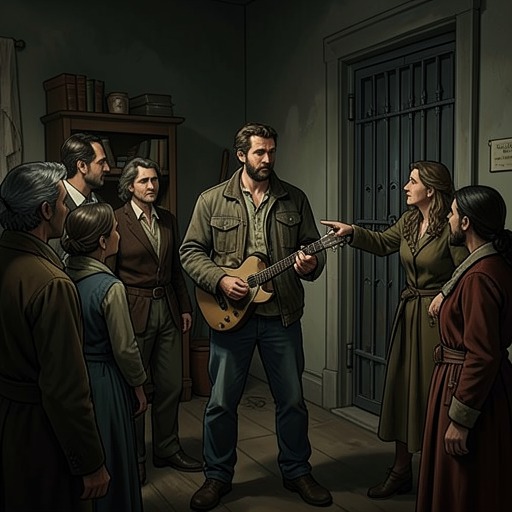
Maurice supplies a story about a lucky town where humans and rats make a deal and follow shared rules. Dangerous Beans suggests that a story may serve as a map, but the narrative distinguishes that possibility from real life: a long conflict cannot be ended by a happy smile alone. It requires a contract, and the contract requires a committee. The Bad Blintz Town Council and senior rats take part, while Maurice moves around the table and joins the discussion. The agreement is therefore presented as deliberation among groups, not as a private promise made by one human and one rat.
Negotiation and mutual security
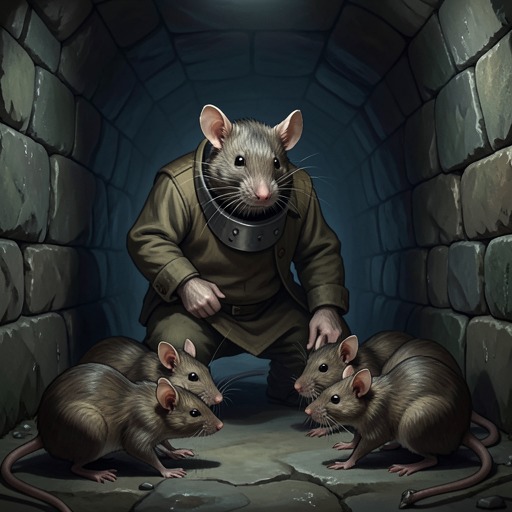
The terms emerge in a town where neither side can rely on force to settle the problem permanently. Keith warns the mayor that chasing the rats away would not make them disappear: they would return, and they live beneath the town’s floorboards. He also makes clear that they know how to use fire and poison. Darktan does not present the rats’ position as a threat, however; he calls it an opportunity. The distinction matters. The warning makes the costs of renewed hostility visible, while the offer leaves room for a negotiated alternative.
The mayor later asks why the rats did not poison the wells or burn the houses, pointing out that they could have done so and that they owed humans nothing. Darktan answers in practical terms. Violence would not improve the rats’ situation; leaving for another town would only make them repeat the same conflict elsewhere. Sooner or later, he argues, the rats would have to talk with humans, and Bad Blintz might as well be the place where that begins. His reasoning makes restraint part of the bargain’s foundation: neither side can build a durable arrangement by treating the other’s destruction as a solution.
Darktan also acknowledges the difficulty of the undertaking. He thinks the agreement might work precisely because humans and rats are arguing over it. He describes reciprocal limits—humans not poisoning the rats’ cheese, and rats not contaminating human jam—as a starting point, not a claim that trust or agreement will come easily. The exchange offers no guarantee that disagreements will vanish; instead, it frames disagreement as something the parties must learn to manage without returning to collective punishment or violence.
Rules, rights, and enforcement
The committee’s discussion shows the difference between a pleasant story of harmony and a functioning civic arrangement. The negotiations range from compulsory bells on cats to the legal status of killing a rat. Maurice insists that killing a rat would count as murder. When the question turns to a rat stealing from a human, the answer is that it would be theft and the rat would have to appear before the justices. The exchange places rats inside a human legal process while also making their conduct subject to rules. It treats them as parties to be governed and held responsible, rather than as a problem to be exterminated.
The discussions also reach the Bad Blintz Watch. Maurice argues that there will have to be rat officers in it. Sergeant Doppelpunkt considers the practical obstacle that he could not fit down a rat hole and notes that the badges would need to be smaller. He accepts that a properly sworn-in rat watchman could arrest anyone, including a human; otherwise, the role would be restricted by size rather than by the officer’s authority. The suggestion that a rat might run up a human’s trouser leg is offered as a possible practical advantage, though the proposal is sent to a subcommittee. This detail captures the agreement’s mixture of serious institutional questions and comic negotiation: inclusion requires changes to procedures and assumptions, not just a declaration of goodwill.
A civic order still being made
The agreement remains a work in progress in the scenes that describe it. The negotiations continue for hours, with many people speaking and Darktan, injured, tired, and hungry, struggling to follow the argument. The committee’s scale and length underline the labor involved in making rules where no shared civic framework had previously existed. The text does not present every question as settled; it shows participants returning to clauses, forming subcommittees, and working through practical consequences.
That process is visible in the street signs. Keith recognizes that one sign uses the Rat alphabet to describe River Street through the rats’ reading of the cobbled road. Malicia identifies the signs’ bilingual format as Clause 193 and notes that the provision had been agreed only two hours earlier. The small signs in the tunnels that she imagines are not confirmed as an adopted measure, but the exchange shows that the agreement reaches beyond abstract rights into public information and shared space. Each group’s language is being made legible in the town’s streets.
Significance
The Bad Blintz rat-human agreement does not erase the history of hostility or promise that people and rats will always understand one another. Its significance is that it changes the terms on which conflict can be handled. The rats are not simply driven from town, and their capacity to think is not left as a matter of human belief: the committee debates legal responsibility, participation in the Watch, and rules governing relations between the communities. At the same time, rats are expected to answer for theft and to take part in a system of mutual obligations.
The agreement’s movement from imagined lucky-town story to committee, clauses, justices, officers, and bilingual signs gives the ending its political shape. Cooperation is not achieved by pretending that differences have disappeared; it is attempted through procedures that make both sides participants in the same civic order. Darktan’s insistence that argument is a start, and his refusal to see violence as a useful alternative, define the arrangement as a fragile beginning rather than a completed peace.