Blunkett and Spears
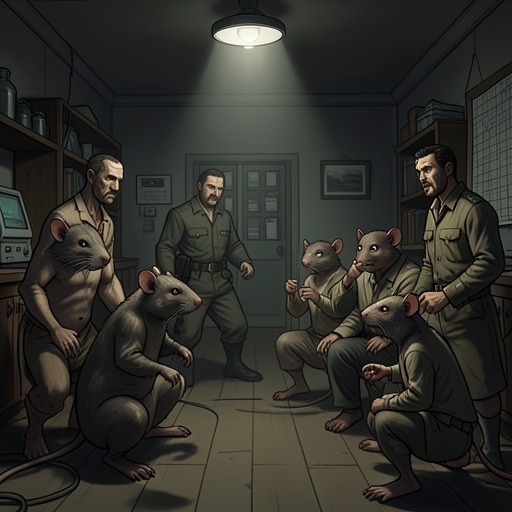
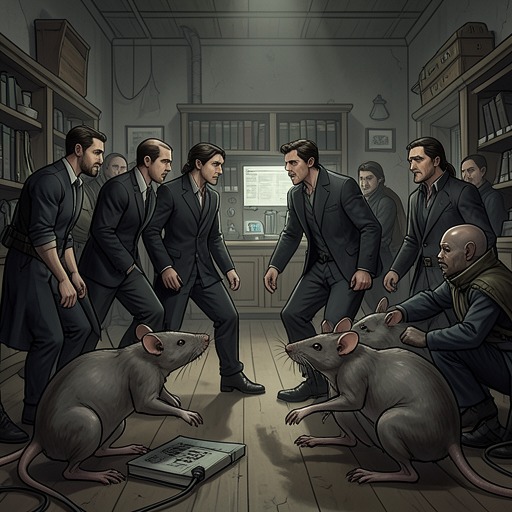
The Amazing Maurice and His Educated RodentsBlunkett and Spears are the two rat-catchers employed in Bad Blintz, where their imposing professional image and noisy reputation conceal a compromised response to a serious rat problem. Their exposure over false rat tails turns them from apparent agents of civic protection into part of the town’s crisis, while the later effort to reach an agreement with the rats offers a sharp alternative to their trade.
Identity and Public Image
The pair first appear in the town square in the recognizable uniform of their profession: long, dusty coats and battered black top hats. Each carries a pole hung with traps and a large bag, and each has a terrier on a lead. The dogs growl at Maurice as they are pulled past. The rat-catchers’ equipment and dogs present a visible show of action, and the waiting crowd greets their arrival with cheers. When the men display what looks to Maurice like black string, the crowd applauds. That response establishes how readily the town accepts the performance of rat-catching as reassurance, even before the displayed material is understood.
Their appearance is therefore more than incidental costume. Traps, dogs, bags, and the display of supposed evidence make the pair legible to the townspeople as the people dealing with the infestation. Yet the spectacle invites scrutiny: what the crowd celebrates as proof of their work looks to Maurice like something other than a rat’s tail. The distance between the town’s confidence and the uncertain evidence on display becomes an early sign that its response to the crisis may itself be unreliable.
Work During the Rat Crisis
Bad Blintz is suffering from food shortages as rats consume or spoil supplies. The town council has been buying food elsewhere, including grain brought by river traders, and bread has become expensive. Malicia Grim describes the town’s attempts to control the rats with traps, dogs, cats, and poison, but says the rats have become difficult to catch. Against this background, Blunkett and Spears are not merely comic intruders: their work is part of the town’s urgent effort to protect food and restore ordinary life.
The gap between their claims and the outcome is important. The rats continue to cause damage, and Malicia reports that the rat-catchers rely on tricks while offering residents fifty pence for each tail. The reward is meant to make rat-catching seem measurable and to recruit the public into the effort, but it also gives the reported tail count practical value. The pair’s apparent success can be presented to a worried town as a quantity of proof, even while the infestation remains unresolved.
Exposure and Escalation
Malicia connects the rat-catchers to the town’s next attempt at dealing with the crisis: after her father calls for Blunkett and Spears, she proposes breaking into their shed to investigate what she calls the mystery of the bootlace tails. The phrase anticipates the specific clue that reveals the deception. When Keith mentions aglets, the small end pieces of bootlaces, one rat-catcher spins around and angrily rebukes his partner, Bill, for having included too many false ones when they already had enough genuine examples. His reaction confirms that the odd black material was not simply a misunderstanding: bootlace ends had been used alongside real rat tails, and someone had noticed.
The exposure also reveals the limits of the pair’s control over the situation. The rat-catchers learn that Malicia has recognized their sham, while Rat-catcher 1 suspects Keith and the unusual cat accompanying him. In a later confrontation, a voice from above warns the men that running, speaking too much, waiting, or trying to outsmart their unseen challenger will bring danger. They look up to find a cat watching from the rafters, and one recognizes it as the boy’s cat. The scene reverses the earlier public display: the men who arrived with traps and terriers are now forced to attend to a threat they cannot readily manage.
Consequences and Narrative Significance
The discovery of the false tails does not, in the available account, establish what formal punishment Blunkett and Spears receive. It does show that the town’s confidence in conventional rat-catching has been exploited, and that its fear and food shortage have created conditions in which a staged measure of success can pass for a solution. Their deception makes the rat problem more than a contest between people and pests: the supposed protectors are implicated in a system that depends on the public believing the crisis is being handled.
The subsequent arrival of the Rat Piper marks an escalation beyond the pair’s work. Rat-catcher 2 says the mayor has sent for him and that his fee is three hundred dollars, presenting the costly specialist as the next answer after the rat-catchers’ failure and exposure. But the story’s eventual direction is different. Maurice proposes that the town council talk with the rats, and Darktan offers the mayor an opportunity to make a reciprocal arrangement. Blunkett and Spears are not shown making that agreement; their narrative importance lies in the contrast their conduct establishes. Their traps, rewards, and false evidence belong to a response built on managing appearances, while the proposed accord depends on acknowledging that the rats can think and can be addressed as negotiating partners.