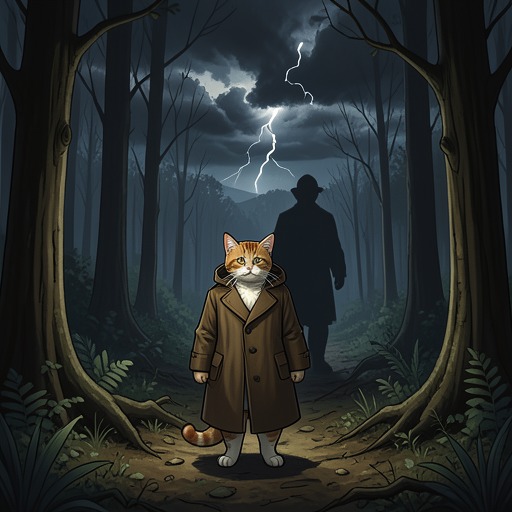
Cats
The Amazing Maurice and His Educated RodentsCats are both a species and a boundary in the novel: they are predators in the Rats’ world, but Maurice’s transformation makes the boundary between cat and thinking person unexpectedly porous. His experience ties feline survival skills to a new capacity for reflection, while the closing return of instinct shows that intelligence does not simply cancel the animal nature from which it emerged.
Identity and the Change in Maurice
Maurice’s change begins with an unfamiliar act of self-recognition. After lunch one day, he sees his reflection in a puddle and thinks of it as himself. Before that moment, he cannot recall having been aware of himself at all; his former mind seems, in retrospect, like a kind of soup. The novel locates the beginning of his identity not in a human explanation of cats, but in Maurice’s own sudden perception of himself as a distinct being. The change also sets him apart from other Cats. Maurice finds them stupid in comparison with his newly active mind and begins spending time with the Rats, who can talk and provide company. The text does not present this as a simple conversion from cat to something else: Maurice remains a cat, but now has to negotiate what that means. His altered consciousness makes him capable of recognizing the Rats as conversational partners, even while his old instincts and habits remain part of him.
Street Survival and Feline Knowledge
Before his transformation, Maurice has survived four years on the streets. He takes that history as evidence that he is smart: the streets expose him to danger from Dogs and freelance furriers, and a wrong move can cost him his life. His battered appearance and conspicuous swagger belong to that hard-won street identity; he walks so boldly that he can flip himself over if he does not slow down, and his fluffed tail forces people to step around it. These details make his confidence comic, but also connect it to a life in which alertness and self-preservation matter. Maurice’s street experience has taught him to notice how people and money work. He explains to the Rats that money is the key to everything, a lesson learned by roaming the city rather than by any formal education. His catlike social technique is similarly practical. A miaow, a purr, or gentle pressure with a claw can steer human attention toward what he wants. In his earlier life, he used this skill at the Wizards' University kitchens, waiting patiently while the cooks guessed at his wishes until they named food he recognized, such as turkey legs or minced lamb. The scene makes feline influence appear less like deliberate reasoning than practiced knowledge of how to get a response.
Cats, Rats, and the Limits of Trust
Maurice’s first consequential encounter with a changed Rat comes when he jumps on Peaches and she asks to talk. His new mind supplies a rule: someone who can talk should not be eaten before Maurice has heard what they have to say. That principle does not make him harmless or remove the risk in his relationship with the Rats. He has to remember not to eat anyone they know, and Dangerous Beans admits that Maurice can be trusted only with reservations where money is concerned. What counts in Maurice’s favor is that he checks before eating a talking person, every time. Hamnpork resists that distinction. In his view, talking does not change what a cat is: a cat remains a cat. The disagreement sets instinctive classification against observed conduct. Dangerous Beans judges Maurice by what he actually does, and concludes that he is decent at heart; Hamnpork sees the species label as decisive. The novel gives neither side a purely abstract argument. Maurice’s companionship with the Rats is real, but so is the predatory relationship that makes trust necessary in the first place. That conflict also sharpens the Rats’ account of their own collective behavior. When Darktan asks why Rats in a ring do not fight the Dogs, Maurice explains that a frightened crowd can cease to think as its individual members might. A single Rat can be brave, he says, while many Rats overwhelmed by fear become a mob. The comparison draws on Maurice’s knowledge of predator and prey, but it also distinguishes the Clan’s disciplined cooperation from a crowd governed by panic. Cats therefore matter not only as individual animals in Maurice’s past, but as part of the danger against which the Rats define their capacity to think together.
Instinct, Conscience, and the Ending
Maurice’s changed identity is tested when he crawls through a pipe. He asks himself why he is doing it, since Cats are not built for such work; his conscience answers that he is kind at heart, and he rejects the description. The exchange leaves his motives unsettled without undoing his actions. He can deny being good and still undertake a difficult task, an ambiguity that keeps his feline self-image from settling into either simple villainy or uncomplicated virtue. During his confrontation with Spider, a mental attack gives Maurice a sensation he recognizes from before the change. For a moment, he understands himself as he was: a bright cat, but only a cat. This is a return to his former condition as he remembers it, not proof that his new self never existed. The distinction matters because Maurice’s identity has been built through a change in awareness, not through the removal of his body or species. The final image makes that distinction unstable. The cat blinks, bewildered and angry, its ears flattening and its eyes flashing green. It no longer thinks; instinct operates beneath reflection, directing its response to a small moving creature. The passage returns feline nature to the level of immediate action, sharply contrasting that reflex with Maurice’s earlier recognition of speech, companionship, and obligation. Cats are thus neither reduced to symbols of savagery nor treated as humans in fur: through Maurice, the novel makes room for change while keeping the pull of instinct in view.