Co-operation versus domination
The Amazing Maurice and His Educated RodentsCo-operation versus domination is the distinction between a community whose members think and act together and a power that merely uses many minds as one instrument. The book tests that distinction in moments of fear, in Spider’s offer to Dangerous Beans, and finally in the difficult move from human-rat hostility toward negotiation in Bad Blintz. Shared strength matters, but it becomes ethical only when it includes regard for those who share it.
A shared identity under pressure
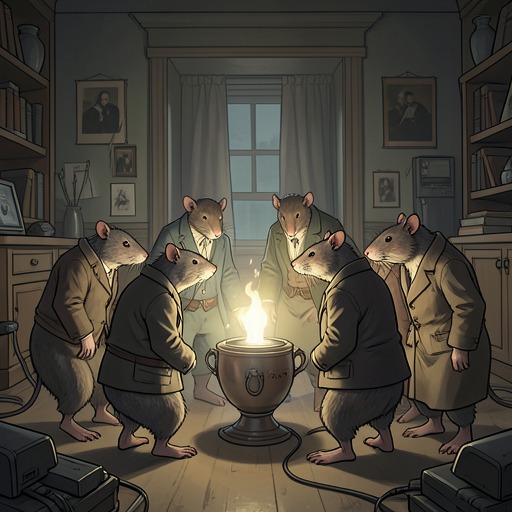
The Clan’s emerging identity first appears as a claim of separation from ordinary animal existence. Dangerous Beans argues that the rats must learn to control fire: a candle’s flame makes a statement to the darkness, declaring that they are separate, not merely rats, but The Clan. Hamnpork distrusts the change, preferring the darkness familiar to earlier generations and seeing the candle as wasted food. Their disagreement makes the flame more than a practical tool: it marks a contested transition from inherited habits toward a consciously shared identity.
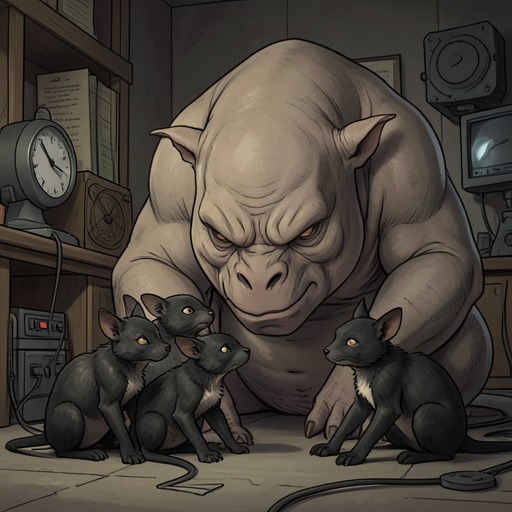
That identity is fragile. When frightened rats run past Peaches and Dangerous Beans, one squeals and gibbers rather than speaking. Dangerous Beans recognizes that they have forgotten how to talk, and Peaches takes up her notes as they try to understand what has frightened them. The episode presents fear as a force that can undo the capacities that distinguish this community: language, reflection, and communication. Collective life is not automatically co-operation; a group can become a frightened mass whose members lose the ability to think and respond together.
Maurice makes that danger explicit while explaining rat-coursing to Darktan. The rats in the ring do not fight the dogs as separate, thinking individuals; crowded together and overwhelmed by shared fear, they run around in confusion. Maurice contrasts the brave, reasoning rat with a mob that behaves like a single mindless animal. His account does not deny that a group can be strong. It identifies the conditions under which numbers alone become a liability: panic can make a crowd act collectively without making it a community.
Spider’s counterfeit unity
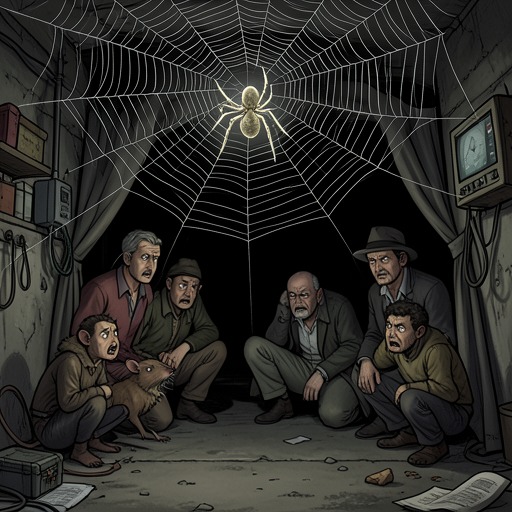
Spider offers Dangerous Beans an apparently powerful alternative. The creature is formed from eight blind rats whose tails are knotted together, an arrangement made by humans for sport. Spider recasts that imposed binding as a source of strength, claiming that minds joined together can achieve more than separate minds and promising that the rats will triumph. Its vision culminates in a planned war against humans, with the prospect that rats will escape their cages and become a plague.
The language of co-operation disguises a structure of domination. Spider says that it can think for everyone; the other rats are not partners whose judgment matters but the bodies and minds through which its own power operates. Dangerous Beans tests the promise by asking whether one of the hypnotized rats has a view of its own. Spider’s surprise at the suggestion exposes the omission at the center of its supposed unity: it can think for many rats, but does not think of them.
Dangerous Beans therefore rejects Spider’s claim to represent the highest form of rat community, The Big Rat. A community founded on war and death, he argues, would embody the worst in rats rather than the best they might become. He does not pretend that the Clan is perfect; its members can be silly and weak. His alternative is nevertheless different in kind: the Clan’s strength comes from acting together, while Spider’s plans subordinate rats to a single controlling mind. Maurice, watching the exchange, likewise distrusts Spider’s offer, seeing that its promise to co-operate would leave Spider in command. The contrast is not between strength and weakness, but between shared agency and power that borrows the language of solidarity.
Co-operation as organized action
Darktan’s leadership gives the Clan’s principle a practical form. Faced with frightened young rats and an unknown danger below, he initially falters over what to tell them. Seeing Sardines signal him, he recognizes the pressure on a leader to offer direction and finds words by looking at the squad before him. He recasts the danger as a test of what they already are: rats with brains, able to think and not simply turn and run. His appeal draws on their shared knowledge of the Dark Wood in the Book, but insists that they are now facing the darkness themselves. The story becomes a means of giving the squad a common purpose rather than a command to surrender judgment.
When the Clan confronts Spider’s controlled rats, its co-operation is visible in how it moves. The rats advance together in a line. When an enemy attacks, the line closes around it; when the remaining rats flee, the formation breaks into pairs that pursue them. The encounter ends quickly. This is organized collective action, not the panic Maurice describes among the rats in the coursing ring, and not Spider’s centralized control. The Clan coordinates its members while allowing them to act as members of a group, rather than turning them into extensions of one mind.
From ideal to negotiated order
The distinction remains unresolved when the immediate danger has passed. Dangerous Beans argues for appealing to a bond between intelligent species, but Maurice is wary of relying on shared intelligence to overcome human conduct. When a human offers to make the rats pets, Darktan objects that this is not what the Clan fought for. Their disagreement keeps the proposed relationship from collapsing into a pleasant story of acceptance: recognition without equal standing could simply replace one kind of subordination with another.
Dangerous Beans calls a story a possible map, but the narrative distinguishes the map’s hopeful image from the work of reality. In the story, humans and rats would shake hands and enter a bright future. In Bad Blintz, peace requires a contract and a committee. The town council and senior rats take part in discussion, while the exhausted, wounded Darktan sits through hours of argument. Coexistence is represented not as a sudden change of feeling but as a process of working out terms among parties who have reason to distrust one another.
Keith urges the Mayor to convene the town council and talk to the rats. He warns that driving them away with dogs and brooms will not solve the problem: they will return, and they live beneath the town’s floorboards and know how to use fire and poison. Darktan presents the proposal as an opportunity, not a threat. When the Mayor asks why the rats did not poison the wells or set houses on fire, Darktan answers in practical terms: what would they do afterward, and would killing humans make anything better? They would eventually have to talk to humans, so it might as well be the people of Bad Blintz.
The answer gives the prospective agreement both an ethical and a pragmatic basis. It rests on refusing needless harm, but also on recognizing that neither side can solve its future by simply driving the other away. Co-operation, in this final movement, is not the denial of conflict or a guarantee that trust already exists. It is the decision to make relations answerable to discussion and an agreement, instead of allowing fear, domination, or retaliation to decide them.