Dangerous Beans's Rules
The Amazing Maurice and His Educated RodentsDangerous Beans's Rules are both a set of remembered principles and a material object that can be lost: a pencilled, water-damaged record of the changed rats’ claim to a different kind of life. The fragments that survive do not provide a complete code. Instead, their significance emerges through the contrast between what the rats hope to be, how fear can undo their shared identity, and the practical agreements required to live alongside humans.
The surviving fragments
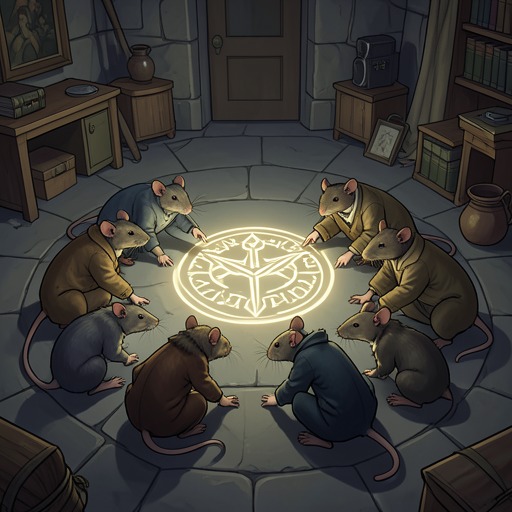
The Rules appear in damaged form when Maurice finds a rolled-up scrap beneath a grating in a tunnel. Water has soaked the paper, and a red stain runs across it; inside are smudged pictures drawn in thick pencil. Maurice recognizes them from having learned them earlier. The text is largely ruined, leaving only the beginning “No Rat Shall…” and the ending “We are not like other Rats”. The torn, illegible middle matters: the scrap preserves the existence of a rule without allowing its full wording to be recovered.
Maurice recognizes the paper as something Peaches carries as though it is precious. His reaction makes the discovery more than a matter of recovering a document: he fears the others will not simply let it go. Immediately afterwards, an alien voice enters his thoughts, asking whether it will find them first—or perhaps already has. The damaged Rules thus surface at a point when the rats’ physical danger and the threat to their community are converging; the writing is a vulnerable reminder of what they are trying to defend, not protection from the danger itself.
Later, Dangerous Beans says that he has lost the Rules. His admission comes amid dripping darkness, and his bitterness about the loss is joined to a larger doubt: he calls them another story, one about rats who imagined they were not rats. Maurice resists that dismissal. He answers that people did try to follow the Rules, and were sorry when they failed. Their exchange leaves the code’s authority unresolved. The Rules are neither shown as an unbroken practice nor exposed as meaningless: their value lies partly in the effort, and remorse, they can demand.
Identity against fear
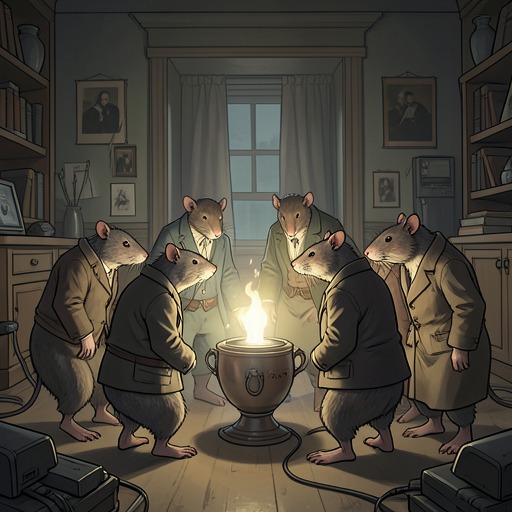
The Rules’ surviving ending, “We are not like other Rats”, echoes Dangerous Beans’s earlier effort to define the Clan through deliberate action. When Hamnpork distrusts a candle and calls its use a waste of food, Dangerous Beans explains that controlling fire is a way to make a statement to the darkness: the rats are separate, not merely rats, but the Clan. Fire here is not just a tool. Its use expresses a collective identity that the Rules also appear to record, while Hamnpork’s suspicion shows that this identity is contested even within the group.
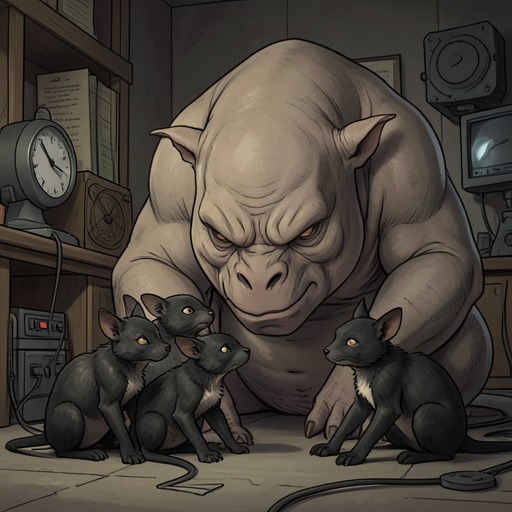
The contrast becomes urgent when frightened rats run past Peaches and Dangerous Beans. One squeals, gibbers, and cannot speak to them; Dangerous Beans realizes that the rats have forgotten how to talk. The episode shows how quickly terror can erase the capacities on which a community depends. A similar distinction shapes Maurice’s account of rat-coursing: rats are put into a ring with terriers, but, he explains, a crowd of terrified rats tends to become a panicked mass rather than a collection of individually brave thinkers. The Rules’ claim about being unlike other rats is therefore not a guarantee of exceptional conduct. It is an aspiration threatened by collective fear.
Darktan gives that aspiration a practical, collective form when he addresses worried rats in the darkness. He insists that they are rats with brains, able to think and to resist the impulse to run, then urges them to face what frightens them together. Later, the Clan advances in a line: when an enemy attacks, the formation closes around it, and the rats pursue their opponents in coordinated pairs when the enemy breaks. These scenes do not establish that the written Rules dictate specific tactics. They do show the difference between a fearful crowd and a group able to act with discipline—a difference that gives the Rules’ language about shared identity its force.
From principle to agreement
Dangerous Beans’s ideas are tested most sharply when Spider offers cooperation alongside the prospect of ruling the rat world and making war on humans. Dangerous Beans entertains the proposition but notes its cost in rat lives. He then asks what a hypnotized rat thinks about the proposed future. Spider’s inability to see that rat as a thinking participant exposes the flaw in his offer: cooperation that treats others as instruments is not a shared order. Dangerous Beans concludes that the scheme would not work. The scene turns the distinction between mere collective power and a community of thinking members into a test of the Rules’ underlying ideal.
The eventual human-rat settlement is not presented as a simple happy ending. Dangerous Beans suggests that a story might be a map, but the narration distinguishes an imagined resolution, in which humans and rats merely shake hands, from real life, which requires a contract and sustained discussion. The town council and senior rats take part in that discussion, while Maurice joins the deliberations. The Rules are not identified as the contract’s text, and the agreement is not described as their direct enforcement. Rather, the settlement gives their concern with living together a political counterpart: a durable arrangement has to be worked out, not wished into existence.
The mayor asks why the rats did not poison the wells or burn the houses, noting that they owed humans nothing. Darktan answers that killing people would not improve the rats’ situation; they would otherwise have to go through the same conflict in another town, and sooner or later they would have to talk to humans. This reasoning makes coexistence a practical choice as well as a moral one. Earlier, Keith warns the mayor that driving the rats away would not solve the problem: they would return, and they live beneath the floorboards. Darktan therefore presents negotiation as an opportunity, not a sentimental reconciliation. Read beside the fragmentary Rules, the ending shifts the emphasis from declaring a separate identity to accepting the work and mutual obligations of a shared future.