Darktan’s succession to Hamnpork’s leadership
The Amazing Maurice and His Educated RodentsDarktan’s succession to Hamnpork’s leadership is not a simple replacement of one capable ruler by another. Hamnpork retains the title and the authority of an older leader until his death, while Darktan comes to embody a different kind of leadership: practical, tested in danger, and increasingly able to give the Clan a shared purpose. Their relationship is shaped by this gap between formal standing and emerging responsibility, and by the difficult moment when the Clan must decide what its customs and loyalties mean after Hamnpork is gone.
An old leader and a changing Clan
Hamnpork’s authority rests partly on seniority and familiar practice. When Dangerous Beans argues that fire can mark the rats as separate and as the Clan, Hamnpork responds with suspicion: darkness had been good enough for their parents, and a candle wastes food. His resistance makes him a contrast to the younger rats’ new ideas, though it does not by itself remove his standing. The disagreement foreshadows the pressure on Darktan to lead a community whose needs are changing faster than its established habits.
The contrast becomes sharper when fear takes hold of the rats. As panicked animals rush past, some have forgotten how to speak; Dangerous Beans and Peaches recognize that something terrible has frightened them. Darktan also understands how fear changes collective behavior. Recalling rat-coursing, he explains that a crowd of rats can behave not like a set of brave individuals but like a frightened mob, driven by shared panic. His emerging leadership therefore depends on more than personal courage: the Clan needs a way to think and act together when fear threatens to overwhelm individual judgment.
Hamnpork’s final journey
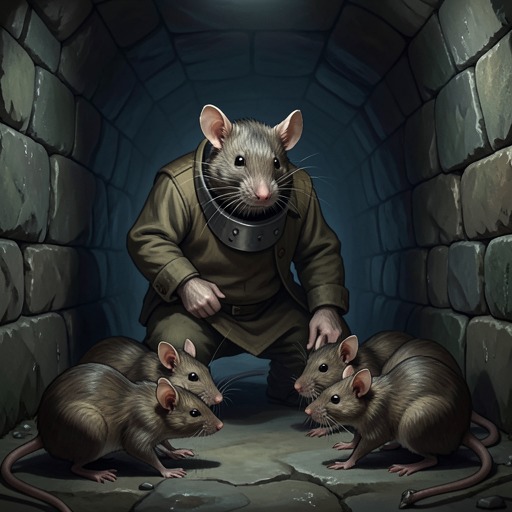
The transfer of responsibility takes place against the physical decline of Hamnpork. As the rats make their slow way back from the stables, he is confused and barely able to walk. He holds on to Sardines’ tail, and Darktan and Sardines support him on either side. They travel through gutters and drains, sheltered only by the night, until they reach the cellar, where a candle is still burning.
Even in this weakened state, Hamnpork remains concerned with his position. He asks Darktan whether he is still the leader, and Darktan answers that he is. The exchange makes the distinction between office and capacity unmistakable: Hamnpork’s claim is acknowledged, even as the others can see that he is close to death. Hamnpork then asks about Darktan’s reported sighting of the tunnel of the Big Rat. Darktan says only that he saw something. Hamnpork imagines that he will go there in his dreams and never wake, and laments that this is not how an old rat should die—not in the light. His words connect his final moments to the Clan’s beliefs, while also registering his disorientation at dying in circumstances he did not expect.
Hamnpork dies with Darktan present. The gathered rats consider what should happen to his body, but Darktan finds that eating him does not feel right. He orders the others to bury Hamnpork and mark the place so the Clan will remember where he is. This decision is a concrete break with the ordinary treatment of the dead, and it gives the new leader’s first public action a moral as well as practical force. The group feels relief, but that relief does not erase respect for Hamnpork; the scene holds both responses together, allowing the old leader to be mourned without pretending that the Clan’s relationship with him was uncomplicated.
How Darktan becomes followable
Darktan does not immediately feel ready to lead. Once Hamnpork is dead, he notices the rats watching him and whispering among themselves. He looks for Dangerous Beans, aware of the crowd’s attention and of the expectations gathering around him. Sardines draws him aside and offers a lesson learned from watching theatre: a leader has to act as though he knows what he is doing, because uncertainty at the top can leave everyone else uncertain too. Darktan admits that he only knows what he is doing when dismantling traps. Sardines answers by recasting the future as a trap, though his analogy offers little comfort.
Sardines also points to the political danger surrounding the succession. With Hamnpork gone, other large rats, including Inbrine and Sellby, might believe they should lead. Darktan protests that he did not die in the trap, but Sardines sees that the event has already become part of how the others understand him. Nourishing has told the Clan that Darktan looked the Bone Rat in the face and returned. Sardines argues that a rat believed to have faced the Bone Rat can attract followers, especially at a time when the group needs someone to follow. In this telling, Darktan’s scar and survival become signs the Clan can read, whether or not they match his own account of what happened.
Sardines further interprets Darktan’s decision to bury Hamnpork as evidence that he is thinking for everyone. The burial and the marking of the place satisfy both old and young rats, giving the new leader an action that bridges generations. Darktan recognizes Sardines’ political intelligence and says he will have to watch him; Sardines disclaims any wish to lead, insisting that he is small and unsuited to the role. Their exchange establishes a useful distinction between Darktan’s authority and Sardines’ influence: Darktan must bear leadership, while Sardines helps him understand how the Clan sees him.
From succession to collective action
Darktan’s new role is tested when he addresses a frightened squad. At first he does not know what to tell them, but a warning glance from Sardines reminds him that leaders are not permitted to display that uncertainty. He begins again by naming the threat as something new, tough, and strong, then turns the description back on the rats themselves: they have brains, can think, and need not run from darkness, fire, noises, traps, or poison. The speech builds a shared identity rather than relying only on Darktan’s personal reputation. He invokes the Dark Wood in the Book and the Bone Rat, recasting fear as something the rats can face together rather than an order to flee.
This is the succession’s larger consequence. Hamnpork’s departure leaves an opening that could have become a contest among powerful individuals; Darktan’s authority instead takes shape through the Clan’s need for coordinated action and through choices the group can recognize as serving its common life. Later, when the Clan enters a room in a disciplined line, its members close ranks around an attacked rat and pursue the enemy together when the opposition breaks. That coordinated movement stands in sharp contrast to the fear-driven mob Darktan had described. His succession is thus not just the passing of a title: it marks a shift toward leadership that asks rats to think and act as a community, even while the customs and symbols inherited from Hamnpork remain part of the Clan’s world.