Hamnpork—Darktan
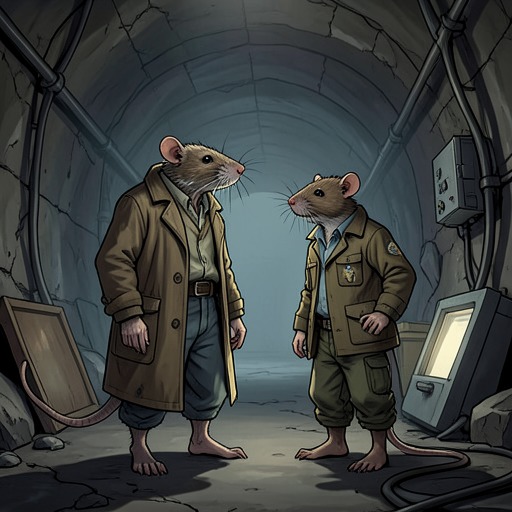
The Amazing Maurice and His Educated RodentsHamnpork—Darktan is defined by a tension between seniority and capability. Hamnpork claims the right to command as the senior rat, but Darktan is the one who understands the practical demands of dangerous work and can recommend what should be done. Their exchanges show that leadership in The Clan is not simply a matter of issuing orders: it also depends on knowing how to meet a threat. Darktan’s restraint keeps that distinction from becoming a direct contest for authority, while his later role in negotiating with Bad Blintz makes his practical leadership public.
A Strain Beneath the Routine
When Darktan asks what is troubling Hamnpork, Peaches says that Hamnpork is thinking about things. Darktan responds with blank surprise and returns to the traps he has to inspect. The moment is brief, but it marks a contrast between them: Darktan’s attention is directed toward immediate work, while Hamnpork is occupied by concerns outside his usual practical focus. The exchange does not explain what Hamnpork is thinking, or establish that Darktan understands the change. It does show that Hamnpork’s state has become noticeable to those around him, and that Darktan registers it even as he turns back to his duties.
That difference sharpens during the expedition discussion. Hamnpork is troubled by what the younger rats might see or understand, and he insists that he will lead because he is the senior rat. Darktan, meanwhile, is already planning how the group can proceed safely. Their disagreement therefore concerns more than who speaks first: Hamnpork treats rank as the basis for deciding what the group does, whereas Darktan approaches leadership through the concrete knowledge required to deal with danger.
The Expedition: Rank and Expertise
Darktan accepts Hamnpork’s demand to lead the expedition, but points out that Mr Clicky will be at the front. When Peaches notes that one Mr Clicky was smashed the previous week, Darktan explains that two remain and that the rats will need to raid another pet shop after those are gone. His replies keep the discussion grounded in the expedition’s actual equipment and risks, while Hamnpork continues to assert that he will decide what they do.
Darktan then makes the practical gap between them explicit. He asks whether Hamnpork knows how to make the traps safe. Hamnpork admits that he does not, but argues that he can tell Darktan what to do. The exchange exposes the limit of command by title: Hamnpork can demand obedience, yet he cannot supply the technical knowledge the expedition needs. Darktan does not use that weakness to claim the leadership for himself. Instead, he continues drawing in the mud and asks whether Hamnpork will be able to identify which levers should be left alone and which parts wedged open. The problem remains concrete, and Hamnpork’s authority does not make it disappear.
Deference Without Retreat
The confrontation appears to reach a turning point when Darktan apologizes for his impertinence. The older males watching are astonished: he has neither leapt at Hamnpork nor cowered. That balance matters to the relationship. Darktan acknowledges Hamnpork’s standing without abandoning his own judgment, making room for cooperation without pretending the difference in their abilities has vanished.
He then states the division of responsibility plainly: Hamnpork, as leader, must give the orders, but Darktan advises investigating the unknown danger because unknown things are dangerous. Hamnpork accepts the recommendation and directs that they investigate, presenting the decision as his own order. The outcome preserves his formal authority while allowing Darktan’s assessment to shape what the group actually does. Neither rat has to turn the exchange into a decisive victory over the other for the expedition to move forward.
This accommodation is not the same as equality of expertise. Hamnpork does not suddenly become the one who understands trap mechanisms, and Darktan does not stop offering operational advice. Instead, their arrangement distinguishes between the right to authorize a course of action and the knowledge needed to carry it out. Darktan’s apology makes that arrangement possible in the moment; his insistence on investigating ensures that deference does not become silence.
Darktan as The Clan’s Representative
In the later dealings with Bad Blintz, Darktan appears in a different role: he speaks directly to the Mayor about how the town should respond to the rats. He warns that calling out the dogs and driving rats away with brooms would not solve the problem; they would return and remain beneath the floorboards. When the Mayor asks whether the rats are threatening the town, Darktan, after glancing at Maurice, presents the proposal as an opportunity. He then asks the Mayor to act as though rats can think and offers, in return, to act as though humans can think too.
The negotiation shows Darktan turning practical knowledge into political judgment. He does not promise that the rats lack ways to harm the town: the Mayor points out that they could have poisoned wells or set fires. Darktan answers that killing the people would not solve the rats’ situation; they would either have to go to another town and face the same problem again, or eventually talk to humans. It might as well be these people. His reasoning moves beyond the immediate contest over command that marked the expedition: it asks what arrangement can last after the immediate danger has passed.
The agreement is not treated as a storybook handshake that settles everything. The possibility of a bright future belongs to the imagined story; in real life, a contract and a committee are needed, with the town council and senior rats involved. Darktan sits through the long discussion, tired and aching, while the argument continues around him. The scene places his leadership within a collective process rather than presenting him as a solitary ruler. The evidence does not show Hamnpork’s response to this later negotiation, so it does not establish how he regarded Darktan’s public role.
The Relationship’s Meaning
Across these episodes, Hamnpork and Darktan embody two distinct bases of authority. Hamnpork’s claim rests on seniority and his insistence that he is the leader; Darktan’s influence comes from knowing how to assess danger, make practical plans, and recognize when confrontation will not solve a problem. Their expedition exchange tests those bases directly, but Darktan’s controlled apology and continued advice prevent the conflict from becoming a simple overthrow of one rat by another.
The later negotiations extend the contrast without resolving it into a reported personal reconciliation. Darktan’s approach to Bad Blintz rests on consequences and future coexistence: violence would leave the underlying problem in place, while discussion can begin to establish rules. In that sense, the relationship’s significance lies less in a declared transfer of loyalty than in the leadership it makes visible. Hamnpork can demand the title and the orders; Darktan demonstrates how judgment can guide action while still leaving room for a group to decide together.