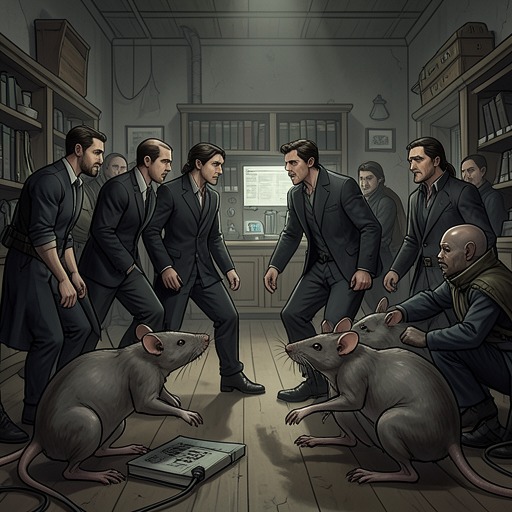
Keith and Malicia force the rat-catchers to confess
The Amazing Maurice and His Educated RodentsKeith and Malicia force the rat-catchers to confess by turning the men’s own methods against them. The questioning begins as a tense confrontation over stolen poison and escalates into an account of systematic theft, captive-rat breeding, and the making of a Rat king. The decisive change is not merely that the rat-catchers admit wrongdoing: their story connects the town’s supposed rat problem to an operation that has treated living rats as both scapegoats and material for profit.
Setup and leverage
The rat-catchers are in a room with rat poison when Maurice intervenes from above. He warns them that running, talking, waiting, or trying to outsmart him will bring danger, then directs their attention to the poison. The threat is calculated: rather than attack them, Maurice makes them consider whether the substance they use against rats might now endanger them. Their reaction shows how quickly confidence gives way when their familiar weapon becomes a source of uncertainty.
Keith then comes up through a floor trapdoor carrying a crumpled paper bag. The rat-catchers are surprised by his appearance and demand to know what has happened to the poison. Keith says that he thinks he put most of it in the sugar. The evidence does not establish that anyone consumes it; the bag and the possibility are enough to make the men take the threat seriously. Keith’s entrance also changes the balance of the scene: the boy they might have underestimated is now participating in a coordinated effort with Maurice, while Malicia is present to press the inquiry.
The confrontation is not presented as a formal hearing. The rat-catchers face pointed questions, and the pressure comes from the prospect that their own practices could be turned against them. Keith uses that pressure to move from the immediate matter of the poison to the larger question of what the men have done with the rats they took away. The sequence makes the confession an exposure of an operation, not simply an admission about one act.
From suspicion to confession
Keith asks what happened to a rat the men had taken. One rat-catcher offers an absurd account of a rat in a hat carrying it away, followed by another large rat entering the pit, confronting Jacko, and escaping. The story is not treated as a convincing explanation. Malicia answers that the rats seem to be all right, and Keith refuses to let the exchange end there: he asks whether the men stole from everyone and blamed the thefts on rats. One of them agrees and admits that they did.
That admission identifies the fraud at the center of the rat-catchers’ public role. The rats were blamed for thefts committed by the men themselves, allowing the rat-catchers to profit while presenting their work as a service to the town. Maurice then adds a quieter accusation: the men killed the rats. His intervention shifts attention from the people they deceived to the animals who bore the consequences. The rat-catchers’ account confirms that the apparent pest-control operation depended on keeping rats alive for another purpose, even as the men used poison and blamed rats for their own crimes.
Keith continues asking about the rats in cages. The assistant explains that the Guild of Rat-catchers had long taken rats alive for the rat pits, treating access to them as a perk of the trade. To maintain a supply, the men bred rats and fed them dead rats from the pits. He presents this practice as customary and harmless, but his explanation makes clear that the operation was not an accidental side effect of catching rats: it required continued capture, breeding, and provisioning. His unease as he speaks mirrors the trap he has helped create for himself. Each answer opens onto a more troubling part of the enterprise.
The operation behind the cages
The account becomes more deliberate when Keith asks what the men were trying to achieve through breeding. The assistant lets slip the purpose: the rat-catchers wanted bigger and better rats. Ron had proposed breeding from those that survived the pits, especially the rats that could evade the dogs. The selection process tied the breeding scheme to the fights themselves. Survival in the pits became a criterion for producing the next generation, while the rats were kept within a human-controlled system of capture and violence.
When a rat-catcher tries to shut down further questioning by invoking a Guild secret, the pressure returns to the same weakness: the men are hungry, distressed, and unable to maintain a shared account. Asked what they had to make, one of them blurts out that they made a Rat king. He then breaks down, repeating the admission and pleading for the questioning to stop. The confession gives the earlier details a new significance. The cages and breeding were not only a supply system for the pits; the men had deliberately produced the extraordinary creature whose existence bears on the danger facing the rats.
This revelation also contrasts with The Clan’s idea of itself as a community of thinking rats. Earlier, Dangerous Beans had described a flame as a way for the rats to declare that they were separate and belonged together as The Clan. Elsewhere, fear has driven rats into a state where they can no longer speak, while Maurice explains how a frightened mass can behave unlike a brave, thinking individual. Against those examples, the rat-catchers’ program represents the reduction of rats to stock: captive animals bred, fed, and sent into pits. Darktan later draws on the opposite possibility when he tells a frightened squad that its members are rats with brains who can think and stand together. The interrogation supplies the human-made circumstances against which that collective identity matters.
Consequences and significance
The confession makes the rat-catchers’ wrongdoing legible in layers. Their thefts and false accusations exploited the town’s assumptions about rats; their use of the pits turned captured animals into a continuing supply; and their selective breeding produced a Rat king. Each disclosure enlarges the stakes, moving the scene from a contest of nerve over poison to evidence of a connected scheme with consequences for both the townspeople and the rats.
The event also marks a contrast between extracting an admission and creating a workable settlement. In the questioning, Keith uses pressure to force the men to tell what they know. Later, when Darktan speaks to the mayor, he offers an opportunity rather than a threat, proposing that humans recognize the rats’ capacity to think and that rats extend the same recognition in return. Maurice likewise describes a town where people and rats can agree on rules, including how food is shared. Those later proposals do not undo the crimes exposed here, but they point toward a different arrangement: one based on reciprocal obligations rather than deception, poison, and control.
As a turning point in the rat-catchers’ exposure, the confession connects the town’s manufactured blame to the hidden fate of the caged rats and the emergence of the Rat king. Its disclosures also sharpen the book’s distinction between a crowd made helpless by fear and a community capable of thought and cooperation. The men’s scheme depends on treating rats as interchangeable, manageable bodies; the rats’ survival depends on recognizing one another as members of The Clan.