Maurice
The Amazing Maurice and His Educated RodentsMaurice is a scarred, self-aware cat whose talent for turning appearances into practical advantage gradually becomes a willingness to take responsibility for others. Known as the Amazing Maurice, he begins as a street survivor who sees money as the key to security; his dealings with the rats, Keith, and the people of Bad Blintz force him to confront the difference between treating life as a story and recognizing its real consequences.
Identity and Awakening
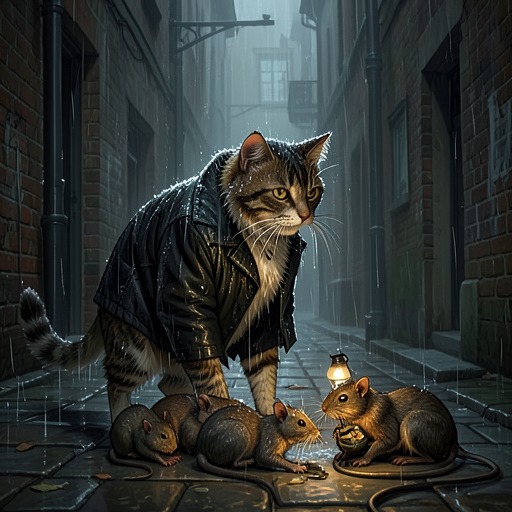
Maurice has lived on the streets for four years, a hard education he considers proof of his intelligence. Dog gangs and freelance furriers make a wrong move potentially fatal, and his ears are damaged and his nose scarred. He swagger-walks so vigorously that he can flip himself over if he does not slow down, while his fluffed-out tail is large enough for passers-by to step around. These details establish a cat who is comic in manner but not sheltered from danger: his confidence comes from surviving it.
His awareness begins abruptly. Looking into a puddle after lunch, he recognizes himself in his reflection and understands that he exists as an individual. Before that change, he recalls his mind as something like soup, though he cannot fully reconstruct how he once thought. The new intelligence is not a gradual education but a sudden alteration that makes Maurice both newly perceptive and newly accountable for what he does with perception.
The rats living beneath the rubbish heap in his territory provide his first sharp ethical test. When Maurice pounces on one, it asks to talk; his newly active mind tells him that someone capable of speech cannot simply be eaten before being heard. This becomes an early limit on his predatory instincts. It does not make him gentle in every respect, but it establishes that thought and speech can change the terms of a relationship, even between cat and prey.
Street Intelligence and the Scheme
Maurice distinguishes between being clever and being wise. The rats may be clever, he thinks, but their understanding of how the world works is incomplete; his own knowledge comes from years of navigating the streets. He adds that survival is not enough: wealth matters too, and he teaches the rats that money opens doors. His outlook is practical, self-interested, and shaped by insecurity about what happens to a stray animal without resources.
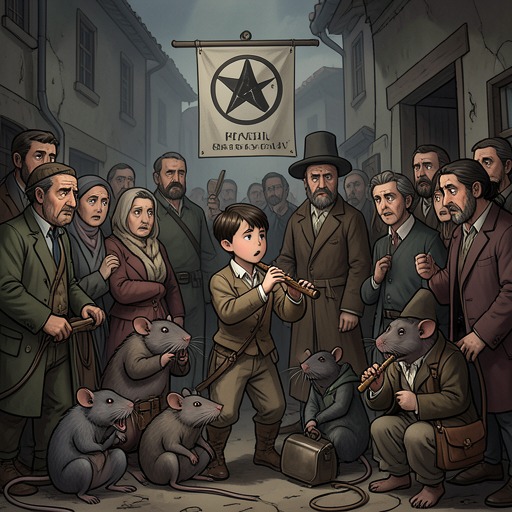
That practical calculation produces his scheme. Seeing a flute-playing boy collecting pennies, Maurice connects the boy, the instrument, and the rats in what seems to him an astonishingly complete idea. The plan turns the rats into an apparent infestation and the boy into the solution, making a staged emergency a source of income. Maurice’s ingenuity is real, but so is its moral evasiveness: he treats a town’s fear as a mechanism that can be operated for profit.
His private ambitions are similarly concrete. At four years old, he imagines retiring to a warm home with a fire and an old woman who will give him cream. He worries that a scruffy, damaged cat will lose out to a fluffy kitten, then considers whether black dye could make him look lucky. The fantasy reveals a vulnerable underside to his swagger: beneath the confidence is a stray trying to design a future in which he will be safe and wanted.
Stories, Fear, and Moral Doubt
Maurice distrusts people who seem to live inside stories rather than reality. He regards Malicia as someone who treats life like a fairy tale and judges Dangerous Beans as a thoughtful rat who assumes everyone else can be as considerate as he is. Maurice’s objection is not simply that stories are false; it is that stories can make consequences seem unreal. In fairy tales, he points out to Keith, death can be only a word. His street experience makes him wary of any outlook that turns actual danger into a tidy plot.
That skepticism does not leave Maurice outside the influence of stories. When he considers what his thinking has done, he recognizes an uncomfortable consequence: once he accepts that others can think for themselves, he starts thinking on their behalf as well. The recognition unsettles him. He groans, then decides they should find out what has happened to Keith. His concern is not presented as effortless heroism; it emerges as a burden of awareness that complicates the self-protective habits on which he has relied.
Maurice’s judgments about groups also reveal the limits of his streetwise certainty. He explains that frightened rats crowded together become a mob, an animal with many legs but no brain, even though an individual rat can be brave. The distinction helps him explain why rats in a ring do not simply fight the dogs set against them. Yet the Clan’s later coordinated advance—holding a line and closing ranks around attackers—provides a counterpoint to his generalization. Individual courage matters, but shared discipline can make a group capable of purposeful action rather than panic.
Responsibility and Confrontation
When Maurice returns to the rat-catchers’ shed, he addresses them from the rafters and warns them that running, talking too much, waiting, or believing themselves clever could prove fatal. The rat-catchers recognize the cat they have seen watching them. Maurice uses the advantage of surprise and his command of the situation to make them listen; the scene shows that his intelligence can serve as intimidation just as readily as it once served a confidence trick.
The confrontation with Spider reaches deeper than physical danger. Spider’s attack brings Maurice a sensation he recognizes from before his transformation, when he was merely a cat rather than the self-conscious being he has become. The assault therefore presses on the boundary between his changed identity and his former existence. Dangerous Beans, meanwhile, refuses Spider’s claim to represent the true nature of rats. Maurice’s recollection makes clear what is at stake in that resistance: intelligence has not erased his animal past, but it has given him a self that can recognize and contest what is being done to him.
Maurice’s most consequential change is visible in the advice he gives the mayor. He lays out the likely failure of simply driving the rats away: they will return, and they live under the town’s floorboards, where they know how to use fire and poison. Rather than present this only as a threat, Maurice helps frame negotiation as a better option. When Darktan offers the mayor an opportunity, Maurice supports the move from force to discussion. His strategy still begins with leverage, but it aims to make cooperation more useful than renewed conflict.
Negotiation and Narrative Role
Maurice carries that approach into the Town Council meeting. When the discussion turns to whether the rats and humans will keep their promises, he proposes a story about a lucky town that makes an agreement with rats and establishes rules. In his example, a householder can ask the rats to leave most of a tray of cakes alone, and the rats can agree. The imagined arrangement is deliberately ordinary: coexistence depends not on making either side harmless, but on setting terms that both can understand and follow.
The story is also a negotiation device. Maurice gives the humans a picture of a future in which an agreement works, while leaving them responsible for deciding whether their town will be the one to make it. This is a marked departure from the original scheme, which depended on people misreading a manufactured crisis. Now Maurice uses invention to make a workable choice visible. His stories remain instruments, but they no longer serve only his private gain.
Keith’s later exchange with the Rat Piper echoes this change in the use of a story. After winning the pipe, Keith proposes that he and the piper lead the rats out of town together, presenting the outcome as a great story while insisting that the piper should still be paid. Maurice is not the speaker in that exchange, but the episode reflects the larger practical principle associated with his development: a durable solution should give the participants a reason to cooperate, rather than leave one side feeling cheated.
Maurice’s arc therefore turns not on the disappearance of his cunning but on what he chooses to do with it. He remains alert to money, leverage, fear, and the power of appearances. What changes is his willingness to let those calculations include other minds and other futures. The cat who first made a business out of a staged rat problem helps imagine a town where humans and rats can live by mutual rules; the decisive gain is not that one side wins, but that the old cycle of fear and return can be replaced by an agreement.