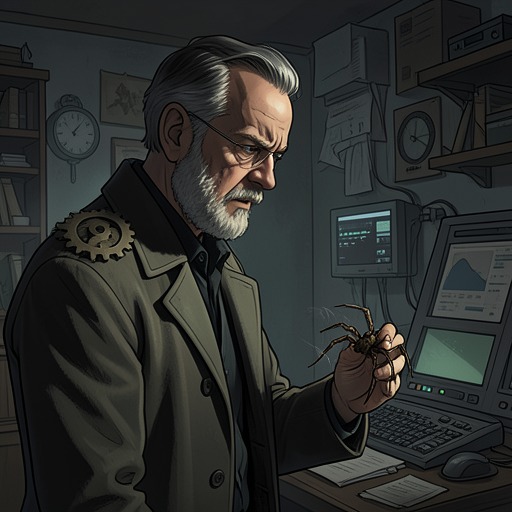
Maurice and Spider’s mental struggle and counterattack
The Amazing Maurice and His Educated RodentsMaurice and Spider’s mental struggle turns Maurice’s changed identity into the ground of a battle for control. Spider invades his thoughts and uses the rats’ fear to command both bodies and minds; Maurice is nearly reduced to the cat he was before. His counterattack comes not as a calm, conscious plan, but through the small surviving part of himself that still knows how to act for others.
The Mind Intrusion
Spider first speaks to Maurice from inside his head, distinguishing itself from the voice Maurice had feared might belong to a Changeling he had eaten. It announces that it is in his mind and will reach his dreams. The threat makes the conflict intimate as well as physical: Spider can address Maurice directly, and later shows that it can exploit what Maurice sees and hears. Maurice’s initial response is defiance, but the exchange establishes how little privacy or distance he has from his opponent.
Spider’s control is not confined to Maurice. When Maurice runs through the tunnels, Spider asks whether it will find the others first, then taunts him about the rats behind him. Dozens of rats, some nearly half his size, wait with the same blank expression. Spider presents their presence as proof of its reach, while Maurice’s refusal to leap at them becomes another point of mockery. The confrontation pits Maurice’s capacity to choose against a mass of creatures whose actions Spider directs.
The distinction matters because the book has already shown how fear can make rats lose the capacities that set them apart. During the growing panic, rats rush past Peaches and Dangerous Beans, one squealing and gibbering rather than speaking. Maurice has also explained that a crowd of frightened rats can become a mindless mob, unlike a single rat able to think and act bravely. Spider turns that vulnerability into a weapon: its power does not merely command individuals but exploits the way panic can dissolve speech and judgment.
Power Against Cooperation
Spider makes its control explicit when Maurice cannot move. It threatens to stop his lungs if he resists, then uses his stillness to tell the assembled rats that even a cat must obey. Dangerous Beans recognizes the power but does not accept Spider’s claim that it should rule. Spider appeals to Dangerous Beans’s understanding of darkness and cooperation, trying to make shared knowledge serve obedience instead. The exchange lays bare the disagreement at the center of the conflict: Spider treats understanding as a route to domination, while the principles Dangerous Beans has taught the Clan bind strength to cooperation.
That contrast also clarifies the limits of Spider’s apparent control. The Clan advances together against Spider’s rats, closing ranks around attackers; when the enemy rats break and flee, the Clan’s formation changes to pursue them. Their coordinated action is the opposite of a crowd driven only by fear. In this wider struggle, Spider can impose a shared blankness, but the Clan can also act collectively through discipline and mutual purpose. Maurice’s connection to that alternative becomes crucial when Spider turns its full force against his mind.
Maurice’s Regression and Counterattack
Spider’s mental assault strips away Maurice’s conscious sense of himself. The storm of thought leaves him with the brain of a cat, and the narration traces the loss as a retreat from the person who can see the world as something outside himself to an earlier, narrower existence. The change recalls Maurice’s own past: before he became Maurice, he was a bright cat, but still only a cat. Spider’s attack therefore does more than immobilize him; it threatens to undo the identity his change made possible.
With that identity suppressed, Maurice’s old impulses surge back. He is drawn toward the actions he had once longed for while feeling helpless among the small, squeaking people around him. The match has fallen into straw and smoke is building, yet the cat now governing him does not attend to either danger. It wants to kill. The episode makes Maurice’s susceptibility to Spider’s influence more complicated than simple submission: Spider’s assault releases a capacity for violence already associated with Maurice’s pre-change nature.
Still, that regression is not complete. A tiny remnant of Maurice remains at the back of his mind, able to give the cat a decisive instruction. It directs him to the central knot of eight tails, and the rat king’s structure is torn apart. The counterattack is thus both physical and psychological: Maurice cannot recover himself through deliberate argument, but the last fragment of his changed identity can still guide the instinctive force Spider has unleashed against the source of its power.
What the Conflict Establishes
The contest between Maurice and Spider makes identity something enacted under pressure rather than secured once and for all. Maurice’s changed nature does not erase his instincts as a cat, and Spider can exploit those instincts by overwhelming his conscious self. Yet the remnant that survives the assault can still intervene for the sake of others. The scene’s reversal depends on that small persistence: Spider reduces Maurice nearly to his former nature, but cannot make every part of him serve its purpose.
The contrast extends beyond the tunnel. Earlier, Dangerous Beans had argued that controlling fire could let the Clan declare itself separate and united; later, the Clan’s coordinated defense gives that identity practical force. Spider, by contrast, attempts to make power mean submission, even when it invokes cooperation. After the confrontation, Maurice supports a negotiated arrangement between rats and people, imagining a town where rules make coexistence possible. That later proposal is not presented as Spider’s defeat alone, but it sharpens the difference between their approaches: Spider commands through fear, while Maurice’s wider response favors agreements that give distinct groups reasons to live together.