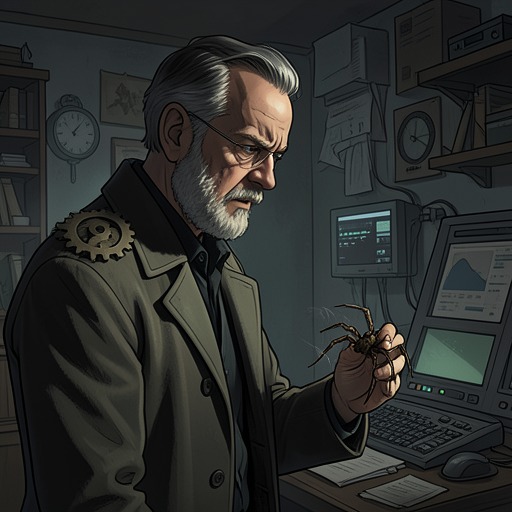
Maurice escapes the rats’ mental control
The Amazing Maurice and His Educated RodentsMaurice escapes the rats’ mental control in a cellar beneath Bad Blintz by working out how the voice in his mind operates. It can issue commands, tug at his movements, and draw on what he sees and hears, but it cannot directly read his thoughts. Maurice turns that distinction into a way out: he shuts his eyes, refuses the voice’s instructions, and escapes through a route the rats cannot immediately block. The encounter reveals both the threat’s reach and its limits, while leaving Maurice with a choice about whether to use his freedom to help others.
The Voice in the Cellar
After squeezing through a drain grating into another cellar, Maurice hears a question that seems to arrive inside his head rather than through his ears. The room is stacked with boxes and sacks; broken cages and the smell of rats mark it as another part of the rat-catchers’ underground premises. Maurice cannot identify who has spoken. The voice seems familiar in an unsettling way: he remembers that the rat-catchers had also acted as if a voice were their own thoughts. The experience raises the possibility that this is not ordinary speech, but Maurice has no clear explanation yet.
The voice urges him to come closer, then presses harder when he does not comply. Maurice’s legs begin to move as if responding on their own. He manages to check the movement by extending his claws and decides not to answer the unseen speaker. His caution has two sources: he suspects someone is hidden among the boxes, and he knows that people might react badly to a talking cat. Even under pressure, he chooses what to reveal about himself rather than allowing the voice to dictate the encounter.
The voice calls his mind wrong and asks what kind of creature he is. Maurice answers with a joke and asks who is speaking, but the exchange does not resolve the mystery. Instead, he makes out three large rats converging on him from different directions. The voice suddenly recognizes him as a cat and commands that he be killed. The rats’ approach and the command coincide, making the threat immediate, while the voice’s alarm suggests that Maurice’s presence has disrupted whatever control it expected to have.
Testing the Voice’s Limits
Maurice’s escape depends on distinguishing what the voice can actually do from what it merely seems able to do. He tries to communicate with it by thinking loudly, asking whether it can read his mind. Nothing happens. That silence gives him a clue: the voice may know what he sees without having access to his thoughts. Rather than confronting the rats directly, he tests this possibility by closing his eyes.
The voice immediately orders him to open them, and his eyelids tremble under the command. The response confirms that the pressure is real; it also sharpens Maurice’s understanding of its limits. He concludes that the voice uses his eyes and ears and guesses at his thoughts rather than hearing them directly. His inward refusal is therefore more than defiance. By withholding the sensory information on which the voice depends, he deprives it of some of its advantage, even while its influence can still make his body react.
This exchange makes the struggle an uneven contest of information as well as force. The voice can issue commands and exploit Maurice’s perception, but it does not have the unrestricted access to his mind that its confidence implies. Maurice cannot make the rats disappear, and closing his eyes does not end the danger; it does, however, help him stop treating the voice as all-knowing. He uses a small, testable uncertainty to recover a measure of agency.
Escape Through the Cellars
While the rats search below, Maurice climbs onto a sloping beam he remembers from the cellar. The beam puts him above the approaching animals and gives him a chance to keep moving without relying on sight. He imagines their noses searching in the darkness beneath him, but does not wait for them to find him. When he opens his eyes again, he sees that the room contains no rats. Instead, a rusted drain cover opens into a tunnel just large enough for him to walk through, with faint light visible beyond it.
Earlier, he had fled the three rats by scrambling over boxes and forcing his way through a gap where rotten bricks had fallen from the wall. That escape deposited him in a cellar filled with stagnant, filthy water. The route was hazardous and unpleasant, but it had broken the immediate pursuit and allowed him to keep testing the voice rather than submit to it. The further drain and tunnel now offer a more promising way onward. The sequence is not a single clean break: Maurice moves from one enclosed cellar to another, using openings in the building to evade both the rats and the voice’s influence.
Once in the tunnel, Maurice thinks of the rat world as dark, muddy, and full of strange voices, and imagines that a way outside will let him leave it behind. But another voice, sounding like his own, raises the question of the stupid-looking boy and the others. Maurice would rather find somewhere warm and let someone else help them. His escape therefore ends not with a settled decision to abandon his companions, but with his reluctance brought into view: being free of the immediate mental pressure does not by itself resolve what he owes to the people he left behind.
Significance of the Escape
The episode turns an apparent invasion of Maurice’s mind into a problem he can examine. The voice’s commands initially blur the boundary between thought, sensation, and action: his muscles respond, his eyelids tremble, and the speaker seems to know what is happening around him. Yet Maurice’s simple tests expose a gap between influence and knowledge. He can be pushed and watched through his senses without being fully understood. His escape begins when he treats that gap as usable information.
The cellar setting reinforces the limits of his position. Maurice has no map of the underground rooms, cannot open doors with handles, and has only fragments of light and remembered space to guide him. He survives by adapting to the openings he finds: a grating, a break in the brickwork, a beam, and finally another drain cover. At the same time, the scene complicates the idea that escape is purely physical. Reaching a tunnel gives him a possible route out, but the thought of the boy and the others makes clear that leaving the dangerous place and deciding what to do are separate problems. Maurice gets away from the voice’s immediate hold; the responsibility confronting him remains.