Maurice—The Clan
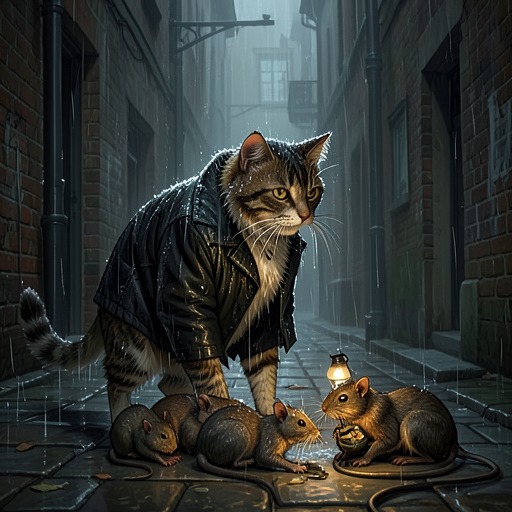
The Amazing Maurice and His Educated RodentsMaurice and The Clan are partners formed by an improbable recognition: when one of the rats beneath the rubbish heap asked to talk, Maurice’s new mind told him not to eat someone who could speak. What began as a practical alliance between a sharp street cat and unusually intelligent rats develops into a test of whether old instincts and self-interest can give way to trust. Their relationship helps turn a money-making trick into a wider argument for cooperation between humans and rats.
An alliance born from recognition
Maurice’s transformation first gives him self-awareness; the rats make that change relational. The rat he pounces on is Peaches, and her question interrupts the ordinary predator-and-prey encounter. Maurice’s new understanding does not make him harmless by nature, but it gives him a rule: hear a talking creature out before deciding what to do. He later emphasizes that he checks every time before eating anyone the rats know. That repeated restraint is the small, practical basis on which The Clan can live alongside a cat.
The rats are not simply a convenient audience for Maurice. Peaches, Dangerous Beans, Darktan, Hamnpork, and the others are different from ordinary rats, just as Maurice is no longer like other cats. He spends time with them because they are people he can talk to, while still seeing their investigation of how they became clever as a distraction. Their relationship therefore begins with both companionship and disagreement: Maurice accepts the change as something that happened; the rats seek an explanation for it.
Maurice’s street experience shapes the terms of their partnership. Four years of surviving among dog gangs and freelance furriers have left him scarred and missing much of his ears, and he is convinced that intelligence is essential to staying alive. He also believes that survival requires money. When he sees a boy playing a flute for pennies, he joins the ingredients in his mind—rats, music, and a human performer—and conceives the scheme that will let the group earn it. The plan gives The Clan a route toward its aspirations, but it also reveals that Maurice initially treats the partnership as a venture whose success depends on his business sense.
Money, ideals, and earned trust
The difference between Maurice’s priorities and the rats’ hopes becomes explicit when he defends his decision to help them. He reminds the rats that he could have sought comfortable work with a conjurer or ventriloquist, but chose instead to help creatures humans do not generally favour. He recognizes Dangerous Beans’s wish to establish a rat civilization elsewhere as admirable, then brings the conversation back to the money needed to make it possible. His commitment is real, but it arrives wrapped in self-praise and calculation.
Dangerous Beans understands that complication rather than overlooking it. When Hamnpork questions whether a cat can be trusted, Dangerous Beans allows that Maurice may not be dependable about money, but points to his consistent refusal to eat those who talk. Hamnpork insists that a cat remains a cat; Dangerous Beans answers that Maurice, like The Clan, is different. This exchange defines the alliance more carefully than a simple declaration of friendship would: trust is not based on denying Maurice’s appetites or habits, but on noticing the restraint he practices despite them.
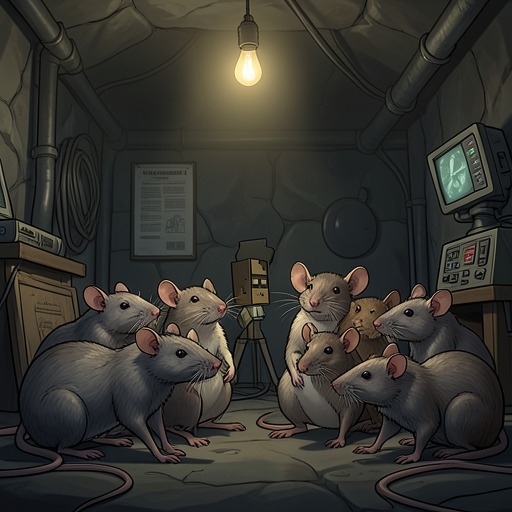
The Clan’s own emerging rules give that trust a collective meaning. Dangerous Beans describes the flame of a candle as a statement to the darkness: the rats are separate, not merely rats, but The Clan. Their shared identity stands in contrast to Maurice’s individual, street-forged resourcefulness. Yet the two forms of survival can meet. Maurice’s refusal to eat those who speak becomes compatible with a community that understands itself through shared commitments rather than mere numbers.
Fear and the difference between a crowd and a clan
The limits of that community become visible when frightened rats race past, squealing and gibbering. Dangerous Beans realizes that they have forgotten how to talk, and Peaches gathers her notes as the rats try to understand what has terrified them. The moment exposes how quickly fear can undo the very capacity that distinguishes these changed rats: intelligence does not guarantee collective courage or control.
Maurice has his own stark theory of that weakness. Recalling the rat-coursing ring, where rat-catchers put live rats among terriers, he explains that frightened rats, overwhelmed by one another’s panic, do not fight as brave individuals might. In his formulation, a mass of rats becomes a large animal with many legs and no brain. The account is blunt, and it can sound dismissive; it also identifies the danger that The Clan’s shared identity must answer. A group can be driven by contagious fear, but it can also learn to act together.
Darktan gives that alternative a practical form. When the squad faces something new and frightening, he turns their attention from uncertainty to their shared capacities: they are rats with brains, able to think and resist the impulse to run. His appeal to The Clan’s identity recalls the statement made around the candle, but now identity is not only a distinction from ordinary rats; it is a reason to take responsibility for one another. The Clan advances in a coordinated line, closing around attacking enemy rats and then breaking into pairs to pursue those trying to flee. The contrast with Maurice’s description of a panicked mob makes their discipline a visible achievement, not an automatic consequence of being changed.
From survival scheme to shared responsibility
The alliance is tested when Hamnpork must be rescued. Maurice begins to suggest a plan based on moving upwards at every opportunity, but Darktan names the obligation that takes precedence: The Clan does not leave its people behind. Maurice questions the rule, then hears Darktan confirm it. The exchange marks a difference between Maurice’s habit of evaluating situations for a way out and the rats’ growing insistence that survival includes returning for one another. It also shows him encountering a principle that cannot be reduced to money or individual escape.
By the later confrontation with the rat-catchers, the partnership has become part of a broader negotiation. Maurice warns the mayor that the rats can do more than run away: they live beneath the town’s floorboards and know how to use fire and poison. But the proposal Darktan makes, with Maurice’s assent, is framed as an opportunity rather than a threat. Darktan offers a reciprocal arrangement in which each side must recognize the other’s capacity to think. Maurice then imagines a town whose rules let people share food with rats and ask them to leave the rest untouched. It is an illustrative proposal, not proof that a complete system has already been established, but it carries their relationship’s central possibility outward: coexistence depends on communication and agreed limits.
Maurice and The Clan never become alike in every respect. Maurice remains alert to money and danger; the rats build a collective identity grounded in thought and mutual duty. Their partnership matters because it makes those differences usable rather than fatal. The cat who once saw rats as prey becomes an ally who helps them pursue a future, while the rats’ trust asks him to recognize obligations beyond his own survival. In that movement—from a talking rat spared, to a rescue that cannot be abandoned, to a proposed human-rat agreement—their unlikely companionship becomes a model for cooperation across a boundary once treated as natural.