No Rat to Kill Another Rat
The Amazing Maurice and His Educated RodentsNo Rat to Kill Another Rat is a principle Dangerous Beans proposes for the Changelings and Peaches preserves in their written rules. It extends the idea of community beyond useful cooperation: even a rat regarded as an enemy remains one of them, and killing should be avoided. The rule is not an absolute denial of danger or necessity. When Peaches asks what happens if killing is unavoidable, Dangerous Beans answers that it may have to happen, but should not. That distinction makes the principle both an ethical limit and a practical guide to life among rats.
Formation and written record
Dangerous Beans gives the rule as a considered thought, not an inherited custom. He has been reflecting on how the Changelings should behave, and Peaches asks whether his prohibition includes keekees—rats outside their own group. His answer is that they, too, are rats. Peaches notes that attempts to talk with them have failed and that they mostly keep away, but Dangerous Beans still asks her to write the principle down. The rule therefore reaches beyond immediate friendship or successful negotiation: an opposing rat does not cease to count as a rat because communication has broken down.
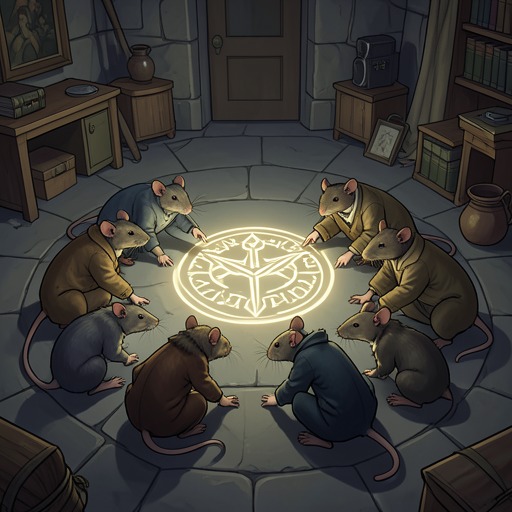
Peaches makes the rule durable in the Changelings’ small archive of thoughts. She draws it as No Rat to Kill Another Rat, using pencil lead on a grubby piece of paper. The materials are modest: her cloth roll holds a few matches, pencil leads, a sliver of broken knife blade for sharpening them, and the paper itself. Yet this record belongs to a developing body of shared guidance. The drawings use a thick line for negation and a trap sign for ideas such as death, danger, or avoidance; Peaches adds a dead rat to make the meaning more serious. The rule is thus both a sentence and an image the group can remember.
Scope and qualification
The prohibition follows from Dangerous Beans’ refusal to treat rats as disposable merely because they are unfamiliar or hostile. When Peaches presses the hardest question—what if a rat has to kill another rat?—he does not pretend that every conflict can be resolved without violence. His reply separates necessity from approval: circumstances may compel an act, but compulsion does not turn it into a good or desirable choice. The rule accordingly guides judgment without promising that danger will disappear.
That qualification matters in a book where fear can overwhelm thought. When frightened rats rush past Peaches and Dangerous Beans, one squeals and gibbers instead of speaking; Dangerous Beans recognizes that they have forgotten how to talk. Elsewhere, Maurice explains that many rats gathered together can become a panicked mob, unlike a single rat able to think and act bravely. Against that breakdown, the rule imagines rats as accountable individuals who can recognize one another as members of a moral community. It does not itself prevent panic, but it offers a standard different from the crowd’s reflex to flee or attack.
A principle tested by conflict
The story places this ethic beside organized violence. Maurice recounts rat-coursing, in which rat-catchers put live rats into a ring with terriers; the rats mostly run in fear. Later, when the Clan confronts the rats controlled by Spider, its members advance together and kill attacking opponents. These episodes do not establish that the written rule is formally invoked during the battle, nor do they erase its tension with the use of force. Instead, they sharpen the distinction already present in Dangerous Beans’ answer: violence may arise under threat, while killing remains something the rule tells the rats not to choose lightly. The principle is a restraint on conduct, not evidence that the Changelings never fight.
Dangerous Beans’ refusal to join Spider’s proposed alliance gives the rule a wider moral context. Spider offers cooperation in a campaign that would bring war between rats and humans and cost millions of rat lives. Dangerous Beans considers the offer, asks what one of the hypnotized rats thinks, and concludes that the plan would not work. The episode does not present the no-killing rule as the sole reason for his refusal, but it sets domination and mass death against the kind of community his principles seek to build: one in which rats are thinking beings, not numbers to be spent by a ruler.
Meaning beyond the rule itself
No Rat to Kill Another Rat belongs to a larger effort to define what makes the Changelings different from ordinary animal behavior. Dangerous Beans has already described fire as a way for the Clan to declare that it is separate and more than merely rats. His prohibition makes that difference ethical as well as symbolic: being a community entails obligations toward other rats, including those who are not easy to like or trust. Peaches’ careful recording turns an individual thought into a shared point of reference.
The ending’s human-rat negotiations echo the rule’s concern with what violence can accomplish, while remaining a separate political question. When the mayor asks why the rats did not poison wells or set fire to houses, Darktan answers that killing humans would not improve the rats’ position; sooner or later they would have to talk to humans. The resulting agreement requires a contract and committee rather than a convenient, storybook handshake. In that context, Dangerous Beans’ principle can be read as one early expression of a broader turn away from endless retaliation. It does not settle every conflict, but it supplies a memorable test: necessity may explain killing; it does not make killing the ideal.