Rat King's shared consciousness
The Amazing Maurice and His Educated RodentsRat King's shared consciousness is the mind Spider claims has emerged from eight blind rats bound together by their twisted tails. It gives him a commanding voice in Maurice's mind and the power to direct other rats, but its apparent unity is built on domination rather than mutual regard. The novel sets this coercive collective against The Clan: one turns many rats into an instrument of a single will, while the other seeks strength through cooperation among thinking members.
Formation and Claimed Power
Spider appears as a bundle of rats moving across boxes as though one creature operated all their legs. When the bundle reaches the light, Maurice sees that the rats' tails are twisted into one huge knot and that every rat is blind. As Spider's voice thunders in Maurice's head, the eight rats rear and tug against the knot. The bodily image makes the shared mind visible: separate animals are bound into a unit, but their physical entanglement does not establish that they freely share a purpose.
Spider explains the knot as the origin of his power. Men tied the rats together for sport and expected them to struggle; Spider claims that, instead, they became strong together. He describes their combined intelligence as increasing beyond the sum of individual minds, culminating in a single, stronger mind. This is Spider's account of himself, not a neutral account of how the collective works. His grand theory turns forced confinement into a claim of superiority, and makes unity appear inseparable from the loss of individual boundaries.
The mind's reach is demonstrated in the scene itself. Spider speaks directly inside Maurice's thoughts and boasts that he can hold a cat back from leaping. He also treats the other rats as instruments of a larger design: he wants the cages opened so that humans will face a plague, and invites Dangerous Beans to join him in that project. The shared consciousness is therefore both a means of communication and a means of control; its power is measured not only by how many rats it can coordinate, but by how readily it overrides their separate agency.
A Collective Mind Without Consideration
Dangerous Beans tests Spider's claim by asking what one of the rats under his influence thinks about the proposed alliance. Spider is taken aback by the question, reasoning that a rat has no reason to think for itself. That response exposes the limit in his idea of collective intelligence: he can think for many rats, but does not think of them. The distinction is the ethical center of their disagreement. Coordination alone does not amount to solidarity if the individuals being coordinated are treated as expendable.
Dangerous Beans refuses Spider's offer. He argues that a true Big Rat, if such a figure exists, would represent the best the rats could become, not their capacity for war and death. He acknowledges that The Clan can be silly and weak, but holds that its strength lies in being together. Spider offers plans for rats; Dangerous Beans insists that he has dreams for them. His answer rejects not collective life, but a version of it in which one will claims the right to command all the others.
Spider answers the refusal with rage and pain directed into Maurice's mind, reinforcing the coercive nature of his connection to others. The episode contrasts the language of unity with its practice: Spider presents the joined rats as strong, yet his response to dissent is to punish it, not to persuade or accommodate it. His shared consciousness can impose a common direction, but the scene gives no sign that it can sustain disagreement among its members as a form of cooperation.
Fear, Identity, and Group Behavior
Other moments in the story distinguish a crowd's behavior from the deliberate cooperation Spider claims to have achieved. During a wave of terror, rats run past Peaches and Dangerous Beans; one squeals and gibbers, and Dangerous Beans realizes that some have forgotten how to talk. The scene presents fear as a force that can undo communication and conscious identity. It is a sharp contrast with Spider's fluent voice and command: both scenes involve many rats acting together, but one is collective panic and the other is a mind imposing direction.
Maurice makes a related distinction when Darktan asks why rats in rat-coursing do not fight the dogs. Maurice explains that many rats, all steeped in one another's fear and panic, behave like a mob rather than like a brave individual rat. His account describes a group's capacity to overwhelm individual judgment without creating a thoughtful shared mind. Spider's collective is more organized than such a mob, but the comparison clarifies that coordination is not by itself proof of understanding or care.
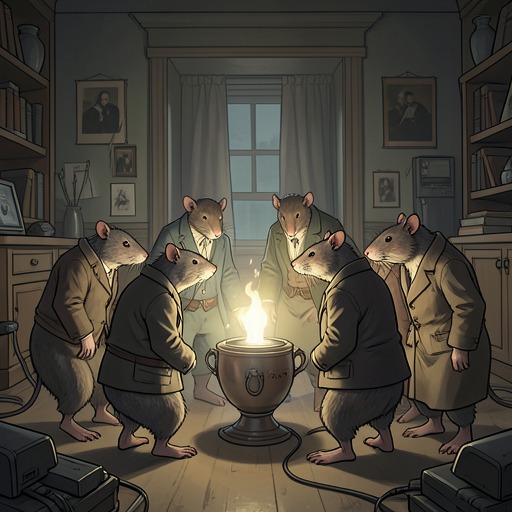
The Clan develops a different basis for collective action through shared identity and discipline. Earlier, Dangerous Beans explains the purpose of controlling fire: its flame makes a statement that the rats are separate, are not merely rats, and are The Clan. Hamnpork remains suspicious of the candle and regards it as a waste of food, so this identity is an emerging idea rather than an unquestioned tradition. The scene links a visible, controlled flame to the Clan's effort to understand itself as a community.
Darktan later turns identity into resolve when he faces a frightened squad underground. Rather than pretend that he knows what lies ahead, he presents the danger as something new and insists that the rats themselves are also something new: rats with brains who can think and who do not have to flee from darkness, fire, noises, traps, or poisons. He invokes the Dark Wood and the Bone Rat to give their danger a shared frame, then calls the squad to confront what is hidden by fear. This is a leader trying to shape collective courage through shared language, not to erase the members' minds in a single controlling consciousness.
The Clan's Counterexample
The contrast becomes physical when The Clan enters the room where Spider's controlled rats are gathered. The Clan advances in a line, keeping together; when an enemy rat attacks, the line closes over it like a fist, then opens again. When the surviving enemy rats smell the terror of their fellows and try to escape, the line breaks into pairs that pursue them. The change from formation to pairs shows coordinated action adapting to circumstances rather than relying on a single visible mass.
The battle is over within seconds, and the squeaks of a few escaping rats fade into the walls. The scene does not present The Clan as incapable of force: its cooperation is decisive and lethal. Instead, it distinguishes the source and structure of that force. Spider's shared consciousness claims strength by binding many minds under one command; The Clan's strength is shown through members who hold formation, respond to one another, and can act in smaller units when the enemy breaks. The difference is not between collective action and individuality, but between imposed unity and organized cooperation.