Rat kings
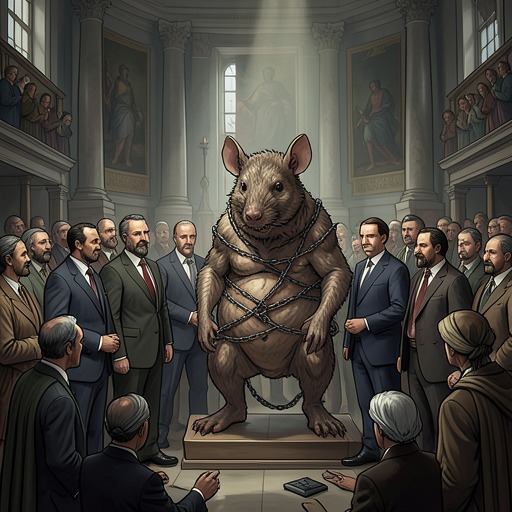
The Amazing Maurice and His Educated RodentsRat kings are groups of rats bound together by their tails, at first discussed as an unsettling legend and later revealed in the form of Spider. The creature’s eight blind bodies move under one controlling intelligence: a grotesque collective whose imposed unity contrasts with the chosen cooperation of The Clan.
Definition and Legend
Malicia describes a Rat king as a group of rats with their tails tied together, while acknowledging that stories claim such knots simply happen. The explanation quickly shifts from natural mystery to human cruelty. Keith observes that a group tied together could hardly hunt because its members would pull in different directions. Malicia counters that some tales give Rat kings the ability to control other rats with their minds, directing them to fetch food or travel to particular places. Since the bound creatures could not move easily, those same stories say they learn to see through other rats’ eyes and hear through their ears; one or two even extend that power to people.
The practical difficulties make the legend seem almost impossible to manufacture. Malicia initially argues that anyone could tie rat tails together, but the challenge is doing so while the rats are alive: the animals would be slippery, moving, and biting. The imagined knot might contain eight rats, twenty, or thirty-two angry ones. She revises her explanation to allow that one or perhaps a few Rat kings could have existed, inspiring people to make imitations, much as stories of crop circles persist despite human explanations. Her speculation leaves room for both fabricated examples and a real creature, a distinction the later encounter sharply resolves.
Spider Revealed
That encounter gives the legend a physical form. Spider emerges from the shadows as a flowing bundle of rats crossing boxes and a sack. Their tails are twisted into one large knot, and every rat is blind. When Spider’s voice fills Maurice’s mind, the eight animals rear and strain against their binding. The scene confirms the essential features of the Rat king stories while making their supposed unnatural origin concrete: Spider says that men tied the rats together for sport, then presents the knot as the source of a new shared strength.
Spider’s account turns enforced physical entanglement into an ideology of domination. It claims that minds multiplied together become stronger than their separate parts, and that the coming opening of the cages will let rats bring a plague upon humanity. Spider can also hold Maurice under its mental influence and describes itself as able to control a cat. Its invitation to Maurice is not simply an offer of companionship: it seeks an ally with a mind capable of thinking for many rats, and imagines their common plans ending in the triumph of rats. The claim that Rat kings can control other beings thus moves from hearsay into the immediate danger of Spider’s demonstrated power.
Collective Fear and Collective Action
The Rat king’s power is more striking against the book’s distinction between a thinking rat and a frightened mass. Maurice explains that rats thrown together in fear and panic do not behave like a collection of brave individuals; they become, in effect, a single animal without a mind. During the crisis among the rats, fear spreads so thoroughly that some run past Peaches and Dangerous Beans gibbering, having forgotten how to speak. The episode shows how a group can lose the very capacities that make its members persons when terror governs their behavior.
The Clan offers a counterexample built on identity and discipline rather than mental subjugation. Dangerous Beans argues for controlling fire because its light declares that the rats are separate, more than merely rats, and The Clan. Later, Darktan calls on his squad to understand themselves as thinking rats who need not flee from darkness, fire, noises, traps, or poison. When The Clan attacks Spider’s rats, it advances in a line; when an enemy strikes, the formation closes over it, then resumes its advance. Once the opposing rats panic and try to escape, the line breaks into pairs that pursue them. The contrast is decisive: Spider makes many bodies serve one dominating mind, while The Clan’s coordination depends on members acting together without ceasing to think.
Significance
Rat kings bind together several of the story’s central concerns: the difference between a legend and a material threat, the vulnerability of groups to fear, and the competing meanings of unity. Their knotted tails offer a literal image of collective life stripped of choice. Spider turns that constraint into a claim that shared strength justifies control, while The Clan’s example shows that organized action need not erase individual judgment. The Rat king is therefore both a monstrous creature and a dark parody of community: its bodies are joined, but its togetherness is coercive.