Ron
The Amazing Maurice and His Educated RodentsRon is the head rat-catcher in Bad Blintz and a principal participant in the town’s criminal operation against the Rats. He helps turn fear of infestation into cover for theft and exploitation, while privately recognizing that the work has become harder to justify. His confrontation with Keith and Malicia brings both the scheme and that unease into the open, though the scene records confession rather than any act of restitution.
Identity and Position
Ron is the senior figure among the rat-catchers, with Bill working beside him. Their relationship has the ease of a long-running partnership: after they return to their hut, Bill bolts the door, and Ron tells him to stop complaining. Bill prepares Ron’s tea with three sugars, and Ron accepts it while they talk. The small domestic routine sits uneasily beside the violence and dishonesty they have been carrying out.
Ron’s authority is also apparent when the two are confronted. Bill defers to him, and Ron takes the lead in responding to the accusations, even when he is uncertain how much to reveal. He has enough familiarity with the operation to describe its practices from the inside, and enough control over the conversation to silence Bill at the hut before their captors intervene.
The Rat-Catchers’ Operation
In a conversation over tea, Ron describes a system of theft and animal breeding that has made the rat-catchers a great deal of money. The men steal goods and blame the losses on the Rats; they also breed large, tough rats for the rat pits, then bring surviving animals back to breed still larger ones. Ron presents these practices as established parts of their work, not as a single lapse. His account makes the operation’s two forms of exploitation—the town’s property and the rats themselves—part of one business.
His unease emerges in the same confession. Ron says that sometimes he wakes in the night and thinks the whole enterprise is stupid, only to come to work and find it seeming sensible again. He singles out tying up children as a point at which the work no longer fits the person he remembers being. The admission does not erase his participation: he continues to work in the scheme, and he acknowledges the cash it has brought in. Instead, the scene shows how he moves between misgiving and the everyday rationalization that lets the business continue.
A separate account from Bill complicates the details without undoing Ron’s admission. Bill says Ron justified taking goods on the grounds that rats ate things anyway, and describes a middle-of-the-night buyer arriving by sailing barge. Ron calls this account a lie and looks sick. The exchange leaves a distinction between what Ron plainly admits—stealing and blaming the Rats—and Bill’s more specific version of how Ron explained or arranged it. Ron’s denial should not be mistaken for a denial of the wider theft, which he has already acknowledged.
Exposure and Confession
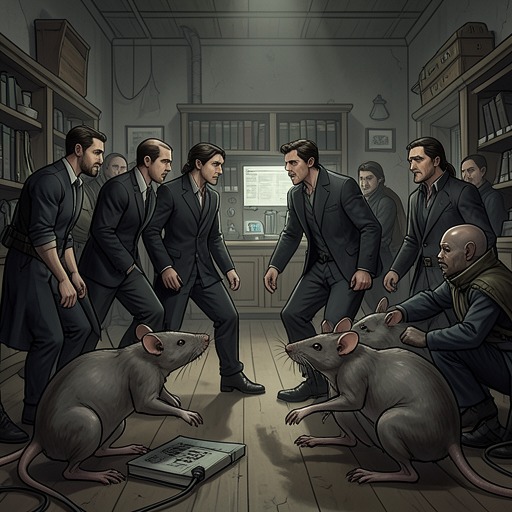
Keith and Malicia confront the rat-catchers after the men return to their hut, shut and bolt the door, and try to settle in. Ron recognizes Maurice as the child’s cat, recalling that it had watched him strangely. From above, Maurice warns the men not to run, talk too much, wait, or act smart, threatening death in each case. Ron’s startled recognition gives way to a more consequential exchange: the rat-catchers know that the Rats can talk because they heard them in the pit.
Keith presses Ron about the theft, asking whether the men took from everyone and blamed the Rats. Ron answers yes. That admission follows his private account of the scheme and turns it into an explicit confession under confrontation. Maurice then says quietly that the rat-catchers killed the Rats. When Keith goes on to challenge their practice of keeping live rats without food, Ron clutches his stomach and says he can feel things happening. The scene supplies no further explanation of that reaction, but places it amid the accusations and the rat-catchers’ fear of what their captors may do.
Character and Narrative Significance
Ron is neither presented as unaware of the harm nor shown breaking decisively with the operation before it is exposed. His nighttime doubts, his shame about tying up children, and his description of the money all coexist with continued participation. The contrast matters: the criminal scheme depends not only on deliberate deception but also on the familiar habit of making wrongdoing seem sensible again when the working day begins.
His account also helps define the scale of the rat-catchers’ conduct. What might appear to the town as ordinary pest control is linked to theft, confinement, breeding, and profit. Ron’s admission that the men blamed the Rats makes that deception explicit, while his discomfort reveals a limit to the excuses he can comfortably maintain. The evidence of his arc ends in exposure and confession; it does not establish whether he later changes, makes amends, or faces a particular punishment.