Sardines
The Amazing Maurice and His Educated RodentsSardines is an older rat of the Clan, recognizable by his restless dancing, homemade straw hat, and taste for theatrical gestures. His comic manner is more than a personal eccentricity: it helps him move through a human town, gives Darktan a model for public leadership, and ultimately offers the rats a way to be seen as something other than a threat. Sardines combines the Clan’s old-fashioned cunning with a performer’s instinct for how an audience responds.
Identity and Character
Sardines belongs to the older rats, many of whom had reached adulthood before the change brought intelligence to the Clan. Their earlier experience left them with practical instincts and suspicion, and Sardines retains a taste for cheeky exploits. When Darktan calls for the rats to return to familiar mischief, Sardines boasts of taking false teeth from an old man. Darktan dismisses the feat as a fluke, but the exchange establishes Sardines as a veteran whose stories and stunts are part of the Clan’s everyday culture.
His identity is inseparable from his movement. Sardines dances even when standing still, his feet tapping on the cellar floor, and he wears a battered hat made of straw, arranged so his ears poke through it. He jokes that a rat needs a hat to get ahead. Darktan teases him about the hat and his habit of telling young rats stories, including one about swimming in a bathtub; Sardines responds with good humor rather than a challenge. He is described as avoiding fights, and his buoyant performance distinguishes him from a more combative idea of rat bravery.
Sardines acquired his showmanship during a period living in a theatre, where he also ate a whole box of greasepaint. The greasepaint seemed to have worked its way into his blood, a comic explanation for his theatrical temperament. His small walking-stick and straw hat become the props of a routine that can turn a rat sighting into a spectacle. That spectacle is useful precisely because humans react strongly to tap-dancing rats, even in places accustomed to rats in their food, roofs, and teapots.
Movement, Scouting, and Rescue
Sardines is exceptionally fast across Bad Blintz. Nourishing has to run to keep up with Darktan, who in turn is running to keep pace with Sardines. He is especially at home on drainpipes, roofs, and gutters, routes he favors because there are fewer Dogs and Cats above the streets. The town’s washing lines, stretched between old houses, become paths: Sardines can cling upside down and move along them as readily as across a level surface. He also goes up walls, through thatch, around chimneys, and down roof tiles, leaving pigeons scattering as the other rats follow.
This agility makes his dancing more than a performance. During the rescue of Hamnpork, Sardines descends through smoky air on a line, stopping between Hamnpork and a dog. He raises his hat with formal politeness, says, "Good evening!", and wraps all four legs around Hamnpork. The moment joins the manners of a stage performer to the urgency of an intervention: Sardines uses his speed and nerve to put himself where help is needed.
His knowledge of the town also makes him a useful scout. He reports climbing drainpipes and travelling along washing lines, and Darktan asks him what is happening. Sardines admits that Cats make him uneasy, though he phrases the admission with comic bravado. Later, when Darktan prepares the rats to enter the dangerous place they call the Dark Wood, Sardines is among the audience whose response helps release the tension. Darktan asks whether he is ready to die for the Clan; Sardines answers, "No, boss! Ready to kill!" His reply preserves his irreverent voice while affirming his readiness to act with the group.
Counsel to Darktan
Sardines recognizes the burden of leadership before Darktan has learned how to carry it. After Hamnpork’s death, he draws Darktan aside and explains that a leader must act as though he knows what he is doing, because uncertainty at the top can unsettle everyone else. Darktan admits that he only knows what he is doing when dismantling traps. Sardines offers a theatrical metaphor in response: the future can be treated as a great big trap, except that it has no cheese. The joke makes an unfamiliar future legible in the terms of Darktan’s old work.
That advice becomes practical when Darktan addresses the young rats. Sardines catches the leader beginning to speak uncertainly and signals him with a slight shake of the head. Darktan recognizes the cue: leaders cannot simply display that they do not know what comes next. He restarts, reframes the unknown danger as something the rats can confront together, and gives them a shared identity as thinking rats who need not flee from darkness, fire, noises, traps, or poisons. Sardines does not make the speech, but his quiet intervention helps Darktan find the authority to make it.
Performance and Human Contact
Sardines’s most consequential counsel comes when the rats consider how to live alongside the people of Bad Blintz. Darktan resists the suggestion that the Clan should work for humans, seeing it as a retreat from the place the rats have won. Maurice argues that the market town’s people are not philosophers and that the rats will need to approach them in terms they understand. When Darktan remains unconvinced, Maurice turns to Sardines for help.
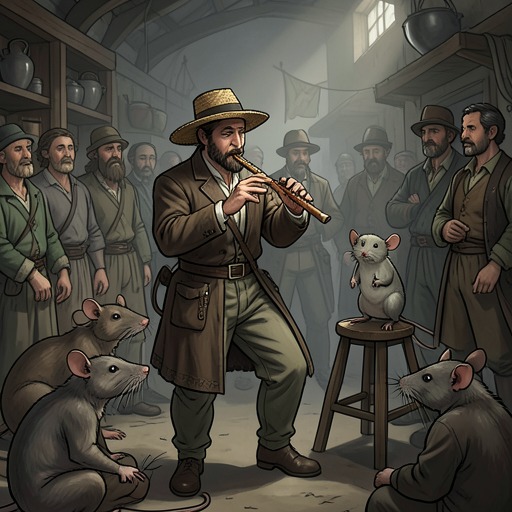
Sardines agrees that the rats need to give the humans a show. He understands Darktan’s fear that people will laugh at them, but argues that laughter is a beginning, preferable to screams. His counsel widens beyond the immediate problem: a rat may think and fight, but the world keeps moving, so survival requires learning to dance. He illustrates the point with a few nervous steps, raises his hat, and twirls his cane; a couple of humans chuckle. The small response does not settle the larger conflict, but it demonstrates that performance can change the terms of an encounter.
That principle recurs in the public contest between Keith and the piper. As the instrument plays a fast, jaunty tune, Sardines emerges from a crack in a nearby wall, counting himself into the rhythm under his breath. He dances ferociously across the cobbles and disappears into a drain. The crowd applauds. When the piper asks whether the dancer wore a hat, Keith says he did not notice, then invites the piper to take his turn. Sardines’s appearance turns an exchange of musical challenge into another public performance by the Clan, with the crowd’s applause registering a response different from panic or hostility.
Narrative Role and Significance
Sardines is a supporting character whose importance lies in the way his apparently frivolous talent becomes useful across several kinds of danger. The hat and dance first mark him as a source of comedy; his speed makes him a scout and rescuer; his judgment helps Darktan act like a leader; and his performance gives humans an accessible first encounter with the rats’ intelligence and individuality. These roles do not cancel one another. Sardines remains playful even when the stakes are serious, and that playfulness helps the Clan adapt without abandoning its identity.
His advice also links cooperation to performance rather than force alone. The Clan can defend itself, but the humans of Bad Blintz must still be approached and persuaded. Sardines offers a way to begin that difficult work without pretending that a dance resolves every dispute: laughter is only a start. In a story where fear can reduce rats to a panicked mass and organized action can restore their agency, Sardines represents a different kind of collective resource—the ability to move, improvise, and meet an audience on unfamiliar ground.