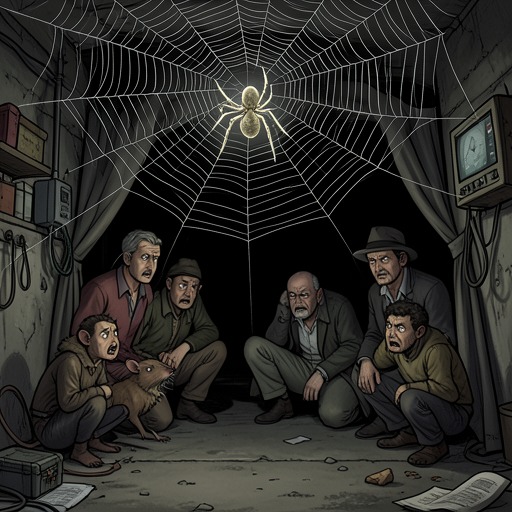
Spider manipulates Keith and Malicia’s minds
The Amazing Maurice and His Educated RodentsSpider’s manipulation of Keith and Malicia makes an imposed command feel like their own humane decision, then pushes Keith toward opening a cage full of hungry rats. The episode’s tension lies in that overlap: releasing the imprisoned rats is something the two have reason to want, but the voice steering them also tells them not to think, and Keith eventually recognizes the possibility that a Rat king has been speaking to them.
A Command Inside an Ordinary Conversation
The intrusion takes hold while Keith and Malicia are talking about whether the events around them could really happen. Keith asks if such a thing has ever happened; Malicia wonders whether it could. The narration supplies a bare affirmative—“Yes.”—without either character having spoken it. Malicia notices the unexplained answer, and Keith points out that she said it, although she denies having done so. The interruption is small but decisive: an outside influence has entered the conversation, yet it first appears as an ordinary spoken word whose source is unclear.
The voice then issues a series of threats and commands, ordering the two to let the rats go and insisting that resistance is futile. Its imperatives—“You will OBEY me” and “Let the rats GO”—make the control explicit to the reader, even as Keith and Malicia’s ensuing words resemble their own judgments. The voice also dismisses itself as “just a story,” directing attention away from the possibility that an active speaker is controlling them. The passage thus puts denial alongside command: the intruder tells them what to do while trying to prevent them from identifying who is doing it.
Compassion and the Appearance of Choice
Immediately after the command to release the rats, Malicia says that keeping them packed into cages is too cruel and that they should be freed. Keith answers that he had been thinking the same thing. Their stated reason is compassion, and the decision fits the moral concern they express; the scene does not present their response as an obviously alien wish. That fit makes the manipulation harder to distinguish from genuine agreement. Spider’s influence does not need to give them a completely foreign motive: it can steer a decision that already has an intelligible ethical basis.
The sequence leaves open how much of their decision belongs to them. Malicia articulates the objection to the cages, and Keith echoes it, but both statements follow the hidden voice’s order. Their apparent consensus therefore cannot serve as proof that they are acting freely. The scene sets the humane impulse to release the captives against the danger of accepting a conclusion without examining its source. Spider’s control works through that gap between a reasonable choice and an independent one.
Keith’s Thought Is Interrupted
The control becomes harder to mistake when the voice commands, “Obey me! Don’t THINK! Follow the story!” Keith begins to say that rats can do something, but the thought will not complete. Asked what he means, he stammers over the missing idea: “Something about rats and rivers. Probably not important.” The river association survives only as a broken fragment, while Keith himself dismisses it. The interruption therefore affects not just what he says but his access to a thought that might have mattered to the decision before him.
The command to follow a story also bears on the way Keith and Malicia have been framing events. Malicia says that this is real life; Keith answers that he thought it was an adventure. The exchange shows their different descriptions of the situation, but does not establish that either one alone explains Keith’s susceptibility. What the scene does make clear is that the hidden voice can intrude on their reasoning while their conversation continues, and that its demand to follow a story accompanies Keith’s loss of the thought he was trying to express.
The Cage and the Recognition of Control
The consequences become concrete when Keith blinks and finds his hand on the latch of a rat cage. Hundreds of rats are watching his fingers, all facing the same way; the narration describes them as looking hungry. The earlier order to release them is no longer just a suggestion in conversation: Keith is physically positioned to act on it, with the caged animals immediately before him. His hand at the latch makes the difference between an apparently chosen intention and a dangerous action visible.
Keith remembers that they had agreed to let the rats out, but cannot account for why he had been about to do so. He asks whether Rat kings can talk to people and whether one has been talking to them. Malicia counters that this is real life, while Keith says he thought it was an adventure. Together, those questions and qualifications register a new suspicion without turning it into complete understanding: Keith identifies a possible source of the influence, but the scene does not show either human having fully escaped it. Spider’s control is significant because it links concealed mental coercion to a specific, immediate risk—the opening of the cages—and leaves Keith trying to distinguish his own judgment from a story being imposed on him.