Spider’s mind control
The Amazing Maurice and His Educated RodentsSpider’s mind control turns thought itself into contested ground: Spider can enter another mind, offer to think in its place, and ultimately make a body obey. The threat is larger than a single victim’s loss of control. Across the story, the contrast between panic-driven rats and The Clan’s deliberate cooperation shows what Spider’s domination tries to replace: not merely independent minds, but a community capable of deciding together.
Nature and Reach
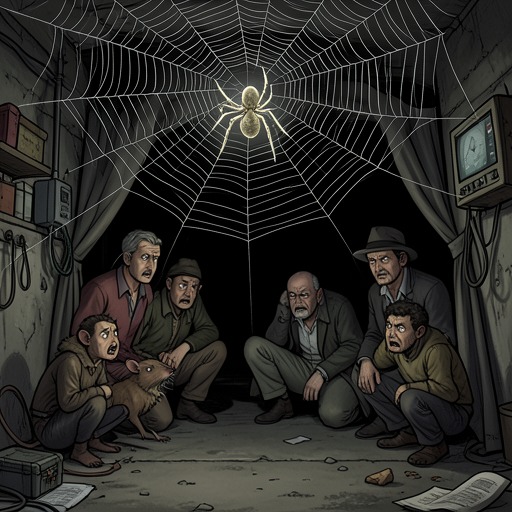
Spider first announces itself to Maurice as a voice unlike the supposed presence of Additives: the voice identifies itself as Spider, then insists that it is not a spider in the ordinary sense. Its language presents control as a service as well as a threat. Maurice’s mind, Spider says, has become small and circular and wants someone else to do its thinking; Spider claims it can supply that thought, and can do so for everyone. The promise of relief from mental effort is therefore inseparable from the demand for submission.
Maurice resists at first. He remembers that he was strong when Spider previously tried to control him, and insists that being a cat makes him immune to a rat’s command. But Spider distinguishes the present Maurice from that earlier opponent: it argues that his mind is now vulnerable because it seeks to run away and let another intelligence take charge. The exchange makes resistance unstable. Maurice recognizes the danger, yet even his thoughts register the temptation to flee; Spider works by turning that wavering into an opening.
The force also reaches beyond a private exchange. When Keith and Malicia are discussing whether the imprisoned rats should be released, Spider’s voice disparages their minds and orders them to obey and let the rats go. Malicia then proposes releasing them, and Keith says he was thinking the same thing. The scene leaves their decision entangled with the command: compassion for the caged rats is present in what they say, but Spider has also shown that it can press into human thought and steer a choice toward its own purpose.
Fear, Groups, and the Loss of Judgment
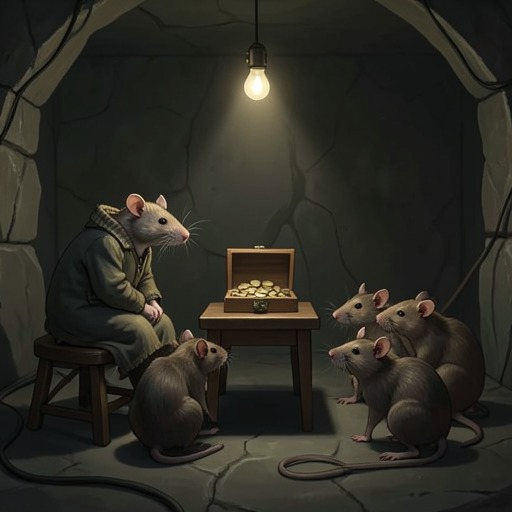
The novel sets Spider’s power against the different ways a group can behave. Earlier, Dangerous Beans argues that a candle flame lets the rats declare themselves separate and affirm that they are The Clan. Hamnpork distrusts the fire, but the disagreement itself shows the rats reasoning over what their shared identity means. Spider’s promise to think for everyone is the dark inversion of that identity: unity imposed from outside, rather than a community made through shared thought.
The effects of fear are visible when rats run past Peaches and Dangerous Beans, squealing and gibbering instead of speaking. Dangerous Beans recognizes that they have forgotten how to talk; Peaches takes up her notes and fears that something terrible has frightened them. The scene gives mental collapse a social form. Language, which permits exchange and deliberation, falls away as terror spreads from rat to rat. Spider’s control exploits precisely this vulnerability: when minds are overwhelmed, surrendering judgment can seem easier than recovering it.
Darktan’s account of rat-coursing supplies another contrast. He asks whether the rats fought the dogs, and Maurice explains that the frightened mass mostly ran around the ring. A single rat may think and act bravely, Maurice says, while many rats together can become a mindless mob. This distinction matters to Spider’s claim to think for everyone. A mass of minds is not automatically a community; it can be driven by shared fear, or it can lose its capacity for thought altogether. Spider offers centralized command as the answer, but the story’s counterexample is cooperation rather than domination.
Direct Control and Resistance
Spider makes the bodily consequences explicit when Peaches turns toward Maurice. The voice declares that the cat will not move; Maurice tries, but his paws do not obey him. Spider then threatens to stop his lungs if he moves and uses his immobilized body as a demonstration to the watching rats. The progression is precise: an intrusion into thought becomes a command over movement, and the threatened control of breathing makes clear that obedience can be enforced through the body as well as the mind.
Spider’s voice also finds Maurice in the tunnels, where it asks whether it will find the others first, or perhaps already has. Maurice runs around a corner on the slimy stone, carrying Peaches’s dampened notes, including the words that remain of her rules. The voice addresses him as a cat and wonders whether it should act like one and keep one of the rats alive for a while. This taunting turns Maurice’s identity into another point of pressure: Spider treats the difference between cat and rat as something it can manipulate, not a boundary that guarantees safety.
The confrontation with Dangerous Beans exposes the ideology behind that pressure. Dangerous Beans rejects Spider’s claim to represent the Big Rat, arguing that Spider thinks for many rats but does not think of them. He imagines a good collective ideal as something made from what rats might become, rather than from their worst impulses, and chooses the Clan’s imperfect but shared strength over Spider’s plans. Spider answers with rage and inflicts a blast of pain on Maurice. The sensation recalls Maurice’s state before he was changed, when he was merely a bright cat rather than the person he has become. Mental assault thus threatens not only present agency but also the developed identity that Maurice has acquired.
The Counterforce of The Clan
The strongest answer to Spider’s claim that it can think for everyone comes through action organized without a single controlling mind. Darktan faces worried young rats and turns their fear into a shared purpose, naming what makes them different: they have brains, can think, and need not turn and run at darkness, fire, noises, traps, or poison. His appeal does not erase their fear; it gives them a common way to confront it. Nourishing, unlike the cowering squad around him, looks at Darktan with shining eyes as the speech takes hold.
Later, The Clan enters as a line, advances together, and closes around an attacking enemy rat like a fist. When fear drives the survivors to flee, the line breaks into pairs that pursue them. The account is not a picture of uniform obedience to a voice in the mind: the rats maintain formation, respond to changing conditions, and act in coordination. Set beside Spider’s threats and Maurice’s temporary paralysis, their discipline marks a different relation between individual judgment and collective strength. Spider makes minds instruments of command; The Clan’s unity depends on minds able to cooperate. That difference is the central significance of Spider’s control: its danger lies not only in what it can make a victim do, but in the model of community it proposes, in which shared thought means surrendering thought to one dominating will.