The Clan
The Amazing Maurice and His Educated RodentsThe Clan is the community of changed rats whose sudden intelligence becomes more than an individual transformation: it gives them a common identity, practices for sharing knowledge, and the ability to act together. First encountered through their conversations with Maurice, the rats develop from a group puzzled by its own new minds into an organized force that can resist panic and negotiate with the people of Bad Blintz. Their defining challenge is how to remain a community of thinking individuals when fear can reduce a crowd to instinct.
Identity and Awakening
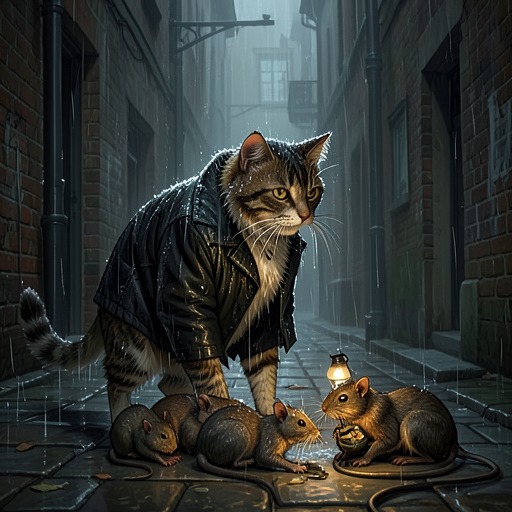
The Clan’s beginnings are marked by an abrupt change in awareness. Maurice, looking into a puddle after lunch, recognizes himself as a self for the first time; his new mind makes other cats seem stupid and brings him into conversation with the rats living beneath a rubbish heap in his territory. When he pounces on one and she asks whether they can talk, a new principle takes hold: he cannot simply eat someone capable of speech before hearing what that person has to say. The rat is Peaches, and Maurice discovers that she and the other rats are unlike ordinary members of their species, just as he is no longer like other cats. He begins spending time with them, with the practical condition that he must remember not to eat rats they know.
The rats themselves wonder why they have become so intelligent. They consider whether something on the rubbish heap caused the change, but Maurice points out that this cannot account for his own transformation, since he has not eaten rubbish. The cause remains unresolved in these episodes; what matters to the Clan is the social consequence. Intelligence makes conversation possible, but the rats also need ways to interpret their new condition and decide what kind of community they will become.
Their chosen name expresses that collective purpose. Dangerous Beans describes a candle flame as a declaration that the rats are separate, more than rats, and members of the Clan. Hamnpork distrusts the fire, recalling that darkness was good enough for earlier generations and objecting that a candle wastes food. His response marks a generational tension: the inherited habits that once seemed sufficient now stand beside ideas about identity, deliberate action, and the future. Peaches reports that younger rats are frightened by shadows, making the flame both a practical object and a sign of the Clan’s attempt to face fear together.
Shared Ideas and Ways of Learning
The Clan’s identity is shaped partly by its encounter with Mr Bunnsy Has An Adventure. Before Peaches and Donut Enter can read the human words, they are struck by its pictures: dressed animals talk to one another and to humans, and the story contains neither traps nor poison. Peaches reads the book aloud as she works through it. Dangerous Beans considers whether it might show a brighter future, while the rats debate why humans would make such a book about Ratty Rupert and at the same time poison rats beneath their floors. The imagined world is attractive precisely because it contradicts the dangers the Clan knows.
The book also prompts experiments and practical adaptation. Some younger rats try waistcoats, but cannot manage the buttons, have trouble making the garments, and find that clothes catch on splinters and impede running; hats fall off. Darktan draws a different lesson from the pictures. He makes a flexible arrangement of wide belts with pockets for metal rods and wire, allowing him to carry useful equipment. Other members of the Trap Disposal Squad adopt the idea. The episode shows the Clan not merely copying a human image of civilized animals, but testing what is useful in its own circumstances.
Peaches helps turn the Clan’s ideas into a form that other rats can share. She works to make a language rats can read, since the human lines and letters are too difficult for most of them. One of the first Thoughts she records is In the Clan is Strength, a difficult idea to translate. She tries to represent it as a large rat made from many small rats. Another Thought states that the Clan is made up of Changelings who are not like other Rats. These efforts give shared principles a durable, legible form, rather than leaving them as ideas understood only by a few. Peaches also carries Mr Bunnsy for Dangerous Beans: although carrying is not quite the right description, since she more often drags it, the book’s presence comforts him and helps him think.
Fear, Crowd Behavior, and Collective Action
The Clan’s intelligence does not make its members immune to fear. When three rats run past Peaches and Dangerous Beans in a state of terror, one squeals and another gibbers; Dangerous Beans realizes that they have forgotten how to talk. Peaches concludes that something terrible must have frightened them and snatches up her notes. The moment exposes how quickly the capacities that distinguish the changed rats can fail under collective panic: language and reflection give way to flight, and even a community with shared ideas can be unsettled by an unseen threat.
The danger of crowd behavior is made explicit when Maurice describes rat-coursing to Darktan. Men bring live rats into a ring and release terriers, while the rats run in fear. Darktan asks why they do not fight the dogs, recalling that he once bit a dog on the nose. Maurice distinguishes the courage of an individual rat from the behavior of a mass of rats overwhelmed by fear and the smell of one another’s panic. The Clan’s challenge, then, is not simply to produce brave individuals; it is to prevent fear from turning many thinking beings into an unthinking crowd.
Darktan faces that challenge when he gathers a squad to confront a new danger. Rats are still emerging from hiding, and some of the sensible ones have run into traps and poisons during the panic. He selects a few experienced older members, including Sardines, but most of the squad are young. Darktan observes that the older rats panicked most, perhaps because they were less accustomed to thinking. When Sardines signals that a leader cannot admit uncertainty, Darktan turns to the young rats’ anxious faces and finds language that gives them a common task: they are rats with brains who must not turn and run. He invokes the Dark Wood from the book and the Bone Rat, presenting courage as a way to face what fear hides rather than a guarantee of safety. The squad’s identity becomes operational: shared ideas are used to change how its members understand risk and their responsibility to one another.
In the ensuing fight, the Clan’s organization is visible in its movement. Its rats advance together in a line; when an enemy attacks, the line closes over the attacker like a fist. As the opposing rats become terrified and try to flee, the formation breaks into pairs that pursue them. The fighting ends within seconds. The scene contrasts the fear-driven mass Maurice describes with a coordinated group capable of holding formation and adapting its tactics. Unity here is not mere sameness: it is the ability to maintain collective purpose as circumstances change.
From Hidden Community to Negotiation
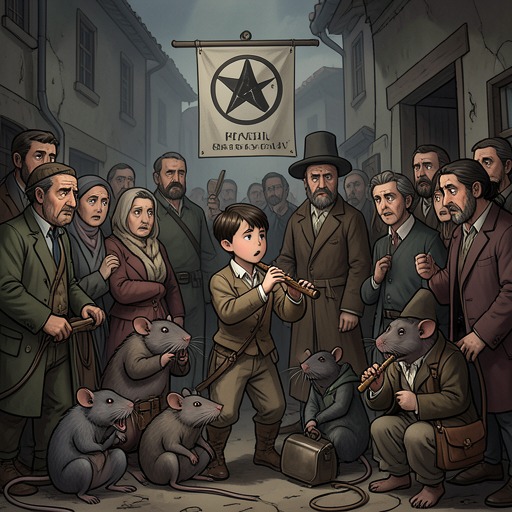
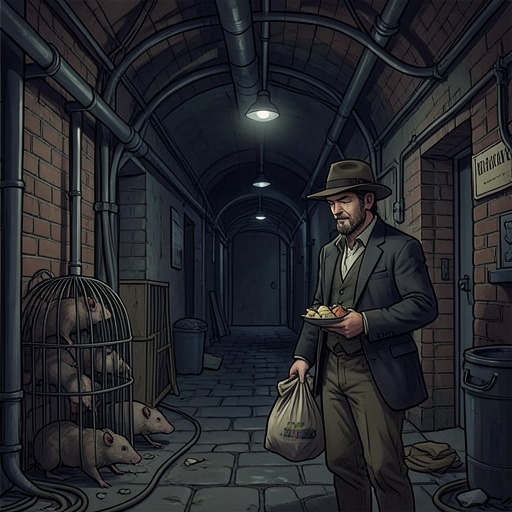
The Clan’s final public emergence takes place in Bad Blintz. Inbrine passes through the tunnels, clears the mud and straw blocking the last passage, and reaches the cage room, where the Clan’s rats uncover their ears when they see him. Soon afterward, rats pour into the town square from drains, gutters, and cracks. They do not squeak or scatter; they sit watching the people. When the mayor assumes that the arriving rats are stragglers who missed the piper, a voice from the group corrects him: these are not rats who follow pipers, but rats with whom the town must deal. The difference is political as well as practical. The Clan appears not as a nuisance to be driven away, but as a party capable of speaking for itself.
Darktan, standing by the mayor’s boots, offers an opportunity rather than a threat. Keith warns the mayor that chasing the rats with dogs or brooms would only make them run temporarily: they live under the town’s floorboards and know how to use fire and poison. Darktan’s proposal is that the humans recognize the rats’ capacity to think, while the rats in turn agree to treat humans as capable of thought. His words make negotiation depend on reciprocal recognition, not on a claim that the two sides are already alike or trust one another.
The mayor asks why the Clan did not poison the wells or burn the houses, since the rats could have done so and owed the people nothing. Darktan answers in terms of consequences: killing the townspeople would not improve the rats’ situation, and sooner or later they would have to speak with humans somewhere. It might as well be Bad Blintz. This reasoning rejects revenge not as a sentimental gesture but as a way out of repeating the same conflict in another town.
The eventual settlement is treated as a matter for a contract, not as the effortless happy ending of a story. Dangerous Beans suggests that stories may be maps, but the reality of a long conflict between people and rats requires detailed discussion and a committee. The town council and senior rats take part, while Maurice paces around the table and joins in. Darktan remains at one end, exhausted after the long night, as arguments continue over the details. The Clan’s significance lies in this passage from awakening to institution-building: its shared intelligence first makes a conversation possible, then makes a durable agreement necessary. Its strength is no longer only the ability to stand together against an enemy; it is also the ability to choose negotiation over destruction and to begin defining a common order with Bad Blintz.