The Clan Defeats Spider and His Rat Army
The Amazing Maurice and His Educated RodentsThe Clan Defeats Spider and His Rat Army is the climactic confrontation in which the Clan confronts Spider, a rat king whose shared consciousness gives him power over other rats. Spider offers Dangerous Beans a partnership based on collective strength and war; Dangerous Beans refuses because Spider’s unity serves domination rather than the rats he claims to represent. The Clan’s disciplined attack breaks the controlled rats’ hold on the room, while Maurice destroys the knot that binds Spider’s component rats together. The victory ends Spider’s immediate threat, but leaves Maurice apparently dead after he saves Dangerous Beans.
Causes and Background
The confrontation brings together two very different accounts of what makes rats strong. Earlier, Dangerous Beans had argued that the Clan’s candle flame could express its separate identity: its members were not merely rats, but a community. That idea is tested when fear spreads through the rats. Some lose the ability to speak, and when Spider’s influence falters, panic returns among those he has controlled. The episode contrasts a shared identity built through choice with a collective state imposed by fear.
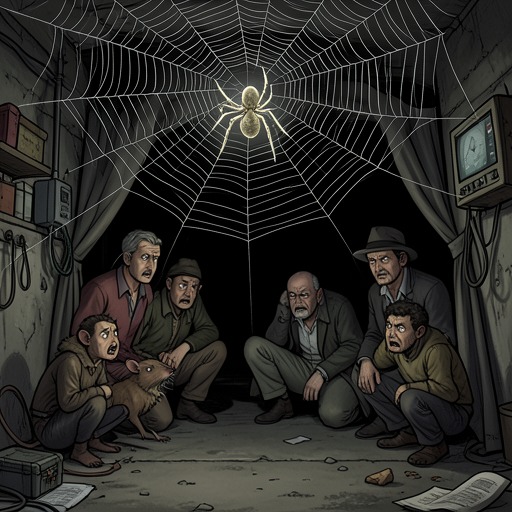
Spider’s appearance gives that threat a physical form. Eight blind rats emerge together, their tails knotted into one mass. Spider explains that humans tied the rats together for sport, but that instead of struggling separately they became a single mind. He claims their joined consciousness grows stronger than the minds of individual rats and imagines opening cages to bring a plague upon humans. He also demonstrates his control by restraining Maurice through mental force. The offer to join forces is therefore both a proposal and a test: Spider sees Maurice as a mind capable of thinking for many rats, like his own.
Spider’s Offer and Dangerous Beans’ Refusal
Spider presents cooperation as a route to power, but Dangerous Beans probes what that supposed partnership would mean for the rats themselves. He asks what one of Spider’s controlled rats thinks, exposing the difference between directing a group and attending to its members. He rejects Spider’s claim to represent a greater good: in Dangerous Beans’ understanding, a genuine ideal of rat community would not make war and death its purpose. His alternative is imperfect but reciprocal—rats may be weak or foolish, yet they can become strong together, and their future should be shaped by hopes rather than Spider’s plans.
This refusal defines the ideological stakes of the battle. Spider treats other rats as extensions of a central will, while Dangerous Beans regards them as beings whose interests matter in their own right. Spider responds by directing his mental attack at Maurice, stripping away the learned identity that has made him more than an ordinary cat. The conflict thus turns on more than which side can command the larger force: it asks whether collective strength depends on submission to one mind or on members acting together without surrendering their judgment.
The Clan’s Counterattack
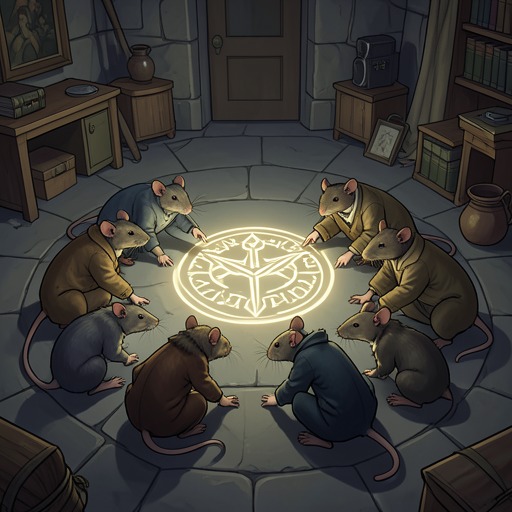
As Spider’s assault takes hold, the rats under his influence cease to hold their attentive, upright composure, and panic begins to spread among them again. Other rats rush into the room, attacking Keith and Malicia as well as threatening those already there. Against this disorder, the Clan advances differently: its rats keep together and move forward in a line. When an enemy attacks, the line closes around it and then reforms. As the controlled rats try to flee, the Clan breaks into pairs to pursue them. The fighting is brief, and the fleeing survivors disappear into the walls. The decisive contrast is between a mass governed by fear and a group able to coordinate its actions.
The Clan’s success is not presented as proof that rats are naturally fearless. Earlier, Maurice had explained to Darktan that a crowd of frightened rats can become a mob, despite the courage an individual rat may show. The battle gives that observation a practical counterexample: coordination changes what a group can do. The Clan’s common purpose does not erase individual members; it allows them to act together rather than simply react to the fear around them.
Maurice’s Intervention and the Outcome
While Spider’s force is being challenged, Maurice’s mind is overwhelmed. The intelligence and self-awareness he has developed are swept aside, leaving the instincts of a cat. At first, he is absorbed by the desire to attack and does not respond to the spreading fire or the danger around him. A small remnant of his former awareness nevertheless directs him to Spider’s vulnerable center. Maurice bites through the knotted tails, breaking the physical bond that holds the eight rats together. Spider’s rage ends with the destruction of that knot, and the mind dominating the other rats is defeated.
Maurice’s action does not leave him visibly triumphant. He makes his way through the fire carrying Dangerous Beans, reaches the Clan, and gently puts him down. Maurice then collapses and appears to die. The narration immediately complicates that apparent ending: Maurice sits up in a slowed, ghostlike world and washes himself, seemingly free of the pain that had burdened him. The scene therefore closes the battle with a sacrifice and a striking uncertainty about Maurice’s condition, rather than with a simple account of victory.
Consequences and Significance
The defeat dismantles Spider’s attempt to turn shared consciousness into a weapon. Dangerous Beans’ refusal establishes that solidarity cannot be measured only by numbers or strength: it also requires concern for the individuals who make up the group. The Clan’s tactics enact that alternative, replacing panic and imposed control with coordinated action. Maurice, whose mind Spider had recognized as unusually capable of thinking for many, ultimately acts not by accepting Spider’s model but by using the last surviving part of himself to stop it.
The episode also carries the conflict beyond the battle. Dangerous Beans survives because Maurice brings him back to the others, while Maurice’s apparent death places the cost of the rescue at the center of the aftermath. The larger resolution later turns toward negotiation between rats and humans, including Darktan’s offer of an opportunity to the mayor. In that context, Spider’s defeat removes a vision of collective power founded on war and domination, making room for a harder alternative: coexistence shaped by mutual recognition and rules.