The Rat-Catchers’ Guild’s membership requirement
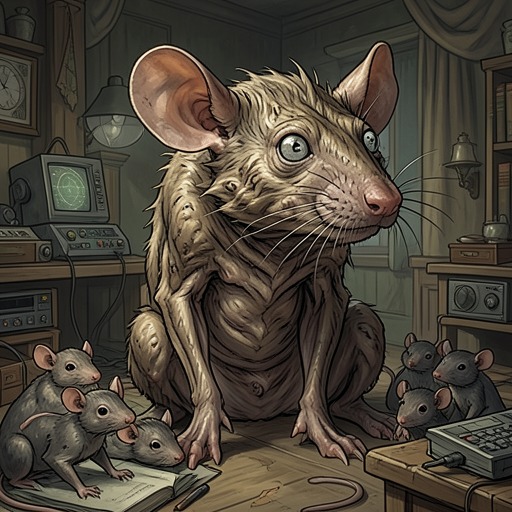
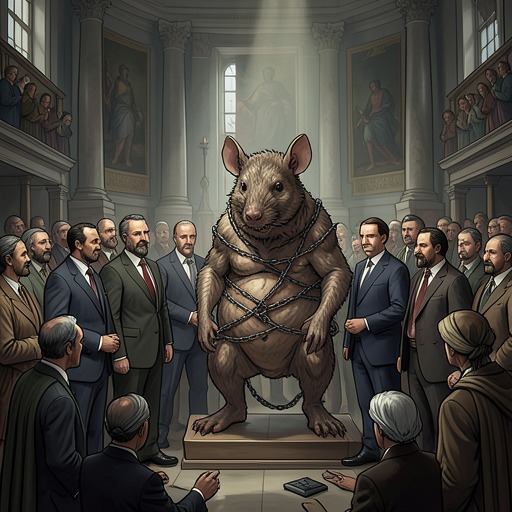
The Amazing Maurice and His Educated RodentsThe Rat-Catchers’ Guild’s membership requirement is revealed as the making of a rat king, a supposed masterpiece in which multiple rats are caught and bound together. The test recasts professional mastery as a grotesque act of domination: an apprentice must prove control over living animals by forcing them into a form that cannot act as a unified creature. The requirement matters both as a secret of the Guild and as a sharp contrast with the rats’ own hard-won capacity for thought and cooperation.
The Secret Behind Guild Membership
The requirement emerges during the confrontation with two rat-catchers. One tries to conceal what lies beyond the old cages by claiming that the area contains plague; when pressed, the other breaks down and admits that making a rat king is something a person must do to join the Guild. His admission turns the rat king from a piece of folklore into a practical test used by the organization.
The exchange also identifies the act as a Guild secret. The first rat-catcher immediately objects when his companion reveals it, even as he struggles to maintain the pretense that there is nothing worth discovering. The confession therefore exposes more than an individual act of cruelty: it points to a concealed practice embedded in the Guild’s path to membership. The evidence does not establish how often the test is imposed or whether every member has completed it, but the rat-catcher’s account presents it as a requirement for joining.
The Rat King as a Masterpiece
Keith interprets the confession through the Guild structure he knows from growing up in a large city. In other guilds, he explains, an apprentice makes a masterpiece at the end of training and presents it to senior members as proof of deserving full membership. The work may be a symphony, carving, or batch of bread; in each case it demonstrates the apprentice’s craft. Applying that pattern to rat-catching, Keith identifies the rat king as the equivalent piece: a demonstration that its maker can control rats.
The explanation gives the requirement a formal logic. It is not described merely as a random initiation ordeal, but as a culminating display of competence, judged against the Guild’s own standard of mastery. Yet the analogy also makes the standard more disturbing. Unlike a finished piece of music or carving, this masterpiece is made from animals that remain alive and resist the hands attempting to bind them. The intended proof of skill is inseparable from the suffering required to produce it.
What Making One Entails
The conversation spells out the physical difficulty behind the test. Malicia initially objects that anyone could tie several tails together. Keith counters that the rats would have to be trapped alive: the moving, slippery bodies would make the string hard to manage, while the animals at the other end would bite. He presses the scale of the problem by naming groups of eight, twenty, and even thirty-two angry rats. The imagined masterpiece is thus not a static knot assembled from inert material, but a struggle with numerous animals at once.
The discussion follows Malicia’s changing assessment. Rat kings have been found in different numbers: she describes one formed from ten rats arranged like a star, with their tails knotted in the middle, and says that another had thirty-two. She acknowledges the folklore surrounding them, but Keith’s account of the Guild requirement makes deliberate construction seem plausible. Malicia concludes that the explanation works as a story, while allowing that there may have been one or a few real rat kings before people attempted to reproduce the phenomenon. The conversation leaves the origins of every reported example uncertain; it does not prove that all rat kings were made by Guild members.
Control, Cooperation, and the Meaning of Mastery
Keith’s practical objection also unsettles the idea that a rat king proves command over rats. If the bound animals pull in different directions, he asks, how could such a creature hunt? The question distinguishes physical subjugation from coordinated action. A rat king may show that someone could capture and bind rats, but the resulting knot does not establish that its maker can direct a functioning group.
That distinction resonates with the rats’ own experience of collective behavior. In fear, rats can lose their capacity for speech and run blindly; a crowd of panicked animals can behave, in Maurice’s description, like one large creature without a brain. By contrast, the Clan can advance in a line, close ranks when attacked, and pursue its opponents deliberately. Those episodes do not define the Guild’s formal test, but they sharpen its irony: the Guild calls a violent binding of bodies proof of control, while the rats’ more meaningful strength lies in thought and coordinated action.
The requirement therefore reveals what the Guild recognizes as expertise and what it leaves out. Its masterpiece makes domination visible and measurable, but the act itself offers no evidence of mutual understanding or genuine cooperation. The rat-catcher’s confession exposes that standard as part of the Guild’s hidden practice; Keith’s reasoning shows how its institutional logic works, while the living rats’ resistance makes its cruelty impossible to treat as mere craft.