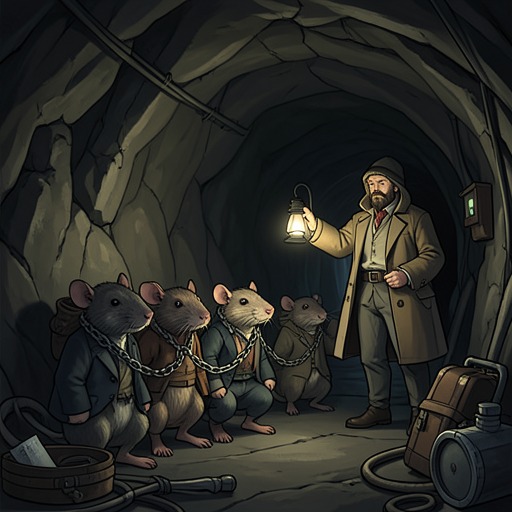
The fabricated rat infestation
The Amazing Maurice and His Educated RodentsThe fabricated rat infestation is a confidence trick built from a familiar public fear: the supposed plague of rats and the miraculous piper who drives it away. Its force comes not from overwhelming numbers but from the way a small, deliberately conspicuous disturbance can make a whole town believe it faces a crisis. The piper’s apparent rescue then turns that fear into income, while a cat waits outside town to share the proceeds.
The mechanics of a manufactured plague
The scheme depends on the gap between what people imagine a rat plague to be and what it takes to stage one. Rat-piper stories are already famous, and the idea of a piper traveling from town to town to clear infestations supplies a ready-made script. Other supposed plagues might involve accordion players, bricks tied up with string, or fish, but rats are the threat people recognize. That recognition is the swindle’s essential resource: the perpetrators do not have to invent a new fear, only activate an old one.
A single rat can be enough to start the performance. It appears in different places, squeaks loudly, bathes in fresh cream, and urinates in flour. The small incidents make ordinary food and domestic spaces seem vulnerable; repetition gives them the shape of a spreading emergency. After a few days, people are ready to welcome the stupid-looking boy and his magical pipe. When rats pour from their hiding places and follow him out, the sight confirms the story they already believe. The crowd is so impressed by the apparent exodus that it does not question why there are only a few hundred rats.
The final act takes place out of town, away from the grateful audience. The rats meet the piper in the bushes, and they count out the money together. The rescue is therefore not a contest between a town and an uncontrollable infestation but a rehearsed exchange: the rats supply the visible threat and the spectacle of departure, the piper supplies the recognizable solution, and the townspeople pay for the conclusion they have been taught to expect. The scheme’s ingenuity lies in making a small, managed event look like a large, miraculous one.
The performance in Bad Blintz
When Maurice enters Bad Blintz with the boy, the town is waking and its market offers mostly used and worn-out goods. At the food queue, Maurice sees the mayor overseeing the servers and recognizes how scarce food is. He understands that a piper may soon be welcome there. The boy, however, begins playing before they can remain inconspicuous: he sets his cap on the ground, collects a few coins, and draws the queue around him. Children dance, people tap their feet, and the listeners smile.
Maurice does not share the crowd’s musical response; human music sounds thin to him. But he recognizes the practical danger of attracting notice. Once the tune is finished and the queue applauds, he slips up behind the boy, hisses at him, and tells him to collect the money and leave. The moment shows how easily the piper’s public performance can begin to take on a life of its own. Even before a rat exodus, a pipe and a receptive audience can make the familiar story feel present—and make its performers visible.
Fear, numbers, and the real behavior of rats
The story also distinguishes the swindle’s staged spectacle from the danger that fear can create when rats really are gathered together. Maurice explains that rats brought into a ring for rat-coursing do not necessarily fight the dogs set against them: the rat-catchers bring them alive, and the frightened animals mostly run around. In a crowd, rats can become a panicked mass, their fear spreading among them. The supposed plague draws on that recognizable image of many rats moving together, but the scam makes numbers and movement serve a deliberate performance.
Elsewhere, collective terror has consequences beyond appearances. When frightened rats rush past Peaches and Dangerous Beans, one squeals and gibbers rather than speaking; Dangerous Beans realizes they have forgotten how to talk. This is not a staged procession led by a piper but a rupture in the rats’ ability to act as a community. The contrast matters: a few rats can manufacture a public impression of a plague, while actual fear can overwhelm the speech and judgment of a group.
The Clan’s later fighting formation presents another contrast to a mindless swarm. Its rats advance together in a line, close around an attacking enemy, and break into pairs to pursue fleeing opponents; the battle ends within seconds. Their coordinated action is not the piper’s theatrical display of rats following a tune. It comes from discipline and shared purpose. Across these scenes, quantity alone proves little: a crowd may be an instrument of panic, a false spectacle, or a thinking group capable of organized action.
From legend to a different bargain
The rat-piper story does not remain only a device for extracting money through fear. In the contest at Bad Blintz, Keith takes the pipe and tells the piper that he will lead the rats out of town, offering to do the job together. He insists that the piper should still be paid: the piper explains that the clothes, bullying, and high fee are part of giving people a show, and Keith says that he should not leave people thinking pipers ought to work for nothing. The familiar public role is thus acknowledged as performance, but the payment is no longer simply the hidden reward for a false rescue.
Maurice imagines a further change in what the story can do. Rather than use the piper’s tale to send rats away under false pretenses, he proposes a future town where people and rats make rules and negotiate about food. Darktan offers the mayor an opportunity rather than a threat, suggesting that rats can think if humans are willing to treat that claim seriously. These proposals do not erase the old swindle; they redirect the same public problem—from fear of rats and the spectacle of their removal toward communication and a possible agreement.
The fabricated infestation therefore works on two levels. As a practical con, it converts a few carefully placed disturbances into a profitable story of crisis and rescue. As a recurring contrast in the novel, it exposes how readily people mistake performance for reality, while insisting that rats themselves are not merely a moving mass. The same image of rats following a piper can disguise a fraud, entertain a crowd, or be recast as the beginning of a more honest arrangement.