The rat-piper swindle
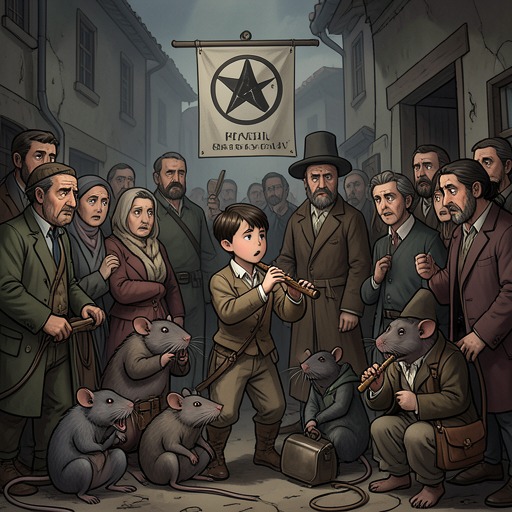
The Amazing Maurice and His Educated RodentsThe rat-piper swindle is Maurice’s scheme for turning a supposed rat plague into a paid performance: rats frighten a town, a flute-playing boy appears, and the rats seemingly follow him out. It succeeds by exploiting a story people already believe. In Bad Blintz, where food is scarce and the town’s rat problem has real consequences, that old deception becomes a starting point for something the original trick could not provide: a negotiated relationship between humans and rats.
Origins and design
Maurice’s idea grows out of his hard-won understanding of money and survival. After four years on the streets, with scars across his nose and much of his ears gone, he considers himself smart enough to avoid becoming prey to dog gangs and freelance furriers. He also concludes that intelligence alone is not enough: money is the key to how people get things done. Seeing Keith, a boy playing the flute for pennies, gives him the pieces of a plan. Maurice approaches him with the proposal, interrupting himself to make sure the boy can hear him down at ground level.
The scheme draws on what Maurice says he has learned about people and governments. In his view, humans pay a piper to remove a rat plague; the piper leads the rats out, the public celebrates, and the government benefits from gratitude at little apparent cost. Maurice treats trickery as ordinary political practice, not an exceptional breach of trust. Peaches objects that the plague exists only because the rats make people believe it does. Their disagreement marks a basic tension in the scheme: Maurice sees a profitable performance, while Peaches recognizes that its success depends on manufacturing fear.
How the false plague works
The performance needs surprisingly few rats. The familiar stories about pipers have already taught people what a plague and its cure are supposed to look like, so a rat appearing in several places can stand in for a much larger infestation. A rat that squeaks, gets into the cream, or fouls flour supplies visible evidence for an anxious public. The apparent scale of the danger comes less from the number of rats than from people’s interpretation of these signs.
After a few days, the boy can arrive as the expected solution. When the rats pour out of holes and follow his pipe, onlookers are impressed enough not to ask how many there are; the account specifies only a few hundred. Once beyond the town, the rats and the piper meet Maurice in the bushes and divide the money. The hidden payment completes the deception: what looked like a public rescue is also a private arrangement among the performers.
The plan is presented as effective even to the rats, including Peaches. Its success depends on several parties seeing different versions of the same event. Residents think a plague has been cured; the piper appears to possess a magical power over rats; the rats understand that they are acting out a part; and Maurice organizes the transaction from outside the display. The familiar story is not just decoration around the fraud. It is the mechanism that makes the fraud legible to its audience.
Bad Blintz and the limits of the old trick
When Maurice and Keith enter Bad Blintz, the town is waking to what looks like market day, but the stalls offer mostly used and unwanted goods. Maurice recognizes the signs of poverty from other towns. At a public food distribution, people present papers and receive bread, followed by a smaller ration of sausage. The mayor watches over the queue and the servers. Maurice reads the rationing as evidence that food is scarce and assumes a piper’s arrival may be timely.
That setting gives the scam a sharper edge than a simple staged nuisance. The town’s fear of rats sits alongside actual hardship and organized food distribution; a paid performance might offer a reassuring public ending without addressing the conditions beneath it. Maurice’s old formula relies on people accepting a story in place of examining what is happening. The appearance of a cure can satisfy a crowd even when the apparent scale of the crisis has been constructed for them.
The scheme’s logic also helps explain why the piper’s public role is theatrical. When Keith later asks why the piper charges so much, the piper explains that the show matters: the clothes and bullying help make the service seem magical and valuable. If he appeared to be merely a rat-catcher, he says, he might receive little more than lunch and a handshake. The performance sells not only rat removal but the appearance of extraordinary power.
From performance to a different bargain
The old pattern changes when Keith wins the piper’s pipe. The piper points out that Keith has won, but Keith does not treat victory as a reason to deny him payment. Instead, he proposes that they lead the rats out together, promises that the piper will receive money, and argues that the town should pay for the service it requested. In his account, the piper has provided a show; the arrangement now makes room for a real procession and a fair fee. The spectacle is no longer simply a means of taking money while concealing the performers’ collusion.
A further change comes when Maurice advises the mayor to speak to the rats rather than rely on force. He warns that shouting, dogs, and people with brooms may drive them away briefly, but that they will return. Since they live beneath the floorboards and know how to use fire and poison, he urges the mayor to listen. Darktan presents the rats’ offer as an opportunity, not a threat. He proposes reciprocal pretence as an opening: the mayor can act as if rats can think, while Darktan will act as if humans can think.
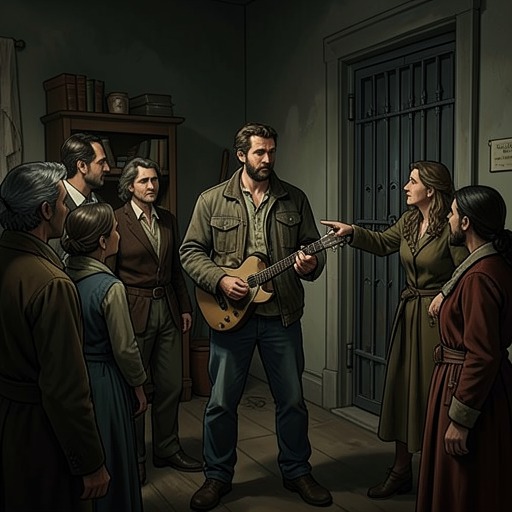
Maurice sketches the possibility of rules that would let residents and rats share a town, but the narrative distinguishes this hopeful proposal from an accomplished settlement. A happy handshake belongs to the version that would exist if this were only a story. Because it is real life, the humans and rats must make a contract, and a committee of town councillors and senior rats spends hours arguing through details. The swindle’s conclusion therefore does not simply expose a trick and return everyone to the old order. It turns a familiar, fraudulent arrangement into the occasion for discussing obligations between the parties.
Significance
The swindle shows how a shared story can be used to manage public belief: a few scattered signs become a plague, and a boy with a flute becomes its apparently magical cure. But the later events also test the difference between a story that feels satisfying and an arrangement that can endure. The piper’s staged authority gives way to a bargain in which payment is made explicit, while the proposed human-rat relationship has to be worked out through rules rather than assumed from a happy ending.
The mayor eventually asks Darktan why the rats did not poison wells or set houses on fire, given that they could have done so and owed humans nothing. Darktan answers that killing people would not improve the rats’ position: they would have to go to another town and face the same problem again, so sooner or later they would have to talk to humans. This exchange contrasts the swindle’s short-term advantage with the practical need for a lasting arrangement. The old trick depends on one side misunderstanding what is happening; the emerging agreement depends on both sides recognizing that they will have to live with the consequences.