We co-operate, or we die
The Amazing Maurice and His Educated RodentsWe co-operate, or we die is both a maxim and a working principle for the Clan. First articulated by Dangerous Beans as a rule for collective survival, it connects shared knowledge and mutual aid with the rats’ ability to resist fear and organize action. Its logic also reaches beyond the Clan: the eventual human-rat settlement rests not on a happy gesture alone, but on the practical need to make a shared future possible.
Origin and Meaning
The principle emerges amid a dispute over whether knowledge should remain an individual possession. Dangerous Beans argues that writing things down would allow a rat’s knowledge to survive that rat’s death, so that the whole Clan could learn from what its members had discovered. Hamnpork resists: he has spent years acquiring his own skills and sees no reason to hand them to younger rats, who might then know as much as he does. Against this guarded idea of personal advantage, Dangerous Beans states the rule: “We co-operate, or we die.”
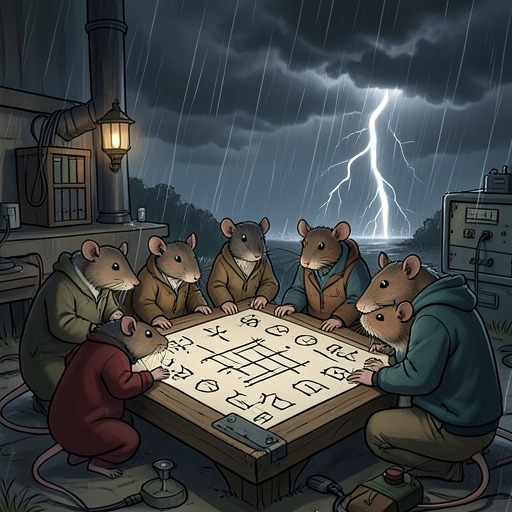
Peaches gives the idea a durable form by working on writing that rats can read. She interprets the difficult word “Co-operate” through an observable example: even keekees sometimes guide a blind or wounded comrade. In her written set of Thoughts, a heavily pressed line represents “no,” while a trap sign can stand for “die,” “bad,” or “avoid.” She also draws the related injunction No Rat to Kill Another Rat. Together, these efforts turn cooperation from a spoken appeal into something that can be recorded, taught, and connected to other rules for living together.
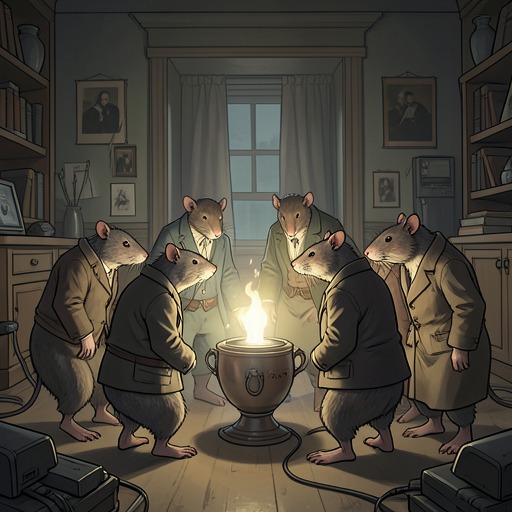
The principle is not only about passing on information. When Dangerous Beans lights a candle, he explains that its flame lets the rats declare that they are separate, not merely rats, but the Clan. Hamnpork distrusts the fire and worries that it will bring trouble; his reluctance shows how an older survival outlook can resist unfamiliar collective practices. For Dangerous Beans, however, shared identity and deliberate action distinguish the Clan from a mere gathering of animals.
Fear, Groups, and Coordinated Action
The story tests the maxim against the effects of panic. When frightened rats run past Peaches and Dangerous Beans, one squeals and gibbers; Dangerous Beans recognizes that they have forgotten how to talk. The episode sharply contrasts the capacity of individual rats to think and communicate with a crowd overwhelmed by fear. Cooperation is therefore not automatic simply because rats are together: it depends on retaining the ability to respond to one another.
Maurice makes a related distinction while explaining rat-coursing to Darktan. The rats placed in a ring with terriers mostly run around in fear rather than organizing a defense. Maurice describes a frightened mass as “A bunch of rats is just a big animal with lots of legs and no brain.” His explanation gives the rule a negative counterpart: numbers alone do not make a community, and shared danger can turn a group into a mob rather than a body capable of thought.
Darktan’s address to his squad offers the alternative. He tells the young rats that they are capable of thinking, holding their ground, and facing darkness, fire, noises, traps, and poisons. In the later confrontation, the Clan moves together in a line: when an enemy attacks, the formation closes around it, and when fear drives surviving opponents to flee, the rats reorganize into pairs to pursue them. This coordinated action gives the maxim concrete force. The Clan’s strength lies not in mere size but in members acting in concert.
Cooperation Against Domination
The rule is tested most directly when Spider offers Dangerous Beans the prospect of ruling the rat world together and making war on humans. Dangerous Beans acknowledges that the proposal is tempting, even while noting that millions of rats would die. He then asks what a hypnotized female rat thinks about the plan. Spider’s surprise at the question exposes the gulf between a coalition built on mutual agency and one that treats its members as instruments. Dangerous Beans concludes that Spider’s scheme would not work. The exchange distinguishes cooperation from the language of cooperation used to disguise domination.
The same practical distinction shapes the proposed settlement between the rats and Bad Blintz. Keith urges the Mayor to talk to the rats through the town council rather than rely on dogs and people with brooms to drive them away: the rats would return, and they live beneath the town’s floorboards and know how to use fire and poison. Darktan calls negotiation a wonderful opportunity, not a threat. When the Mayor asks why the rats did not poison wells or burn houses, Darktan answers that killing the humans would not improve the rats’ situation; they would only have to repeat the conflict elsewhere, and sooner or later they would have to talk to humans.
Dangerous Beans suggests that a story might serve as a map, but the characters recognize that real life requires more than a happy ending. A contract and a committee are needed; the town council and senior rats take part in the discussion, with Maurice also at the table. The scene does not specify the agreement’s terms, but it makes the principle’s political consequence clear: coexistence must be worked out through discussion and an arrangement that both sides can live with. Cooperation is not sentimental agreement. It is the alternative to repeating a conflict that benefits neither community.