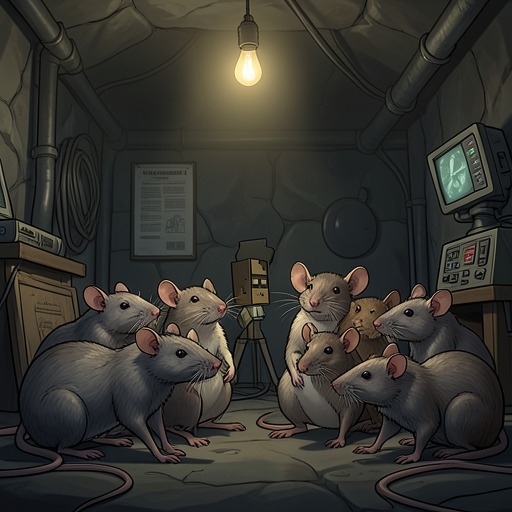
We don't leave our people behind
The Amazing Maurice and His Educated RodentsWe don't leave our people behind is the Clan’s rule of loyalty in action: a member’s capture does not make that member expendable. Darktan gives the principle its clearest expression when the rats need a plan to rescue Hamnpork, insisting that their identity as a clan obliges them to go back for him.
The Rule in the Rescue Decision
The rule emerges when Dangerous Beans asks Maurice for help and Maurice begins to suggest an escape route. Darktan interrupts with the purpose of the mission: to rescue Hamnpork. When Maurice questions whether the rats really have to go back, Darktan repeats the commitment without qualification. The brief exchange turns a practical question about what to do next into a test of what belonging to the Clan requires.
Hamnpork is the leader, but Darktan’s argument is not that the rescue will be easy or that Hamnpork is the most capable rat. Maurice begins to point out that Hamnpork is old and that Darktan is the tougher one. Darktan instead stresses that the rat-catchers have taken one of their own. The rule therefore resists judging a clan member’s worth by usefulness or strength: Hamnpork’s membership is enough to make his rescue a shared responsibility.
Clan Identity Against Fear
The rule’s force is sharpened by the contrast between coordinated loyalty and panic. Earlier, Dangerous Beans explains that lighting a flame lets the rats declare that they are separate, not merely rats, but the Clan. That shared identity is fragile under terror: when rats run past in a state of fear, they have forgotten how to talk, and Dangerous Beans sees how completely panic can interrupt thought and communication.
Maurice describes the same danger through the rats used in rat-coursing. Faced with dogs, they run together in fear rather than acting as brave individuals; as he explains to Darktan, a mass of frightened rats becomes a mob without a mind. The rule points toward the opposite possibility. Loyalty gives the group a reason to remain responsible to one another rather than letting collective fear dictate that each rat flee alone.
From Principle to Collective Action
Darktan’s later leadership shows how a shared commitment can be made actionable. When he faces a frightened squad, he tells them that they are rats with brains, able to think and not simply turn and run. His speech recasts their fear as a challenge they can meet together. It does not repeat the rescue rule, but its insistence on shared identity and resistance to flight develops the same idea: the Clan’s strength depends on members acting as a community.
The principle also finds a visual counterpart when the Clan attacks the enemy rats. The rats advance together in a line, close ranks around an attacker, and pursue those who flee. Their formation contrasts with the uncoordinated running of a panicked mob. The rescue declaration thus belongs to a broader pattern in which identity is not just a name or a belief; it becomes a discipline of coordinated action.
Meaning and Limits
The rule establishes loyalty as an obligation that persists under danger, not a sentiment reserved for safe moments. Darktan applies it to Hamnpork even as Maurice raises doubts about Hamnpork’s age and ability. In doing so, he makes the Clan’s membership more important than convenience or individual calculation.
Its significance lies in the contrast it draws between a crowd bound only by shared fear and a community bound by responsibility. Panic can make rats lose speech, thought, and direction; the Clan’s commitments give them a reason to regroup and act. We don't leave our people behind is therefore both a promise about whom the rats will rescue and a measure of whether they are acting as a clan at all.