Andy Warhol's death
The Andy Warhol DiariesAndy Warhol’s death enters this account not through a description of his final illness, but through Pat Hackett’s retrospective contrast between his everyday health anxieties and the condition that led to his death. A gallbladder problem in February 1987 became the decisive fact; the diary’s surviving frame also makes his last words to Hackett, “Thank you,” an intimate point of closure.
Illness and Retrospective Recognition
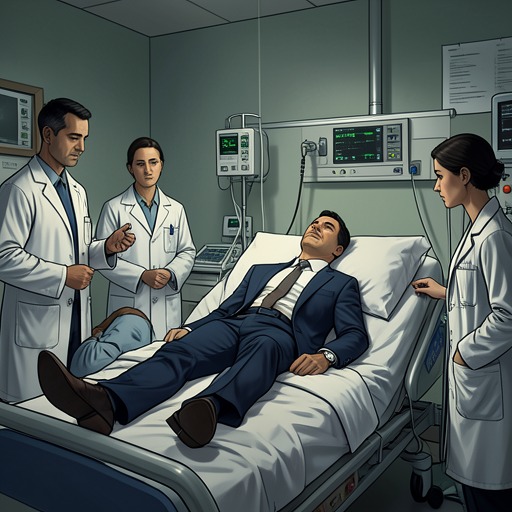
Warhol feared going broke and feared cancer: even a headache or freckle could make him wonder whether he was seriously ill. Yet Hackett observes that, in retrospect, he scarcely mentioned the health problems that genuinely worried him. A lump in his neck in June 1977 was eventually pronounced benign, while the gallbladder problem in February 1987 led to his death. The contrast is significant but limited: the record establishes the earlier reassuring diagnosis and the later fatal consequence without supplying further medical details.
An earlier biopsy episode shows how uncertainty could enter his daily account. Warhol went to Memorial Sloan Kettering Cancer Center for a biopsy under local anesthesia, then returned to work while still unsure what the test would reveal. When he later received good news, his neck was swollen and painful, and he went to church to give thanks. That episode did not become the fatal illness; in Hackett’s retrospective account, it instead underscores the gap between the health scares Warhol openly recorded and the gallbladder problem that ultimately proved consequential.
The Diary as a Record of the Ending
Hackett’s account of Warhol’s death is inseparable from the routine that produced the diary. Before 1976, Hackett kept a sketchy Factory log of business visitors, the previous night’s events, and cash expenses. In fall 1976, the two began speaking by telephone on weekday mornings. What began as a record of activities, places, and business costs also became a diary, while remaining shaped by Warhol’s concern about tax scrutiny. It tracked expenses down to ten-cent calls from street payphones, and the IRS continued auditing his business from its first major audit in 1972 until his death.
The routine had its own weekly rhythm: Hackett did not make weekend entries, but on Monday the pair covered Friday, Saturday, and Sunday in a triple session. Hackett took notes on a legal pad and typed them immediately after the call, while Warhol’s intonations were still fresh. This process preserved an account closely tied to conversation, but the published book was not the unabridged record: its original 20,000 pages were reduced by cutting whole days, weeks, and portions of days, as well as many names.
Last Words and Editorial Framing
Hackett also removed much of the personal exchange between them, including direct references to Hackett or material meaningful only to the two of them. Where personal references remained, Hackett recast them in the third person, using the initials PH, so that readers could occupy the place of the person listening at the other end of the morning call. The published diary is therefore both a record of Warhol’s daily life and an edited account shaped to make that private routine accessible to readers.
Against that editorial background, Hackett’s recollection that Warhol’s last words to them were “Thank you” carries particular weight. Hackett describes him as polite, respectful, and habitually grateful, especially for even small acts of help. The final phrase does not provide a medical account of his death; it closes the surviving personal frame with a quality Hackett presents as characteristic of their daily dealings.