Crystal healing and crystal energy
The Andy Warhol DiariesCrystal healing and crystal energy become a repeated, practical belief in Andy Warhol’s diary rather than a settled doctrine: he seeks treatment, follows instructions for a programmed stone, and trusts sensations of renewed energy, while also questioning whether the healers are sincere and recording a crystal that fails to repel office cockroaches. The entries preserve the tension between felt conviction and uncertainty. Crystals promise to make invisible forces tangible, but their effects remain open to interpretation and, at times, to a test that appears to go wrong.
Treatments and the programmed crystal
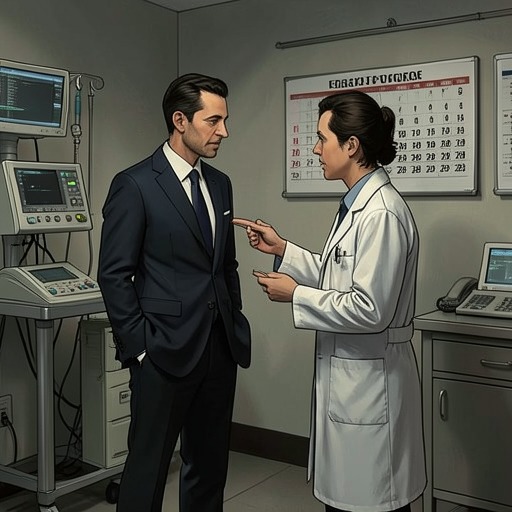
On August 15, 1984, Warhol described a session with a crystal healer as “like an exorcism.” He lay on the practitioner’s table with his eyes closed while the healer repeatedly asked whether he knew where he was. When the healer touched him and he showed no reaction, the practitioner said he was not in touch with his pain. Warhol’s account holds the two explanations apart: the touches did not hurt, but the healer interpreted his lack of response as insensitivity that would have to change.
The practitioner then used Warhol’s crystal to determine how long it would take to program, offering intervals from a minute to a day. At four days, the crystal gave the answer the healer accepted. Warhol was told to wait for it to be ready, keep it with him at all times, and leave it no more than ten feet away while asleep. The prescribed distance and waiting period gave the belief a precise routine: an unseen energy was to be prepared through an interaction, then maintained through proximity.
Warhol did not present himself as wholly persuaded by the session’s explanations. He called the practice “hokum-pokum,” yet added that he believed it helped through positive thinking. He also reasoned that gold and jewels mattered to people for a reason, and that wearing pearls around a stone could have an effect. When the healer said he had negative powers within him, Warhol asked how long he would need to keep coming, but received no answer. The system could specify the crystal’s four-day programming time while leaving the duration of treatment vague. Still, Warhol wrote that he felt better on leaving.
Sensation, confidence, and suspicion
That feeling of energy became one of Warhol’s recurring measures of whether a practitioner was doing something. At an appointment with Dr. Bernsohn, he asked whether the doctor could be featured in Interview. Dr. Bernsohn declined, saying he was not doing the kind of things he wanted people to know about. Warhol nevertheless reported feeling energy after leaving him, as he did after seeing Dr. Li. By contrast, another practitioner whom an acquaintance had sent him to made no difference to him. He also recalled Eizo making his hand sweat through concentration. These comparisons gave his belief a bodily register: not proof he could demonstrate, but a felt contrast between sessions that seemed to work and one that did not.
His trust in Dr. Bernsohn coexisted with an acute suspicion of the relationship’s financial and personal edges. The doctor offered stones that had been programmed for himself and said he would reprogram them for Warhol. He also wanted to look at Warhol’s paintings to see what vibrations he received from them. Warhol worried that Dr. Bernsohn might see a painting worth $50,000 and demand it, then interpret a refusal as negativity to be cured. He called the possibility a “scam,” but returned to the counterweight that he felt energy and that healers had notably hot hands. The diary does not resolve this contradiction: bodily reassurance makes the practice persuasive even as Warhol notices how easily belief could expose him to pressure.
A former Harvard student challenged the belief from a different direction. After Warhol showed him his crystals and explained their power, the man was astonished that someone who had once laughed at hippie ideas could now believe in crystals. He regarded the turn as a recycling of the same old counterculture. Warhol rejected that equivalence, insisting that the new practice depended on being positive rather than negative. His response suggests that he understood the crystals not simply as a return to an earlier fashion, but as a present method for cultivating an attitude he thought mattered.
Rituals, teachers, and expanding claims
The practice accrued instructions small enough to enter daily life. In Aspen, Dr. Bernsohn told Warhol that the secret to sleeping was to scratch and brush the crystal, then place it on his forehead. By the following spring, the treatment had expanded into an all-day appointment involving Dr. Bernsohn and a visiting practitioner, Dr. Reese, who was to work on Warhol’s cranium. Asked how he had become interested in crystals, Reese described seeing a figure called “Mr. Morning” as a baby, then developing an interest in electricity and the body while in the army.
Reese’s claims joined crystals to distant sacred sites and ordinary consumption. He said he had traveled around placing crystals on the pyramids and the Wailing Wall, and that he cured his coffee by passing a crystal over it ten times. Warhol noted Reese’s Episcopal faith and said that it made him feel more at ease: he did not have to worry that crystal belief might be against Christ. The detail shows how Warhol weighed a healer’s claims through more than sensation; religious compatibility also affected whether the practice felt safe to him.
The appointment also brought a more extravagant appeal. Reese’s assistant asked whether they should tell Warhol what they wanted him to do, and Reese eventually agreed. The assistant told him that his forces were with them, that he had to go to Tibet, and that he could do great things. The practitioners also spoke of needing people to support their studies. Warhol wondered whether they would ask him for money, remembered that Dr. Bernsohn was materialistic, and recorded being told that he had been Chinese in another life. He called the people ridiculous while maintaining that he believed in the crystals and their energy, which he imagined as having come from the earth’s center. His distinction was explicit: skepticism toward the people did not, for him, cancel belief in the stones.
Testing the belief and its limits
On April 24, 1985, Dr. Bernsohn reported that Reese considered Warhol a “Janooky,” a leading crystal person who might become especially important. The following day, Dr. Bernsohn said he did not want to be associated only with crystals because practitioners in Massachusetts had lost their licenses. Warhol found the caution curious: if someone truly believed in the practice, he thought, accepting its consequences should be part of that commitment. His objection was not a claim that crystal healing had been proven; it was a challenge to the gap between professed conviction and professional self-protection.
The clearest practical setback came when Warhol put a crystal in the office kitchen to repel cockroaches. Instead, he reported, they were getting more roaches than ever. Dr. Bernsohn said he would consult Dr. Reese; later he told Warhol the crystal had been reprogrammed to “un-reverse itself,” after which Warhol wrote that they would see what happened. The entry records the proposed correction, not its success. The crystal’s failure made its material presence conspicuous: it was no longer simply an object presumed to help, but an intervention whose effect could be judged against a visible problem.
That same visit produced another striking demonstration of the healers’ method. Dr. Bernsohn asked his secretary Judy to lie on the table and pretend to be Warhol’s dog, Amos. He asked what was wrong with her; she identified a crushed vertebra and possibly an ulcer, details Warhol said he had not supplied. Judy then said she no longer wanted to be a dog and wanted to return to being human. Dr. Bernsohn told Warhol to give Amos comfrey for the ulcer. The episode extends the practice from stones to bodily diagnosis and imagined identification, but the diary supplies no independent confirmation of the diagnosis or the remedy’s effect.
Across these entries, crystal energy is sustained by repeated acts—programming, carrying, brushing, placing, and reprogramming—and by sensations Warhol treats as evidence of change. Yet the journal keeps the counterevidence in view: an unresponsive session, fear of a healer’s demands, concern about money and licensing, and the cockroach crystal that initially seemed to make matters worse. The belief’s force lies in that unresolved combination. It offers a concrete ritual for managing invisible influences, while Warhol’s close attention to its failures and practitioners prevents the diary from presenting faith as simple certainty.