Interview
The Andy Warhol DiariesInterview was the magazine Andy Warhol started in 1969, initially as a small, film-oriented publication built around stars speaking in their own words. Over time it became a glamorous meeting place for celebrity, fashion, and art, and a practical extension of Warhol’s work: the promise of appearing in its pages helped draw people to the office, while its covers and portraits turned public attention into a continuing editorial and commercial resource. The diary account follows that growth not as a smooth success story but as a sequence of editorial experiments, staff tensions, advertising negotiations, and repeated decisions about who should appear next.
Founding and editorial approach
The original conception was deliberately focused: stars would talk, their words would remain unedited, and, when possible, one star would interview another. The format offered a new kind of magazine conversation, with celebrity not merely as a subject but as a participant in producing the feature. The publication began on a very low budget, in keeping with Warhol’s preference for financing a venture modestly and expanding it gradually rather than surrendering ownership to a backer.
That economy could be visible in the production itself. After the first issue had gone to press, a lawyer warned that a phrase used by an interviewee about a film critic could be libelous; changing the wording would have been safer, but it was too late to alter the printed copies. The episode captures the improvisational conditions of the early magazine: its editorial ambition ran ahead of the legal and production safeguards available to it.
The magazine’s early working life overlapped with the changing organization of Warhol’s studio. Gerard Malanga, one of Warhol’s first painting assistants and a performer in early films, shared a large desk with Fred Hughes. Malanga answered phones while writing poetry and briefly became the magazine’s editor when Warhol launched it. Hughes, meanwhile, was developing into the manager of Warhol’s art career. His experience with the de Menil family had introduced Warhol to wealthy art patrons, but his lasting value to the artist lay in his understanding of the work and his sense of how and where to present it. The magazine thus emerged within a workplace where artistic, managerial, and editorial roles were already intertwined.
In the summer of 1974, the Factory moved from Union Square West to the third floor of 860 Broadway. Warhol soon told receptionists to stop answering the phone with the name Factory, which had begun to sound dated; the workplace was simply the office. By then Bob Colacello, who had arrived after writing a review of Trash for The Village Voice, was working mainly for the magazine. He wrote articles and the column OUT, which chronicled his social life, and in 1974 became executive editor. His role helped shape Interview’s image, while the magazine’s name itself had acquired a slight change, becoming Andy Warhol’s Interview.
Growth, covers, and the celebrity pipeline
From 1975, Interview became a much more active part of Warhol’s daily routine. That year he bought out Peter Brant, a newsprint manufacturer and art collector, to become the magazine’s full owner and publisher; Hughes took the title of president. Warhol had previously remained comparatively detached from routine operations. Now he came in to inspect art director Marc Balet’s layouts and arranged conference-room lunches to pitch the magazine to prospective advertisers. Ownership brought him closer to the practical work of keeping the publication visible and financially viable.
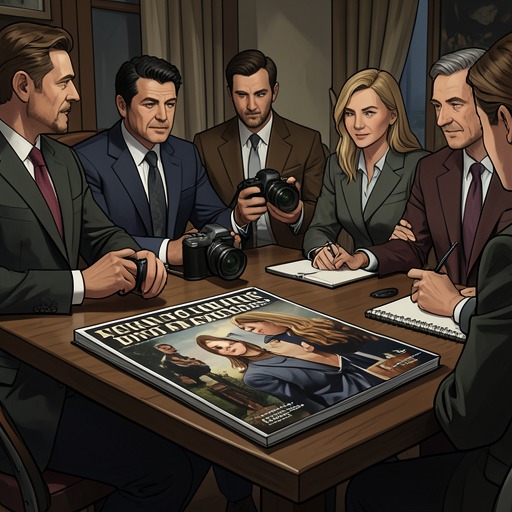
Circulation rose year by year, and by 1976 the magazine had developed a recognizable mix of sophisticated self-mockery and glamour. Celebrities wanted to appear in it. Warhol often conducted a cover interview himself, sometimes with a staff member, while the office became a steady destination for potential subjects. His recurring promise had shifted from getting someone into a movie to getting them into the magazine. Interview also made room for unfamiliar faces through picture features with headings such as Interman, Viewgirl, Upfront, and First Impression, presenting young men and women who had not previously appeared in print. The magazine’s prestige depended both on established names and on the suggestion that the next striking face might be discovered in its pages.
Warhol’s portrait practice supplied a related image-making process. He photographed a subject with his Polaroid Big Shot camera, taking about sixty Polaroids, selected four images, and sent them to a screen printer to make positive images on acetate. He then chose one, determined the crop, and altered details to make the subject appear more attractive before having the image enlarged for the final silkscreen. Alex Heinrici was his silkscreener before 1977; Rupert Smith took over afterward. The process makes clear how closely Interview’s celebrity culture sat beside Warhol’s portrait work: the public image was not simply recorded but selected, cropped, retouched, and prepared for circulation.
The diary repeatedly shows cover choices being made in response to timing, audience, and competition. A cover of Paloma appeared in an issue that Warhol noted carried fifteen pages of advertisements. He considered whether a young Harvard graduate, Maura Moynihan, might work as a cover subject because she was attractive, smart, and had a rock band. He proposed Shirley MacLaine partly in the hope that viewers of Donahue might buy the issue, even though Robert Hayes disliked the idea. Later, Warhol judged the Richard Gere issue the magazine’s biggest seller to that point, despite disliking the interview inside: the subject’s appeal, he concluded, could matter more to sales than the quality of the conversation. When the Stallone issue later became its biggest seller ever, the commercial lesson was reinforced.
Interview’s public presence extended beyond the printed issue. At the opening of a Fiorucci store, Warhol was pushed through a crowd of thousands, went behind a counter holding hundreds of copies, and signed them; the store had turned the event into a discotheque. He also carried copies through the streets and gave them to people who approached him, finding that a magazine could help him move on from encounters. The object functioned at once as publication, advertisement, souvenir, and a portable token of access to Warhol’s world.
Staff, advertisers, and internal pressures
The magazine’s expansion depended on sales staff and editors whose work could be both celebrated and contentious. At an advertising party, people crowded into the office soon after it began, and Gael Love, newly full-time after graduating from college, was widely regarded as energetic and well suited to selling ads. Yet Warhol’s later dealings with her could be strained: he complained about printing costs and communication, while also recognizing that he should have encouraged rather than criticized the staff. His diaries record the contradiction between relying on colleagues to keep the magazine running and resenting their methods or personalities.
Advertising presentations could expose the gap between a confident pitch and the numbers behind it. At a lunch for Bloomingdale’s, Colacello presented circulation as 80,000 and said that 20 percent came from subscriptions. When associate publisher Carole Rogers gave the subscription figure as 7,000, the room reacted with embarrassment, and a Bloomingdale’s representative later reported that the discrepancy had become a subject of conversation on the way back. The department store still thought Interview reached the right people and might advertise, but the exchange showed that prestige alone did not erase the need for credible figures.
Editorial work brought its own clashes. Catherine Guinness eventually told Warhol she was leaving Interview for a senior editorial job at Viva. He initially treated her tears as a personal gesture, then learned that she had cried with others as well; colleagues were pleased to see her go, a reaction that surprised him. In another episode, Anna Wintour presented Colacello with a fashion-insert proposal she had developed over three months. He dismissed it immediately, and the force of the response left her crying. These encounters reveal an office where editorial ideas and careers were subject to abrupt judgments, even as the magazine sought to appear polished and sophisticated to readers.
The pressure to keep producing also shaped the magazine’s relationships with contributors. Truman Capote agreed to create long slice-of-life pieces for Interview. The plan was to record him, have Brigid Berlin transcribe the tapes, and let Capote turn them into articles. When The New York Times expressed interest in reprinting his column, Colacello worried that Capote might take the work elsewhere. Warhol thought he would remain with Interview, though he suspected Capote might eventually make a book from the material. Berlin later reported being overworked as Capote recorded interviews and she transcribed them; the arrangement also left Capote with the copyright, allowing him to develop the work into a book. The magazine could attract valuable contributors, but the terms of that attraction could leave its staff carrying substantial labor without controlling the resulting material.
Other pressures were more immediately practical. Colacello sought additional office space because, as Warhol recorded with characteristic skepticism, he said it was difficult to lie to advertisers when others could hear. Warhol thought the real concern might instead be making personal calls in a crowded office. Robert Hayes’s frequent absences were eventually connected to his cocaine use, which Warhol understood in the context of photographers and stylists freely supplying the drug to editors seeking work. Such episodes brought the magazine’s business setting into view as a social environment, where professional access, personal habits, and editorial labor were difficult to separate.
Competition, circulation, and changing strategies
As celebrity covers became more valuable, access to subjects was contested. Warhol thought Rolling Stone was pressuring people to choose between its cover and Interview’s. He cited difficulty securing John Travolta and Sean Penn, while noting that music covers, including those featuring Sting, Michael Jackson, and Diana Ross, sold well. His response was to seek younger, less established subjects and to find the exact moment when a cover might land neither too early nor too late. The magazine’s continuing search for new faces was not only an aesthetic preference; it was a strategy for maintaining access and sales as competing publications asserted their influence.
The diary also records how Interview’s reputation could be challenged or used against it. Warhol bought copies of National Lampoon after it parodied the magazine. He worried that a cover might resemble an earlier one too closely, objected when a Jane Fonda cover did not look like her, and criticized a proposed movie issue for lettering that seemed old-fashioned and photographs of Sylvester Stallone that looked too much like ordinary film stills. In his view, the picture needed some distinctive detail to identify it as Interview’s own image. These judgments show him treating visual identity as a matter of both artistic distinction and market recognition.
Promotion could generate rapid results. Gael Love arranged a subscription promotion with Swatch: a subscription offer was paired with the purchase of watches, and she estimated it might bring in 30,000 new subscriptions. On one later day, the office recorded 600 subscriptions from the promotion, a striking result that Warhol compared with the number the magazine once obtained in an entire year. The diary does not establish whether the full forecast was reached, but it does record the excitement of seeing the promotion translate into immediate orders.
The magazine also faced structural cost decisions. When the office was nearly moved out of 860 Broadway, Si Newhouse came to lunch and offered to buy Interview. Warhol wondered whether the purpose might be to eliminate a competitor, and, with Hughes away and Vincent Fremont at lunch, he did not want to hear an offer without them present. The episode places the magazine at a point where ownership itself was negotiable. Later, as postage rates increased, Gael Love said that reducing Interview’s size by an inch would save $20,000 per month. Warhol questioned what value a large format held if it did not justify that cost. The paper dimensions that helped define the magazine’s visual presence were also a recurring financial calculation.
The diary’s view of the magazine
Interview appears in the diaries as more than a publication; it is one of the principal settings in which Warhol’s daily life is organized. The magazine is present in cover meetings, advertising lunches, staff disputes, interviews, office moves, and the circulation of copies on the street. Its importance comes through in the way a commercial decision can become personal—the disappointment over a cover, irritation with an editor, or delight in a successful issue—and in how social access can be converted into editorial material.
That account is itself mediated. Pat Hackett described keeping a sketchy Factory log before she and Warhol began weekday morning phone calls in 1976. The routine began as a record of the previous day’s activities and business expenses, including small cash costs, but became a diary in the broader sense. They did not make regular weekend entries; Monday sessions covered Friday through Sunday. Hackett took notes during the calls and typed them soon afterward. She later reduced the original 20,000 pages for publication, removing whole days, weeks, portions of days, and many names to create narrative flow. She also eliminated much of the interpersonal exchange between herself and Warhol, sometimes recasting herself in the third person. Consequently, the magazine’s presence in the published diary is not an unfiltered office record: it is a selected account in which commercial routines and workplace relationships are preserved through editorial choice.
Across the years represented, Interview changes from a low-budget experiment into a recognizable platform with sought-after covers, advertisers, and a widening staff. Its growth never removes the tension between editorial invention and commercial calculation. Each cover must be distinctive but timely; each celebrity appearance can provide prestige but may be unavailable; each promotional success must be measured against costs and the demands of production. The diary’s recurring attention to those decisions gives the magazine its particular significance: Interview is both a vehicle for making public images and a business whose daily operations continually test how much cultural glamour can be sustained by the work behind it.