Ronnie Cutrone
The Andy Warhol DiariesRonnie Cutrone was an artist who worked as Andy Warhol’s painting assistant in the 1970s, helping maintain the daily production of the studio while developing a career of his own. In the diaries, he is both a practical presence—stretching canvases, supplying ideas, and working at the office—and a volatile colleague whose arguments and private crises could abruptly take over the room. His story moves from intimate involvement in Warhol’s workshop to a departure followed by visible success as an artist.
Identity and Work in Warhol’s Studio
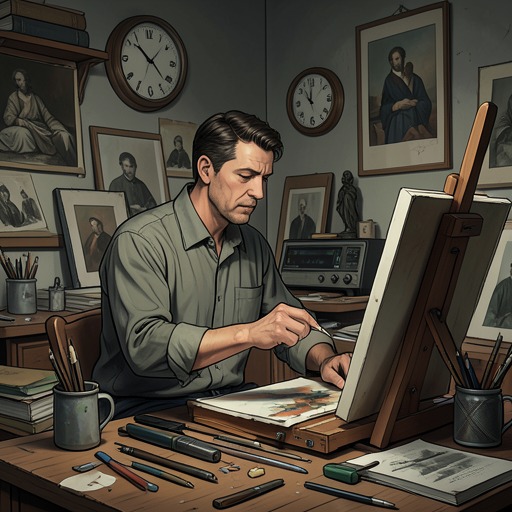
Warhol’s account identifies Cutrone as a painter and assistant, and places his work within the material routines of the studio. The job was not simply to execute a settled plan: Cutrone could prepare and stretch canvases, offer artistic suggestions, and contribute to works that Warhol was still deciding how to make. When Warhol rejected the way Cutrone had cut and stretched the Hammer and Sickle works during his absence, Cutrone objected that he had done the work for nothing. Warhol explained that he often needed to see an unwanted result before he knew what he wanted. Cutrone accepted that the effort could still be useful if Warhol could react against it, but resented work that seemed to have no purpose at all. The exchange makes their collaboration look less like a smooth division of tasks than a negotiation over uncertainty, effort, and authority.
Cutrone’s place in the studio also intersected with Warhol’s commercial activity. Warhol relied heavily on commissioned portraits for income throughout the 1970s, and commissions helped sustain an office and a magazine that needed financial support. Cutrone later described this practical background: in his view, Pop Art had passed into a period of new movements, while Warhol still had an office to run and felt that Interview required subsidy. Cutrone’s explanation situates portrait production not only as an artistic practice but as part of the business that kept Warhol’s operation going. The diaries give a concrete sense of the method behind that work: Warhol took about sixty Polaroids of a sitter with a Polaroid Big Shot, selected images for transfer to acetate, and then chose, cropped, and cosmetically altered one before it was enlarged into a silkscreen. Cutrone’s role belonged to the workshop environment in which these repeated, labor-intensive processes took place.
Interview’s expanding profile formed another part of that environment. By 1976, the magazine’s self-mocking sophistication had made celebrities eager to appear in it, and Warhol’s promise to put someone in the magazine had become more common than his earlier promise to put someone in a movie. Cutrone’s work at the office took place within this growing intersection of art, publishing, celebrity, and portrait commissions. The diary also shows how crowded and loosely organized that workplace could feel: at one point, a would-be helper disappeared while meant to assist Warhol, then returned to talk with Cutrone, who apparently had little to do. This is not a formal account of Cutrone’s job description, but it does place him among the people whose presence and activity shaped the office’s everyday life.
Collaboration, Friction, and the Office
The diaries record Cutrone as a source of ideas as well as labor. On one day, after being woken by Gigi and dealing with a restraining order, he drank heavily at the office and began directing Warhol and offering art ideas. Warhol noted that the suggestions were useful. The scene captures an unusual overlap between personal distress and creative contribution: Cutrone’s state affected how he behaved at work, but did not prevent Warhol from finding value in his input.
Other episodes show the same workplace under strain. Warhol complained when Cutrone made three lengthy phone calls, and later described him as difficult after an argument about stretching a canvas crookedly. Cutrone challenged Warhol’s authority by listing the things he believed Warhol did not do himself, including painting, photographing, and stretching. The disagreement was not only about a technical error. It exposed an enduring imbalance in the studio: Cutrone performed practical work, while Warhol retained the final decision about what counted as a successful result. Warhol compared Cutrone’s behavior to an earlier period when he had been drinking and using drugs, while noting that he was no longer doing so. That comparison is Warhol’s judgment, not an independent account of Cutrone’s condition.
The office could also turn ordinary tasks into occasions for embarrassment or disorder. Warhol once kicked over paint Cutrone had left on the floor and spent the afternoon cleaning it from his clothing and boot. On another day, Cutrone was still stretching canvases while a colleague tried to sell a print to visitors. In a later account, Warhol screamed at him over repeated telephone calls. These incidents are small, but together they show the close quarters in which the assistant’s work, visitors, interruptions, and Warhol’s own artistic demands converged. The studio was at once a production space and a social workplace, and Cutrone’s daily conduct mattered in both roles.
Cutrone’s artistic interests were not confined to assisting Warhol. He was preparing a substantial role in a performance associated with Walter Steding, whose manager Warhol said he was. Later, Cutrone was going to Basel to show his own work at an art fair with Lucio Amelio. The diaries do not describe the performance or the art-fair presentation in detail, but the two references mark distinct professional avenues beyond the assistant’s position: performance and the exhibition of his own art.
Gigi and Personal Upheaval
Cutrone’s relationship with Gigi repeatedly entered the office’s daily record. At one point Warhol noted that they were back together. Later, Gigi appeared at the office with police and a restraining order, prompting Cutrone to drink and direct his frustration into work. These moments establish a relationship that shifted between reconciliation and serious conflict, without supplying a complete account of what happened between them.
The diaries also describe a proposed pregnancy and a subsequent separation. Gigi told Warhol that she was pregnant and would remain in New York and have the baby if Cutrone wanted it; otherwise, she would leave and divorce him. Later, she told Cutrone she wanted a divorce and said she had had an abortion. Warhol questioned whether the pregnancy had been real, but the diary offers no way to resolve that uncertainty. The episode is significant less as a settled account of the pregnancy than as evidence of how personal decisions and disputed information circulated through the studio’s social world.
A particularly painful episode followed Cutrone’s return to work after a night away. Gigi arrived demanding to know what had happened to her cats. Cutrone told colleagues that he had found them in distress and killed them; he also said that he had not fed himself or the animals for five days because he had no money and was too proud to borrow any. Warhol suspected that Cutrone had acted to retaliate against Gigi, but that was his interpretation, not a confirmed motive. The diary records the office’s shock and Warhol’s inability to look at Cutrone afterward. It marks a severe rupture between Cutrone’s private crisis and the people around him, and sharply contrasts with the earlier notice that he and Gigi had reunited.
From Assistant to Independent Artist
The later entries show Cutrone moving toward an independent career. Warhol recorded that Cutrone’s art was selling very well, including a sale to Steve Rubell’s brother. At a separate gathering, Cutrone appeared with a girlfriend and was again described as having a strong market for his work. Warhol introduced Robyn to Alexander Iolas partly because Cutrone’s career had progressed after leaving the studio; he hoped that an introduction might similarly help Robyn. The comparison makes Cutrone’s departure consequential: he became an example within Warhol’s circle of an assistant whose own artistic prospects could flourish beyond the workplace.
That success did not erase the history of disagreement. Warhol’s diary can register irritation with Cutrone’s work habits and arguments while also recognizing his ideas, documenting his artistic opportunities, and noting the demand for his art. The resulting portrait is not of a simple apprentice or a seamless collaborator. Cutrone occupied several positions at once: assistant, artist, participant in the office’s social life, and a person whose relationship troubles could become impossible to separate from work.
Narrative Role and Later Appearances
Because the book is a diary, Cutrone emerges through recurring encounters rather than through a continuous biography. Warhol records a fight over canvases, a day of unwanted phone calls, a performance role, office visitors, personal crises, and the growing sales of Cutrone’s art. The abrupt movement between these subjects is itself revealing: professional evaluation and private life appear in the same matter-of-fact record, sometimes only a few entries apart. Cutrone’s character is therefore presented through changes of register—from useful source of ideas to frustrating colleague, from distressed partner to increasingly successful artist—rather than through an explicit account of his inner life.
Cutrone also remained connected to the art world around Warhol after his departure. Years later, Warhol encountered him at a gallery with his girlfriend Tama Janowitz, whose writing had attracted publishers’ interest. Cutrone was described as looking stylish, and Warhol again noted that his art continued to sell. This late appearance echoes the earlier reports of his career gaining momentum, while showing him still moving through the same overlapping social and artistic circles. The diaries do not settle the contradictions in Warhol’s view of him; they preserve them. Cutrone’s significance lies partly in that unresolved closeness: he was indispensable enough to shape the workday, independent enough to leave it, and successful enough for Warhol to keep measuring the difference between his own studio and the career Cutrone made outside it.