Sotheby's
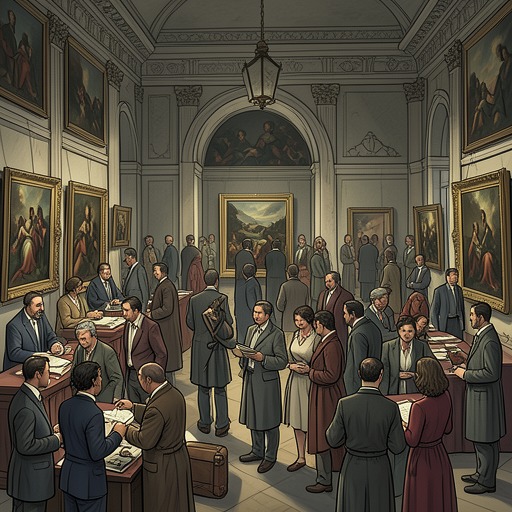
The Andy Warhol DiariesSotheby’s is a recurring setting in Andy Warhol’s diary, where the auction house serves at once as a showroom, a marketplace for his own work, and a vantage point on changing tastes and prices. Visits stretch from 1978 to 1986: Warhol goes to look at collections and auctions, encounters paintings attributed to him, watches works sell or fail to sell, and reflects on how the trade can alter the objects it handles. The location’s significance lies in this repeated movement between looking, valuing, and seeing art circulate beyond its maker’s control.
Early Visits and Personal Provenance
In June 1978, while in London, Warhol went to Sotheby’s to see the Von Hirsch collection, which he described as the biggest collection since Scull. The brief visit establishes an early pattern: the auction house drew him not only as a seller but as a spectator of major collections and of the comparisons that shaped their public standing.
By October, a visit had become more personally consequential. Thomas Ammann called, and Warhol went to Christie’s to obtain catalogues because some of his old drawings were coming up for sale. The drawings had belonged to Bill Cecil, who had died in a car crash; Cecil’s family was in the American antiques business. Warhol connected that family’s influence to his own collecting, recalling that he had acquired his first cupboard from them. The cupboard had since become a piece of office furniture in the Interview office, used to store pencils and rubber cement. The recollection links auction catalogues and the circulation of old drawings to a more private history of collecting: an object acquired through one connection could become an ordinary working fixture, while the drawings returned to the market.
Authentication, Estimates, and the Handling of Works
In March 1985, Sotheby’s staff asked Warhol to assess several paintings attributed to him. Among them was a blue fake Electric Chair, a work of the kind Gerard Malanga denied making. Warhol noticed that it was poorly stretched and that a border had been added. He explained that buyers seeking a larger picture might purchase a work rolled and then stretch it with the border included. The episode makes the auction house a site of practical judgment about authenticity and alteration, not merely a place where prices are announced. It also shows how commercial expectations could change a painting’s physical presentation before it reached prospective buyers.
At the same visit, Warhol saw four large Flower paintings and speculated that people were selling off his work. In October, he found his Ten Lizzes on preview for an upcoming auction. He thought it had been cut down substantially, apparently stretched to make it look better. The estimate was $400,000, while other paintings in the sale were expected to bring $200,000 or $300,000. The works came from Philippa and Heiner Friedrich’s Dia Foundation. Warhol also met older visitors who recognized him from The Love Boat, a reminder that the auction preview gathered not only art and sellers but members of a public who knew him from television.
A separate visit in October brought a less aesthetic encounter with the objects on view. Warhol was disturbed to see people pulling up chair upholstery to inspect it, including to check whether the wood was original American wood throughout. The activity struck him as excessive, but it disclosed a method of valuation: close inspection could involve physically disturbing the furniture in order to establish its material history. At Sotheby’s, provenance and condition were not abstractions; they could be pursued by lifting the covering from a chair.
Crowds, Sales, and the Auction Market
In April 1985, Warhol found Sotheby’s jewelry auctions crowded eight people deep in the category. He thought people were buying at auction instead of in stores and wondered whether this meant that retail stores would suffer. He suspected that stores might send representatives to buy and bid up their own categories. The crowded room thus prompted him to consider not just individual purchases but the relationship between auction sales and retail trade. He also encountered Ivana Trump in the basement, looking at less expensive items, a small detail that placed different price levels within the same auction-house visit.
That month, Warhol ran into Patricia Neal in an elevator. She was selling a Francis Bacon painting and was upset that its reserve was only $250,000. She told him that another Bacon had been sold to pay for her son’s baking school, which she considered wasteful because he did not bake. Warhol also saw a 1964 portrait he had made of Happy Rockefeller in the sale catalogue, estimated at $30,000 to $40,000. He wondered why she was selling it rather than donating it to a museum, which he thought could have produced a $500,000 tax write-off under the new prices. He noted that a Nelson Rockefeller painting had also been sold months earlier. The catalogue brought together financial calculation, family circumstances as reported to him, and the changing market value of portraits.
In September, Warhol and Benjamin went to Sotheby’s to see a large exhibition of Indian art, which he described as containing millions of things. In November, the auction of works from Philippa de Menil and Heiner Friedrich showed the difference between expectation and result. Thomas Ammann had offered Dagny Corcoran $350,000 for a blue Liz painting, but she expected $500,000 and put it into the auction; it failed to sell, reaching only $250,000. A Jasper Johns painting expected to bring $2 million sold for $700,000. Philip Johnson bought the Stamps for $150,000, though Warhol thought it should have brought $500,000. These results led him to question why the owners had chosen auction rather than private sale. At Sotheby’s, estimates and bids could make the distance between anticipated value and realized price starkly visible.
The Market Turns Back on Warhol’s Own Work
By May 1986, Warhol was again looking at his paintings at Sotheby’s, this time a Ticket to Studio 54 work offered for an estimated $5,000 to $7,000. He wondered who was selling it, recalling that he had given such paintings to Halston and Barbara Allen. The uncertainty about the seller accompanies the work’s return to the market: a gift, once it left his hands, could reappear in an auction catalogue with a price attached.
In January 1986, Sotheby’s had just sold a table for $1.2 million, a record. Warhol compared that result with the inexpensive objects he remembered buying at the armory, many for $35. He regretted not choosing the $100 objects, which he thought would now be worth a great deal, and observed that buyers wanted one-of-a-kind things while his art was the opposite. Later that year, Sotheby’s told him that one of his Soup paintings had done well, reaching $6,600. He recalled that Jay had been sent to bid on a set of Ladies and Gentlemen and on some Flower paintings; a set of Jasper Johns Numbers sold for $140,000. In November, at the second day of the Renaissance auctions, Warhol and his companions lost out on everything. He nevertheless described the experience as enjoyable because they could learn by seeing, touching, and feeling the objects without spending anything. He also noted that he spoke with the Black employees at auction houses about what they thought of the works. Across these visits, Sotheby’s remains a place where prices are tested, objects are handled, and looking itself becomes a way to take part in the market.