Warhol's time-capsule gallery auction plan
The Andy Warhol DiariesWarhol's time-capsule gallery auction plan was Andy Warhol's idea of turning his accumulating archive into gallery material: boxes filled with the ordinary documents and objects sent or given to him could themselves be offered for sale. The proposal grew directly from a daily routine of collecting almost everything, then imagining how those sealed records of a life might be presented as distinctive lots.
A daily system of preservation
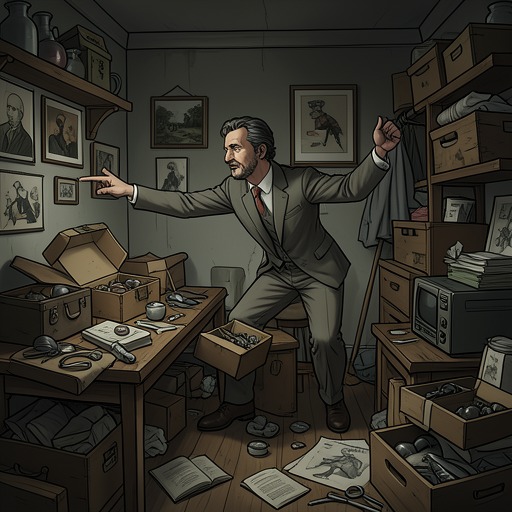
At the office, among the day's appointments, calls, mail, and gifts, Andy Warhol sorted material for his Time Capsules. Each was a brown cardboard box measuring 10 by 18 by 14 inches. Once filled, a box was sealed, dated, and put into storage; an identical empty box took its place, ready for more. The method made accumulation repeatable: rather than treating each container as a final collection, the routine kept the act of collecting going.
The boxes drew on the steady stream of material arriving at the office. Letters, invitations, gifts, and magazines were among the items he considered for storage. He retained or gave away less than one percent of what people sent or gave him; nearly everything else went into a capsule. His standard was expansive rather than narrowly archival: if he found something interesting, and his interest extended to almost everything, it could belong in the box.
The auction that suggested a use for the boxes
The proposal surfaced during a visit to an exhibition of Joan Crawford's belongings, which was being taken down ahead of an auction. The sale included saved correspondence, among it letters from lawyers and schoolteachers; even the gallery employee was wearing one of Crawford's sweaters. Faced with a life represented by objects now available for purchase, Andy Warhol thought that he, too, should auction some of his time-capsule boxes in an art gallery.
He did not describe a plan simply to sell undifferentiated containers. He wanted each box to be made interesting, suggesting that he might add one of his dresses or an old shirt. The proposal joined the chance quality of the daily archive to a deliberate act of presentation: the contents accumulated over time, while the selected addition would give each sale a particular point of interest. The account records this as an idea, not as an auction that took place.
Accumulation and editorial selection
The plan sits beside a broader tension between preserving material and deciding what others will see. Andy Warhol's boxes were designed to retain almost everything that passed through his hands, while Pat Hackett describes a sharply selective process for preparing the diaries for publication. The original diary ran to 20,000 pages; she cut whole days and sometimes weeks, and reduced lists of names to those most relevant to the narrative. The physical archive and the published diary therefore followed different rules: one stored abundance, while the other shaped a readable record through omission.
Hackett also kept editorial explanations to a minimum to preserve the flow of Andy Warhol's voice. She removed direct references to herself and to matters meaningful only to the two of them, recasting the few personal references she retained in the third person as PH. That editorial practice did not determine what went into the boxes, but it clarifies why the capsules' near-total accumulation and the diary's curated account should not be mistaken for the same kind of record. The gallery-auction idea imagined the boxes not just as storage, but as objects whose selection and presentation could make an archive legible to an audience.