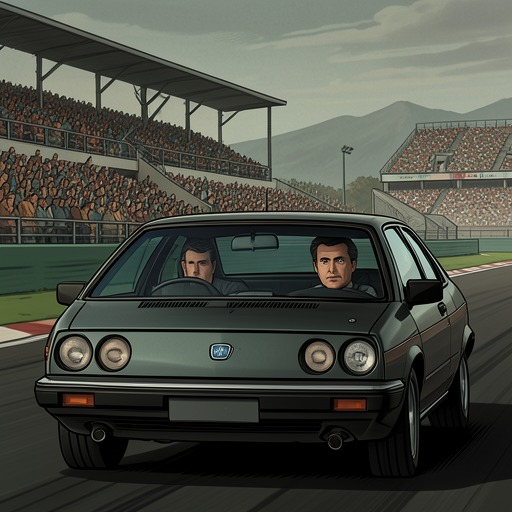
1993 Grand Prix of Europe
The Art of Racing in the RainThe 1993 Grand Prix of Europe stands in Enzo’s memory as the greatest automobile race of all time and the clearest proof of Ayrton Senna’s mastery in the rain. Recalled while Enzo watches Denny’s racing footage, it becomes both a landmark in its own right and the standard against which Denny’s talent is measured.
The Race in Enzo’s Memory
Enzo recalls Senna passing four championship drivers on the opening lap: Schumacher, Wendlinger, Hill, and Prost. The feat gives the race its enduring force in his account. It is not merely a celebrated result but an instance of exceptional judgment and control under wet conditions, the quality that makes Senna, to Enzo, a genius in the rain.
The race occupies the highest place in Enzo’s private ranking of what he has seen on television. Even as an old dog facing the decline of his body, he holds fast to this memory as an image of ability made unmistakable through action.
Denny Measured Against Senna
The memory returns as Enzo and Denny watch a tape of one of Denny’s races. In that race, the track is dry for the pace lap; just after the green flag, a torrential wall of rain engulfs it, and the surrounding cars spin into the fields while Denny drives through. Enzo sees the performance as a near-echo of Senna’s wet-weather command, and judges Denny to be as good as him.
The comparison is also a contrast in recognition. Enzo believes Denny’s ability goes unseen because his life is bound by responsibilities: his daughter, Zoë; his wife, Eve, who was ill until she died; Enzo himself; life in Seattle; and his job. Yet Denny sometimes returns from racing with a trophy and tells Enzo how he performed in Sonoma, Texas, or Mid-Ohio, keeping the brilliance Enzo recognizes alive in their private exchange.
Narrative Significance
The race enters the story through Enzo’s recollection rather than through a staged account of the competition. Its details are selective but precise: the rain, the opening lap, and the four names Senna passed. That compressed memory supplies a sporting ideal against which Enzo interprets Denny’s footage and gives shape to his conviction that Denny’s talent deserves wider notice.
The remembered race also links Enzo’s reflections on mortality to an image of enduring skill. As he prepares for a life beyond his failing body, the performance remains something he can carry forward: a vivid example of what he has learned to recognize and value.