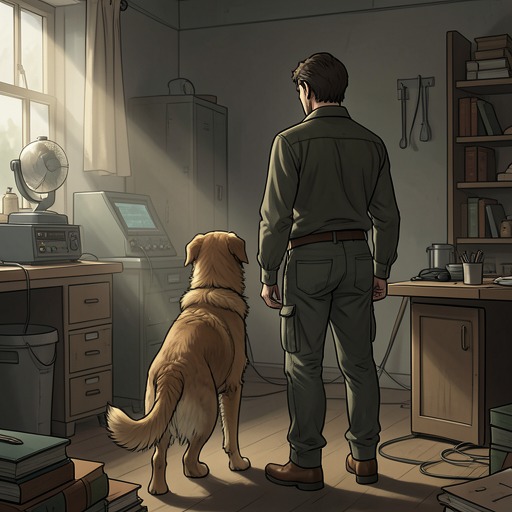
Denny Swift and Enzo
The Art of Racing in the RainDenny Swift and Enzo are bound by a relationship that exceeds ordinary owner-and-dog companionship: Denny depends on Enzo as a steady presence through family illness and personal strain, while Enzo understands himself as a humanlike soul whose purpose includes caring for Denny. Their bond is expressed less through conversation than through repeated acts of attention—waiting beside him, staying with Eve when asked, and responding to Denny’s gestures. Yet their understanding is not effortless: Enzo cannot explain what he knows, and Denny sometimes misreads what Enzo’s behavior means.
Identity and the Shape of the Bond
Enzo regards his canine body as a shell and believes his inner self is human. That conviction shapes the intimacy he claims with Denny: he does not see himself merely as a pet receiving care, but as a companion who can understand, comfort, and protect the people in Denny’s family. The novel presents that belief through Enzo’s first-person account, where observable behavior—remaining close, responding to touch, and waiting at Denny’s side—coexists with Enzo’s humanlike interpretations of Denny’s thoughts and needs.
Denny, in turn, recognizes something unusually perceptive in Enzo. After an incident in which he has wrongly blamed and treated Enzo harshly, he apologizes, affirms his love, and says that Enzo would never deliberately harm Zoë. He also reflects that there seems to be a person inside the dog, someone who understands him. Enzo silently confirms that this is how he sees himself. The exchange makes explicit what their everyday companionship has already implied: Denny experiences Enzo as more than an animal, even though Enzo cannot answer him in human speech.
Companionship Amid Work and Racing
Denny’s racing ability is central to how Enzo regards him. Watching a race recording together, Enzo recalls Denny driving through a sudden downpour while other cars lose control, and compares the feat to Ayrton Senna’s celebrated opening lap in the 1993 Grand Prix of Europe. Enzo believes Denny is as gifted as Senna, but sees his opportunities constrained by responsibilities: he has a daughter, a job, and a family life in Seattle. When Denny travels to race, he sometimes returns with a trophy and tells Enzo about competing in Sonoma, Texas, or Mid-Ohio. For Enzo, these returns make Denny’s talent visible even when the wider world does not give it full recognition.
Their closeness also appears in quiet, unceremonious moments. After a difficult hospital visit, Denny sits with Enzo on a berm for a long time without speaking. Enzo does not press him for an explanation; he lies beside Denny and makes himself available. This is a recurring form of support in their relationship: Enzo treats presence, rather than advice or speech, as the response Denny needs when he is upset.
Care During Eve’s Illness
As Eve becomes ill, Denny takes on more of the family’s daily work. He reduces his hours so he can take Zoë to preschool, teaches her at home, and assumes responsibility for shopping, cooking, and cleaning. Enzo understands these changes as Denny’s effort to relieve Eve of stress, while recognizing that the added responsibilities leave less room for the playful, affectionate interaction he had seen between Denny and Eve. Enzo’s own role shifts with the family’s needs: Denny trusts him to remain with Eve when he takes Zoë out, asking him to care for her, and Enzo stays close when she is in bed or has fallen to the floor. Eve sometimes holds him while describing her pain.
Enzo believes he can detect that something is wrong with Eve before her condition is diagnosed, but he has no way to communicate the warning. His inability to make Denny understand what he senses marks a limit within their extraordinary-seeming bond: Enzo may interpret human states and illness with confidence, but he cannot reliably convey that knowledge in words. Later, when Denny and Zoë visit Eve in the hospital, their days settle into a strict routine of camp, work, meals, visits, bedtime, and household tasks. Enzo accepts fewer walks and less attention rather than add another demand to Denny’s burden.
The strain is not simply practical. At one point Denny asks why Eve has sent him away when Zoë, her parents, and Enzo are present, while Eve says she does not want him to see her in that condition. Enzo understands her wish, and his presence becomes a form of companionship that Denny cannot provide in that moment. When Denny later tells Zoë that Eve will stay with her grandparents for a while, the family’s circumstances change again; Enzo remains part of the circle of care even as illness separates its members.
Misunderstanding, Trust, and Repair
The relationship is not immune to fear and misinterpretation. During a period of solitude lasting about forty hours, Enzo believes he sees Zoë’s stuffed zebra moving and behaving threateningly. When Denny later finds Zoë’s toys destroyed, he assumes Enzo is responsible and reacts in anger. Enzo does not understand the destruction and attributes it to the zebra, showing how his confident inner explanations can diverge from what he actually knows. Denny’s anger frightens him, but Denny later recognizes that Enzo would not intentionally hurt Zoë, apologizes, and reassures him of his love. Enzo feels both the hurt of the encounter and the force of the reconciliation; the apology restores trust rather than erasing the earlier failure of understanding.
Enzo also reads Denny through physical and emotional cues he believes a human would overlook. During a tense meal, he senses Eve’s fear and anger through what he describes as the bodily signs of stress, although he cannot see her. His account distinguishes the cues he perceives from the conclusions he draws about what she is prepared to accept. This pattern recurs in the bond: Enzo’s close observation makes him attentive to Denny and the family, but his canine limits and humanlike assumptions leave him unable to know or explain everything.
Shared Burdens and a Late Act of Care
When Denny faces the pressure of the custody dispute, Enzo remains a witness to both his distress and his endurance. Enzo cannot attend the trial; he reconstructs it from dreams, imagined courtroom scenes, and what Denny recounts. That narrative limitation matters to their relationship: Enzo’s devotion does not make him omniscient, and his understanding of Denny’s legal ordeal is assembled from fragments rather than direct participation. At a moment when Denny is considering a settlement, Enzo sees a zebra image on a souvenir pen and interprets it as the destructive impulse within a person, not an external demon. He understands the threatened signature as contrary to what Denny truly wants for his daughter. The episode joins Enzo’s private symbolism to his continuing effort to protect Denny’s bond with Zoë.
Near the end of Enzo’s life, that care turns toward helping Denny release him. When Denny comes home and calls to him in their familiar manner, Enzo resists his usual eager greeting and stays down, deliberately acting more helpless than he feels. Denny takes him to the bath and apologizes for being late, linking the delay to Enzo’s accident. Enzo recognizes that Denny has misunderstood what happened and does not want him to feel responsible. He wants Denny to see that he can let Enzo go, especially after everything Denny has endured and overcome. Enzo imagines returning to Earth as a man, finding Denny, and greeting him in a way that would leave a trace of recognition between them. The imagined future is Enzo’s own expression of the relationship’s defining hope: that separation need not cancel the understanding and loyalty they have shared.