Denny Swift and Enzo's Bond Through Adversity
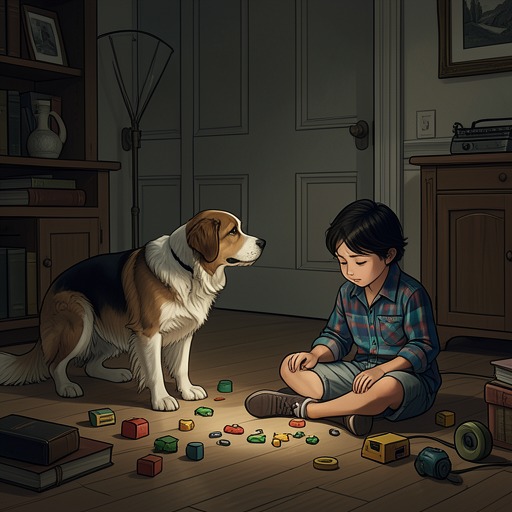
The Art of Racing in the RainDenny and Enzo’s bond is a steadfast companionship whose meaning sharpens under loss: Enzo witnesses Denny’s grief, intervenes when despair threatens to make him give up Zoë, and remains beside him to the end. Their closeness is conveyed less through explanation than through recurring gestures—Denny’s hand on Enzo’s head, Enzo’s bodily acts of refusal, and the care that continues even when words fail.
Identity and Shared Life
The relationship is built across the ordinary life the two share with Eve and Zoë. In an old video of the family at Long Beach, Enzo watches Denny, Eve, and toddler Zoë chasing kites on a wide beach. The remembered weekend belongs to a world before the family knew they would be separated. Watching the footage beside Denny, Enzo sees their former closeness made visible: beach, ocean, and sky preserve a shared past even as the present has become painful and divided.
That family memory is part of what makes Enzo’s companionship more than a background presence. He has lived within the household’s history and carries its losses alongside Denny. When Denny reaches out and scratches the crown of Enzo’s head, the gesture is familiar and continuous with their life together. In a moment shaped by grief, that small touch renews a bond already established through years of shared experience.
Enzo’s account of Eve’s final night also places him inside Denny’s family life at its most consequential threshold. He describes seeing Eve’s soul leave her body in a dream, while Denny does not yet know she has died. The difference between what Enzo believes he has witnessed and what Denny knows underscores their unequal but intimate positions: Enzo is beside Denny through the aftermath, even when he cannot explain what has happened. In Enzo’s understanding, Eve’s death ends her painful battle; for Denny, it begins another struggle.
Grief and the Work of Staying
After Eve dies, Denny’s grief becomes a starting point rather than a resolution. Enzo recognizes that distinction and remains near as Denny confronts the custody conflict over Zoë. When Denny’s hands shake after others leave, the strain is made physical. He pours a drink, but Enzo later finds him watching the old family video instead. The choice returns Denny to a memory of the people he loves, and Enzo watches with him rather than turning away from the sadness.
The video’s remembered happiness does not undo the separation that followed. Its force comes from the contrast: Denny and Enzo can see how young the family once was, while knowing that they have since been divided from Eve and Zoë. Enzo’s presence gives Denny a companion for holding both realities at once. Denny rests a hand on him, and Enzo stays beside the couch, sharing the scene without needing to make grief disappear.
Their connection also informs Enzo’s understanding of Eve’s example. He reflects on her declaration that she is alive and on the joy she finds in a day she experiences as reclaimed from death. Enzo takes that way of living as something to aspire to when he becomes human. The thought connects his attention to Eve with his loyalty to Denny: the household’s experiences shape how he understands endurance, even as he remains the dog who accompanies Denny through the consequences.
Gestures, Resistance, and Loyalty
Enzo repeatedly treats action as his means of communicating with Denny. When Denny is in danger of yielding in the custody struggle, Enzo recognizes the settlement papers as a threat to Denny’s commitment to Zoë. Though old and recently injured after being hit by a car, he pushes himself onto Denny’s lap, takes the papers in his mouth, and refuses Denny’s command to drop them. His intervention turns companionship into a concrete act of resistance: he puts his weakened body between Denny and a decision Enzo understands as surrender.
When Denny continues to warn him, Enzo urinates on the papers. Denny and Mike laugh, and the laughter breaks the immediate pressure of the scene. But the joke also communicates what Enzo’s other gestures have been trying to say: Denny should not sign away his claim to his daughter. Denny answers by rejecting the settlement as well, declaring that he will not give up and recalling his promise to Zoë. Enzo cannot settle the legal dispute, but his interruption helps Denny reaffirm what he intends to fight for.
The relationship is reciprocal rather than simply protective in one direction. Enzo acts when he believes Denny is about to abandon hope, while Denny’s long care for him continues as Enzo’s health declines. Their closeness does not spare either of them from pain. It gives them a way to meet it together, through a remembered family, a hand laid on a dog’s head, and gestures forceful enough to interrupt a decision.
Farewell and Continuing Bond
Near the end of Enzo’s life, their usual companionship takes on the pressure of a farewell. Denny speaks directly to him, saying, “You’ve always been with me,” and calling him “my Enzo.” Enzo accepts the recognition: Denny is right about the constancy of their relationship. Denny also gives him permission to go if he needs to, while Enzo acknowledges how deeply Denny’s sadness makes him want to stay with Denny and Zoë in the apartment.
The farewell preserves both attachment and release. Denny’s words do not deny that Enzo may die; they make clear that the bond remains even as he lets Enzo leave. Enzo’s response similarly holds two truths together: he would rather remain with them, yet he believes that a dog’s soul is released after death to run through the world until it is ready to be reborn. The fields he imagines are not presented as a replacement for Denny and Zoë, but as the next part of a journey he believes he must take.
Narrative Significance
Through Enzo’s narration, the relationship links physical companionship to endurance across separation and death. Its defining language is often bodily: a hand scratching an ear, paws pressed onto a lap, papers seized and defaced, a dog carried when he can no longer manage alone. These gestures matter because Enzo cannot explain himself in ordinary speech, while Denny’s actions show that he understands their force.
The bond does not make Denny invulnerable or promise an easy outcome. Instead, it helps him resist despair at moments when he might abandon what he values. As Eve’s death begins Denny’s painful struggle and Enzo approaches his own end, their loyalty is shown not as an escape from loss but as a way of remaining present within it. The relationship closes with separation anticipated and love still acknowledged: Enzo may have to go, but the life he shared with Denny remains central to how both of them understand what it means to stay, to let go, and to continue.