Embracing the Rain
The Art of Racing in the RainEmbracing the Rain names a principle of driving and a lesson in how to meet what cannot be fully controlled. For Denny, rain makes mistakes more consequential and a car’s behavior less predictable; the answer is not to withdraw, but to anticipate, act deliberately, and stay responsive. Enzo extends that principle beyond the track: Eve, once an unpredictable source of fear to him, becomes someone he can begin to approach differently.
The Principle on the Track
Denny describes wet-weather driving as an exercise in delicacy: “Very gently. Like there are eggshells on your pedals,” he says, because a driver must control the car without overcorrecting. The image makes the required pressure vivid. The driver cannot treat the pedals as switches to be stamped or trust that ordinary movements will have ordinary results; small inputs matter when the track is wet.
The danger is not simply that rain makes driving difficult. Denny explains that water can make a car handle unpredictably and amplify mistakes. A driver who waits for an unexpected movement to happen and only then reacts may be too late, since the reaction itself takes place at speed. Fear, in this account, has a rational source: the conditions demand respect. But respect cannot mean surrendering to the uncertainty or allowing fear to dictate every move.
Denny’s alternative is to initiate a controlled action before the car’s behavior becomes an emergency. If he deliberately makes the car move in a particular way, he can anticipate what follows; he may let it get a little loose, then correct it before the movement turns into a full spin. The distinction is between being surprised by the car and participating in its movement closely enough to respond early. Control here does not mean eliminating risk. It means engaging with the risk while there is still room to act.
A Lesson Made Visible
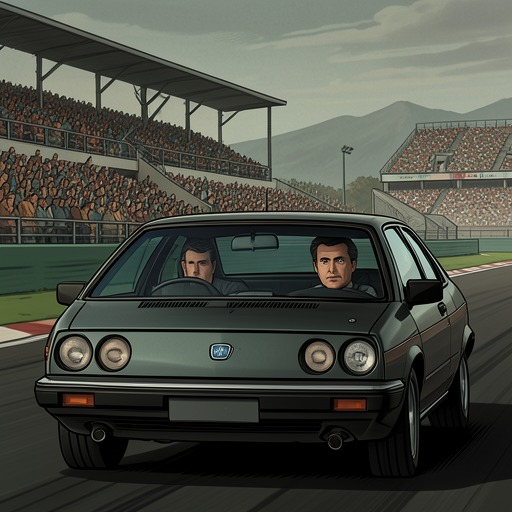
The televised race gives the principle a concrete test. The rain keeps falling, and Denny’s team has made the right choice while other teams pull into the hot pits to change to rain tires. On screen, Denny’s car’s rear end steps out. His hands are already turning to correct it; the car goes sideways, but he avoids a full spin and continues past the others. The scene makes his explanation physical: the correction is ready before the slide can become a crisis.
The sequence also preserves the difference between understanding danger and being overwhelmed by it. Eve says she is afraid even watching the race, and holds a hand to her forehead when the car slides. Her alarm is not mocked or disproved; the maneuver is genuinely precarious. Instead, the successful recovery shows what Denny means by acting before an unpredictable event has fully unfolded. Embracing the rain is therefore not bravado or denial. It is a practiced willingness to work inside conditions that remain dangerous.
From Racing to Relationship
Enzo applies the racing lesson to his own response to Eve. He acknowledges that he has wanted to love her as Denny does but has been afraid. In his account, she has been his rain: the unpredictable element he treats as a threat. The analogy carries the driving principle into a relationship without making Eve herself a problem to be controlled. What Enzo can change is his own mood and energy, and thus the way he approaches her.
That shift has a small, telling form in the surrounding scene. Eve calls him a sweet dog and occasionally rubs his neck with her bare foot as she passes. Enzo recognizes the gesture as meaningful to him, even though it is limited. His response does not establish that fear disappears or that he has mastered the relationship. Rather, he describes having changed something in himself and, as a result, allowing Eve to regard him differently. The lesson is reciprocal in a way a driving technique is not: his changed stance opens the possibility of a changed response from another person.
Limits and Significance
The concept offers a practice, not a guarantee. Enzo explicitly stops short of claiming mastery over his destiny; what he has experienced is a glimpse of mastery and a direction in which to keep working. That qualification matters. On the track, a driver’s anticipation can help prevent a slide from becoming a spin, but the rain remains unpredictable. In Enzo’s relationship with Eve, a changed disposition can alter their interaction, but it does not amount to total command over another person or over the future.
Across these two contexts, embracing the rain means staying present enough to respond rather than retreating into fear. Denny’s driving advice prizes gentle control, anticipation, and action initiated before surprise takes over. Enzo turns those ideas into an emotional discipline: instead of treating Eve’s unpredictability as a reason to remain afraid, he works on the energy he brings to her. The rain remains a source of risk, but it also becomes the condition in which a more attentive form of engagement can be learned.