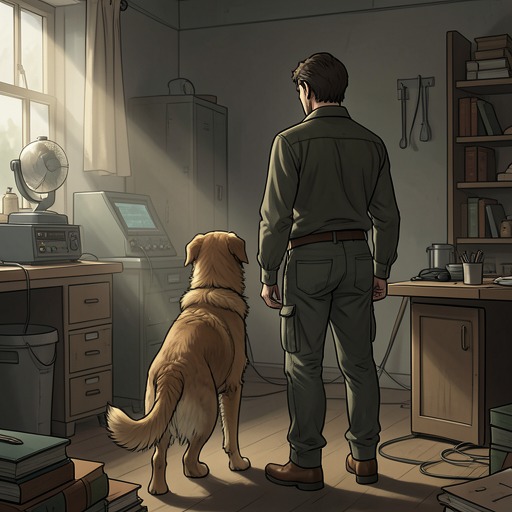
Enzo Stops Denny from Signing the Custody Settlement
The Art of Racing in the RainEnzo stops Denny from signing a custody settlement at the moment when legal pressure and exhaustion have made surrender seem practical. With Denny’s signature poised over the papers, the aging dog takes them away, escapes with them into the backyard, and finally marks them so they cannot be treated as an ordinary agreement. The intervention changes the scene’s direction: Denny rejects the proposed terms and recommits himself to fighting for Zoë rather than accepting a compromise he experiences as giving her up.
The dispute behind the papers
The settlement attempt follows Eve’s death and a custody conflict that began when Maxwell and Trish said they wanted to raise Zoë. They presented their proposal as a plan for her welfare, citing their parenting experience, available time, financial resources, large home, and ability to provide for her education. Denny rejected their claim to custody, but the dispute became a lawsuit. The grandparents’ arguments therefore met both his refusal to give up his daughter and the practical advantages they believed they could offer.
The conflict also unfolded against Zoë’s clearly expressed wishes. When Denny discussed the possibility that she would stay with Maxwell and Trish, she acknowledged that her grandparents wanted her, too, but trusted that her father would not leave her there forever. Later, while living apart from Denny, she insisted that she wanted to return home to him and Enzo. Her request did not itself settle the legal question: Denny explained that lawyers and judges would decide where she lived. The gap between what Zoë wanted and what the adults and court could determine remained part of the pressure surrounding the agreement.
Denny had already accepted a limited visitation schedule: Zoë would be with him on alternate weekends, from Friday after school until Sunday after dinner, and on Wednesdays until before eight o’clock. The schedule represented a victory in the ongoing proceedings, but it did not give him the daily life with his daughter that she wanted. The settlement papers appeared in the aftermath of that painful limitation, not as a routine piece of paperwork detached from the family’s losses.
The proposed compromise
At Mike’s kitchen table, Denny sits with a cup of tea and a manila folder while Mike paces nearby; Tony is absent. Mike urges Denny to accept the agreement as the sensible choice. Its terms promise to end child-support payments, provide for Zoë to attend a private school on Mercer Island, and pay for her college education. On the criminal matter, the proposed resolution would be misdemeanor harassment and probation, with no sex offense on Denny’s record. These terms offer tangible relief and future provision for Zoë, while asking Denny to accept a custody arrangement he cannot bear.
Denny does not treat the offer as an easy calculation. He nods as Mike lays out the advantages, then asks for a pen. Even with it in hand, he hesitates over the documents. He describes his sense of the compromise to Mike as an enduring personal cost, not simply a financial exchange. The folder brings together pressures that have accumulated over time: the strain of the custody fight, the prospect of losing a larger place in Zoë’s life, and the appeal of ending at least some of the legal and financial burdens. His pause makes the signature an active choice rather than a formality.
Enzo’s intervention
Enzo recognizes the small sliding zebra on the pen as a reminder of the zebra motif associated with fear and destructive impulses. He interprets Denny’s approaching signature as an act of surrender that does not represent what Denny truly wants. The dog’s conclusion is specific to this choice: Denny would not willingly give up his daughter for a summer arrangement and relief from support payments. As Denny brings the pen toward the page, Enzo believes that the signature would let fear and exhaustion make the decision for him.
Although old, injured by a car, and reliant on pain medication, Enzo climbs onto Denny’s lap, takes hold of the papers, and gets them into his mouth. When Denny and Mike try to retrieve them, he evades them through the living room. The chase is slow, but Enzo applies a racing lesson Denny taught him: a race is not over until the checkered flag falls. He notices a partly open window with a screen, lunges through it, and reaches the porch before moving into the backyard. Mike and Denny follow but pause, surprised by what Enzo has managed despite his condition.
When Denny warns him, Enzo makes one more deliberate gesture: he marks the papers. The act makes the refusal unmistakable, and its absurdity breaks the tension; Denny and Mike laugh together, with Denny laughing harder than Enzo has seen in years. The comic release does not make the custody stakes trivial. It gives the men a moment in which Enzo’s physical protest communicates what he cannot say, interrupting the momentum toward a signature.
Denny’s decision and the action’s significance
Mike suggests that Mark Fein could print the papers again for Denny to sign. Denny refuses. He rejects the settlement along with the reasoning that it is the smart option, insists that he did nothing wrong, and resolves not to give up. He frames the custody fight as a race he will continue even if he runs out of fuel on the last lap, connecting his decision to the racing principles that have shaped his outlook. Most importantly, he says he promised Zoë he would not quit.
The action turns on the difference between an offer’s practical benefits and its emotional and parental cost. The agreement could ease financial pressure and limit the consequences of the criminal case, but Denny sees signing it as surrendering his daughter. Enzo cannot decide the legal dispute or guarantee its outcome. His interruption instead prevents this particular decision from being made in a moment of depletion, and gives Denny time to return to the commitment that has sustained his resistance. Afterward, Denny bathes Enzo and turns on one of their racing videotapes, restoring a familiar shared routine as the fight continues.