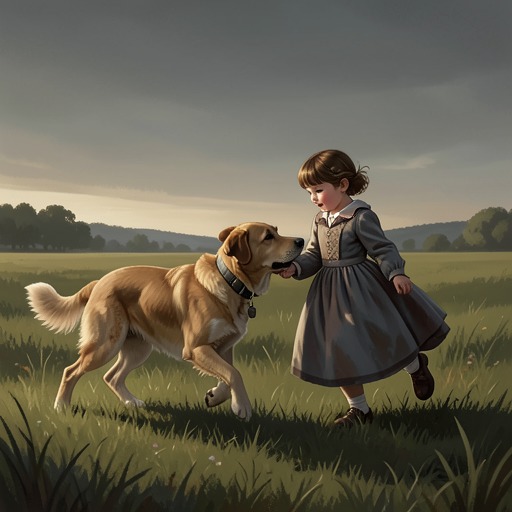
Enzo and Zoë
The Art of Racing in the RainEnzo and Zoë’s relationship grows from an obligation Enzo first feels before she is born into a lived companionship built through play, daily care, and trust. He cannot protect her from every loss or separation, but he becomes a steady presence in her childhood, and she recognizes him as part of the home and family she wants to return to.
A Promise Before Zoë’s Birth
While Eve is grieving Denny’s absence, she asks him to promise that he will always protect the baby she is carrying. Enzo understands that Eve is speaking to Denny, not to him, and that he is only Denny’s surrogate. Still, the request gives shape to a role he has long wanted: although he cannot interact with people as fully as he wishes, he can comfort Eve and protect her child. He regards this moment as a beginning, not as proof that he can fulfill every part of the promise.
When Denny returns from Daytona, holding his newborn daughter changes his unhappy mood. The baby is named Zoë, after Eve’s grandmother, not after Enzo. Enzo nevertheless makes the promise his own: he will always protect her. The distinction matters to the bond’s beginning. Zoë’s name and human family history are her own, while Enzo’s sense of responsibility comes from what he has heard and chosen to carry forward.
Play as a Shared Language
After Zoë’s birth, Denny and Eve both return to work, and Zoë spends her days at daycare. Enzo is left alone in the apartment for long stretches, a sharp contrast with the busy first months when he was included in family play. During one of those earlier games, Eve and Denny toss a ball of socks across the living room while Zoë watches from her bouncy seat. Enzo chases the socks, bats the ball into the air with his nose, and makes Zoë squeal and kick so vigorously that her seat scoots across the floor. The play ends with the family laughing together; Enzo is not merely nearby but an active participant in Zoë’s delight.
He later imagines continuing that companionship through a game he invents and Zoë names Enno-Fetch. An adult rolls or throws a sock ball or one of her toys, and Enzo pushes it back with his nose so she can laugh and the game can begin again. The invented routine gives their relationship a recognizable rhythm: Zoë initiates the fun with help, Enzo returns the object, and both respond to the other. When the adults’ work schedules leave him alone, this memory of shared play makes the absence keenly felt.
The bond also survives a moment when Zoë is hurt and afraid. After a fight in the household, she stands crying in the hallway, worried about her animals. Enzo approaches her carefully among the wreckage of the fantasy world she had shared with him. He knows her role-playing well enough to understand that it expressed how she saw herself and her place in the family. He lowers himself and rests his nose beside her thigh, raising his eyebrows as a tentative appeal for forgiveness. Zoë eventually lays a hand on his head. She does not yet scratch him, and the hurt has not vanished, but the touch signals that she forgives him while still needing time.
Care Through Eve’s Illness
As Eve’s illness changes the household, the practical work of caring for Zoë falls increasingly to Denny. He cuts back his hours, takes her to preschool, teaches her numbers and letters, and assumes the shopping, cooking, and cleaning. He cannot also give Eve the same playful, physically affectionate attention that Enzo remembers. Instead, he entrusts part of that care to Enzo, asking him to stay with her while he takes Zoë out so she will not hear her mother’s cries. Enzo curls up beside Eve’s bed, or beside her when she collapses on the floor, and she sometimes holds him close and tells him about her pain.
The family’s weeks in the hospital bring another change in Zoë and Enzo’s shared life. Denny imposes a strict daily routine: Zoë eats breakfast at home, goes to summer camp, returns for dinner, and visits Eve at the hospital before Denny bathes her and reads her a story. Enzo receives less attention, takes fewer walks, and no longer goes to the dog park. He accepts this reduction in their usual companionship as part of protecting Eve and preserving the family’s care for her. His promise to protect Zoë does not mean that he can keep family life unchanged; it means remaining part of it as its demands shift.
Separation and Zoë’s Own Choice
When Eve is ill, Denny asks Zoë to stay with Maxwell and Trish. He explains that he will visit every day, spend weekends with her, and sometimes have her stay with him, while Eve wants Zoë to be with her grandparents. Zoë understands that Maxwell and Trish want her too, and reassures her father that he will not leave her there forever. The exchange makes her separation from Denny—and from Enzo—an explicit and painful arrangement rather than a disappearance of their bond.
Their companionship resumes in physical play when Zoë is back with Denny. She dresses in her pink ballet clothes and puts the bumblebee wings she wore the previous Halloween on Enzo. Together they run around the backyard until her feet are stained with dirt, then dance, laugh, and pretend to be angels. The scene recalls the earlier sock-ball games, but now Zoë directs their shared make-believe more fully: she chooses the costumes and the play, and Enzo joins her. Their relationship is expressed not through explanation but through her willingness to bring him into her invented world.
After Eve’s death, Zoë’s wishes become especially clear. She tells Denny that she does not want to remain with her grandparents and wants to live with him and Enzo. Denny explains that lawyers and judges must decide where she will live; the decision is no longer simply a family arrangement. Zoë presses him to tell them she is coming home. When Denny explains that someone has accused him of doing something bad, she asks whether the accusation came from Maxwell and Trish, showing that she is actively trying to understand the conflict rather than standing outside it. Her appeals treat Enzo as part of the home she has lost and hopes to regain.
Memory, Grief, and Continuing Presence
Enzo’s bond with Zoë is also held in shared memory. After Eve’s death, Denny watches an old video of Eve, Zoë, and Enzo at Long Beach, from when Zoë was a toddler. Enzo remembers them chasing kites on the beach, unaware that they would ever be separated. The video makes their earlier life visible again—not as a promise that it can be restored, but as evidence of a family in which Enzo and Zoë belonged together.
As Enzo’s own life nears its end, his attention remains fixed on Denny and Zoë. He would rather stay with them in the apartment, watching people in the street below, than leave Denny to miss him. That wish gives the original promise a final, reciprocal shape: Enzo has spent his life wanting to protect Zoë and remain beside her, while she has named him as someone with whom she wants to live. Their relationship is neither only guardian and child nor only dog and playmate. It is a durable companionship whose meaning is clearest in the repeated acts of staying, playing, comforting, and wanting to return to one another.