Enzo’s old age and declining health
The Art of Racing in the RainEnzo’s old age and declining health turn the novel’s concern with a dog’s inner life into a concrete question of bodily limits: pain and failing mobility increasingly govern what he can do, while his care for Denny shapes how he faces what comes next. The decline is neither a single diagnosis nor a sudden event. It emerges through discomfort, an inability to rise, repeated veterinary visits, and Enzo’s growing insistence that prolonging his life is not the same as helping him.
Identity and Bodily Decline
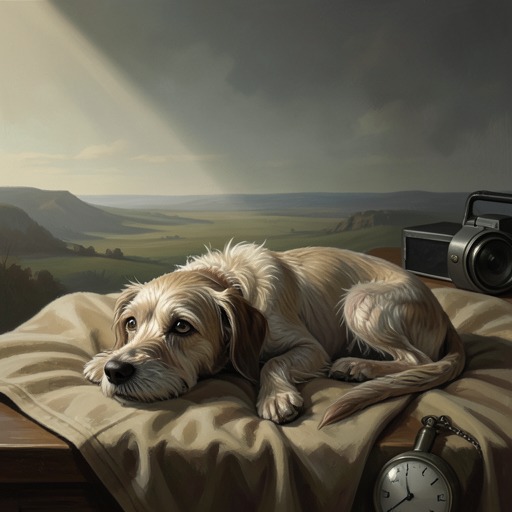
Enzo identifies himself as old, but the condition is more than a number of years. His hips hurt, his vision is clouded by cataracts, and he imagines a future in which pain medication and steroids merely reduce joint swelling while his body continues to deteriorate. He pictures the practical indignities that might accompany further loss of function, including Doggie Depends and a wagon that would support his hindquarters. These are fears about what could happen, not a record that Denny actually used those aids. Enzo recognizes that Denny would consider such care an expression of love; what troubles him is the prospect of being kept alive after his body has become, in his view, a humiliating shell.
The narrative makes the decline immediate through a failure Enzo does not expect. When Denny asks whether he can get up, Enzo tries, scrambles, and panics: he had thought he was only pretending, but discovers that he truly cannot rise. His rueful description, “Life imitating art,” captures the sudden crossing between a gesture meant to communicate and a physical incapacity that cannot be willed away. The moment distinguishes performance from bodily fact without diminishing either: Enzo’s intentions matter, but his body has acquired limits that intention cannot reverse.
Care and the Changing Routine
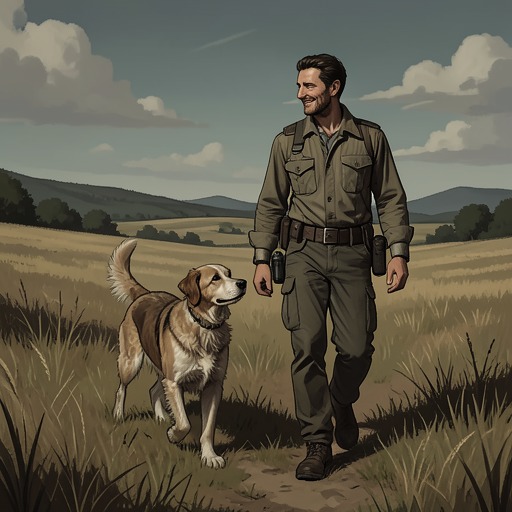
Enzo’s condition alters ordinary routines around the apartment. After Denny centers his weight over his legs and Enzo can stand, Enzo rubs his muzzle against Denny’s thigh to show him that he is all right. Denny answers, “There’s my Enzo.” The small exchange makes care reciprocal: Denny steadies Enzo physically, and Enzo responds with a gesture that reassures his owner. Yet the successful recovery does not erase the underlying problem. On their brief walk down the block and back, Enzo’s hips hurt so much that Denny notices. Denny knows enough to see that the difficulty is not a passing inconvenience.
Their evening also shows how the household accommodates Enzo’s limits without turning them into an abstraction. Back inside, Denny gives him bedtime cookies, and Enzo settles into his bed on the floor beside Denny’s. Denny then phones Mike, his friend from the shop, to ask him to cover the next day so that he can take Enzo to the veterinarian again. The request makes the cost of care concrete: Enzo’s needs reshape Denny’s work schedule, and Denny responds by making time for another appointment.
The visits have become frequent because the veterinarian has been trying different medicines intended to make Enzo more comfortable. Enzo’s assessment is blunt: they do not really help. The account therefore separates the fact of treatment from its desired result. Medication and veterinary attention are present, but neither is presented as a cure or as a restoration of Enzo’s former ease. His declining health is experienced through the gap between efforts to relieve discomfort and the persistence of that discomfort.
Communication and the Decision Ahead
Enzo’s account of illness is inseparable from the problem of being understood. He says that “Gestures are all that I have”; his long, flat tongue is poorly suited to the complex sounds of speech, so he relies on actions that may have to be deliberately emphatic. The opening image of him waiting for Denny on the kitchen tiles in a puddle of urine gives that limitation a stark physical form. His body is not simply failing in private: it becomes part of the message he is trying to convey. The episode in which he cannot get up sharpens the uncertainty, because a gesture can be mistaken for acting until physical incapacity confirms what it signifies.
Enzo also interprets age through a belief about what follows a dog’s life. A television documentary about Mongolia persuades him that, once a dog has finished living his lifetimes as a dog, the next incarnation will be as a man. He has long felt almost human and regards the soul as more important than the dog’s body that contains it. This belief does not remove the pain or establish what will happen to him; it gives the prospect of death a meaning within Enzo’s own understanding. His resistance is directed particularly at being kept alive as his body deteriorates, not at the conviction that his existence has significance.
Denny’s Recognition and Enzo’s Plan
Denny’s response moves from observation to action. He sees Enzo struggling on the walk, arranges time away from work for another veterinary visit, and tells Mike that he is unsure whether the trip will be a round trip. The line marks a change in the conversation from ongoing treatment toward the possibility that Enzo may not return. Denny’s voice becomes rough as he says it, conveying the strain of acknowledging that possibility without turning it into a settled outcome.
Enzo, meanwhile, says that he has set the Master Plan in motion. The evidence presents this as his intention at a moment when medicines are failing to make him comfortable and the prospect of further deterioration weighs heavily; it does not yet explain the plan’s full contents or establish its eventual outcome. That withheld detail matters. Enzo is trying to communicate a decision in a relationship where he cannot rely on words, while Denny must interpret the gestures and circumstances before them. The old age described here is therefore both a physical decline and a narrowing interval in which care, understanding, and the question of how long to continue become inseparable.