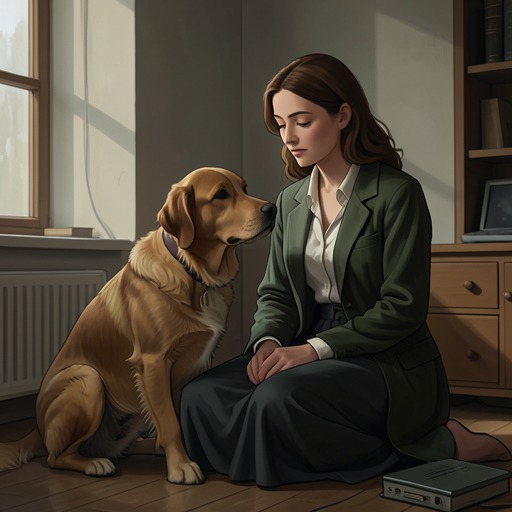
Eve’s Brain Tumor Diagnosis and Surgery
The Art of Racing in the RainEve’s Brain Tumor Diagnosis and Surgery marks the point when an illness that had surfaced in scattered, bewildering episodes becomes an unmistakable family emergency. The diagnosis and treatment are largely withheld from Enzo, who narrates the events from outside the hospital; what he can witness is the disruption of ordinary life, Denny’s efforts to care for both Eve and Zoë, and Eve’s startlingly altered return home. The gaps in Enzo’s knowledge are part of the event’s meaning: he senses danger early, but cannot make himself heard, while the clinical explanation arrives through fragments of human conversation and visible consequences.
Symptoms and an Unheard Warning
Before the family knows what is wrong, Enzo detects a foul, decaying smell near Eve’s head when she leans down to feed him. He interprets it as evidence that something is wrong inside her head. His perception is not a medical diagnosis, and he understands that he has no means to tell Denny or Eve what he has noticed. The irony is painful: Enzo believes his nose has recognized the disease before the machines do, yet his inability to speak leaves him watching without being able to warn them.
Eve’s symptoms are unpredictable rather than steadily progressive. Crushing headaches may give way to debilitating nausea; dizziness and dark moods appear on other days, with periods of relief—sometimes lasting days or weeks—between attacks. When a severe episode interrupts her day at work, Denny is called to help. He drives her home, asks a friend to follow in her car, and spends the rest of the day watching helplessly. Because the episodes recede, hope repeatedly returns, and the family has no clear pattern by which to understand what is happening.
The mismatch between Eve’s suffering and Denny’s attempts to solve it becomes another strain. He urges her to see a doctor and seek medication, while Eve fears that medication will mask pain rather than resolve its cause. Enzo understands her complaint as an account of pain that cannot be reduced to its outward symptoms, though he also recognizes Denny’s frustration at being unable to help. When the possibility of an operation enters the family’s conversation, Denny tells Mike that the doctors may skip a biopsy and remove the mass because it is already causing headaches, nausea, and mood swings. He insists on distinguishing a mass from a tumor until testing establishes what it is, a small but telling sign of how carefully he tries to hold to what is known while facing what is feared.
Hospitalization and the Family’s New Routine
Eve remains in the hospital for weeks. Enzo cannot enter or hear the hushed medical conversations, and no one explains the diagnosis, prognosis, or analysis to him. His account therefore does not supply the doctors’ detailed reasoning or the precise mechanics of the surgery. Instead, the hospital’s importance is measured in its absence from his view and in the changes it imposes on everyone else.
With Eve hospitalized, Denny has to care for Zoë and Enzo while visiting whenever he can. He replaces the family’s former spontaneity with a fixed schedule. Zoë eats cereal while Denny prepares a sack lunch: a peanut-butter-and-banana sandwich on whole-grain bread, potato chips, cookies, and a small bottle of water. He takes her to summer camp, works, collects her afterward, cooks dinner, feeds Enzo, and then brings Zoë to visit Eve. At home he bathes Zoë, reads to her, and puts her to bed before turning to bills and disputes with the health-insurance company over costs and payment schedules. Weekends are largely spent at the hospital.
The routine is efficient, but its efficiency records a loss. Restaurant meals and breakfasts at a coffee shop disappear; Enzo’s walks become infrequent and trips to the dog park stop. Denny and Zoë have little attention left for him, and Enzo decides not to demand any. He accepts the neglect as a sacrifice that might protect Eve and preserve the family’s sense of togetherness. After two weeks, Maxwell and Trish offer to take Zoë for a weekend so Denny can rest. He agrees, though Enzo senses his reluctance as Denny packs her overnight bag. The care crisis has made even a brief separation from Zoë feel strange.
Eve’s Return and the Prognosis
Eve’s discharge does not restore the family to its former life. A few days after Denny tells Zoë that her mother will stay with her grandparents for a while, the three of them go to Maxwell and Trish’s house. A hospital bed has been installed in the living room, with a remote-controlled frame and a clipboard at its foot; a nurse is there to care for Eve. The nurse and Maxwell initially send Enzo into the backyard, but Zoë comes to him, and the two play while they wait for Eve to arrive.
When Eve is brought inside, Enzo at first fails to recognize her as the person being wheeled toward the bed. Her head is covered by a stocking cap, her cheeks are sunken, and her skin is sallow. She lifts her head and looks around. The familiar homecoming the family had anticipated is therefore inseparable from the shock of seeing how ill she has become. Eve makes a joke about feeling like a Christmas tree as everyone gathers around her, but the uneasy laughter that follows cannot erase the visible evidence of her condition.
The family’s conversation also reveals the gravity of the prognosis. Denny objects when Trish speaks as though Eve’s future has already been decided, insisting that no one can know what will happen. Maxwell answers that the doctor has been definite: Eve has six to eight months. Trish’s whispered grief for her daughter gives the estimate its human weight. The event thus changes the family’s understanding not only of Eve’s symptoms but of the time they may have left with her.
Aftermath and Narrative Significance
The illness continues to shape family life beyond the hospital and the immediate recovery period. In February, Denny takes Zoë and Enzo to the Methow Valley, while Eve is too weak to travel and her parents remain behind with her. The trip is organized around Eve’s wish that Zoë spend time with relatives, because, as others say, Eve may die soon. Enzo objects to the reasoning he overhears: the prospect of death has turned a family visit into preparation for loss. The snowy outing, with its group meals, horseback riding, sledding, and snowshoeing, places Zoë among relatives while making Eve’s absence newly conspicuous.
The event is also structured around competing kinds of knowledge. Eve lives the symptoms; Denny tries to manage their consequences; doctors supply a diagnosis and prognosis that Enzo cannot hear directly; and Enzo offers an animal’s perception of danger that no one can understand. His limitations do not give him complete knowledge: he cannot inspect the medical evidence or explain what he smells. But his position makes the family’s silence visible. He is expected to protect Zoë, yet he cannot protect Eve or even tell the humans what he believes he has detected. The diagnosis and surgery therefore mark both a medical turning point and a painful narrowing of Enzo’s role—from a witness who senses that something is wrong to a companion who can only remain present as the family reorganizes itself around Eve’s illness.