Eve’s terminal brain cancer
The Art of Racing in the RainEve’s terminal brain cancer is the illness Enzo senses before the family can name it, a disease whose uncertain course gradually rearranges the lives of Eve, Denny, and Zoë. Its progression is marked less by a steady decline than by recurring, disruptive episodes and intervals of hope; after Eve dies, the loss becomes the beginning of a new struggle for Denny and his daughter.
Early Signs and Enzo’s Perception
Before the family’s machines identify a disease, Enzo detects an unfamiliar odor near Eve’s head when she bends to feed him. He understands it as evidence that something is wrong inside her head. He cannot warn Eve or Denny, however, and his inability to speak leaves him watching without a way to intervene. The episode establishes a painful limit in his role as the household’s watchful companion: he believes he recognizes the danger, but cannot make that knowledge understood.
The book distinguishes Enzo’s perception from a clinical diagnosis. His early certainty comes through smell and instinct, while the family later depends on medical equipment to identify the illness. Enzo views those methods as belated and symptom-driven; that judgment belongs to his narration, not to an independent medical assessment. The contrast nonetheless shapes the illness’s emotional meaning: he senses a threat before the humans around him have a name for it, yet his insight cannot alter what happens.
Symptoms and Uncertain Course
Eve’s condition is described as elusive and unpredictable. Episodes vary: a crushing headache, debilitating nausea, or dizziness followed by a dark mood. They do not occur in a dependable sequence. Days, and sometimes weeks, of relief separate them, allowing ordinary life and hope to return before another episode disrupts both.
When Denny receives a call at work, he goes to help Eve, drives her home, and asks a friend to follow in her car. He then spends the rest of the day watching over her, unable to control the illness. His response is practical and devoted, but the recurrence of the episodes makes care feel provisional: each interval of improvement may be followed by another crisis.
Eve is wary that medical treatment will mask her pain rather than resolve its cause, and she doubts that a doctor will be able to help. Denny urges her to seek medical care and medication, but he does not understand her objections as Enzo does. In Enzo’s account, the disagreement reflects their different ways of confronting suffering: Denny reaches for an intervention, while Eve fears that a diagnosis and treatment will explain or suppress symptoms without changing the underlying condition. The narrative presents this as a conflict in understanding and hope, not as proof that medical care could not help her.
Separation and the Final Months
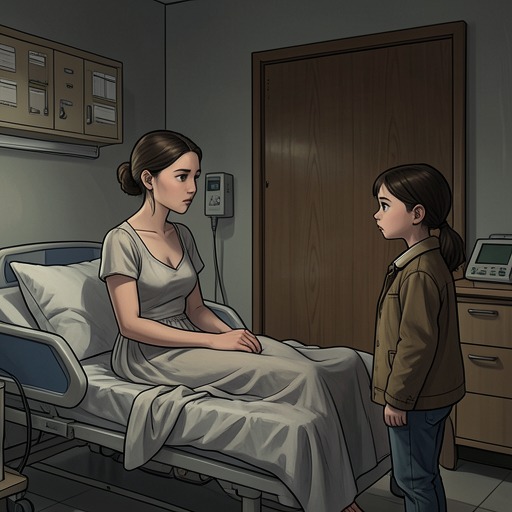
As Eve’s illness advances, Denny tells Zoë that her mother will stay with her grandparents for a while, until she feels better. He breaks off before explaining why the arrangement will be easier, leaving the child with only a partial explanation. A few days later, Denny brings Zoë and Enzo to Maxwell and Trish’s home. A hospital bed has been set up in the living room, with a nurse in attendance. Enzo is sent into the backyard, but Zoë comes to him and reassures him that Eve is coming. The household’s change is concrete: Eve’s care now occupies a specially equipped bed at her parents’ home, while Zoë and Denny adjust to being apart from her.
The time that follows is measured in months rather than a clear medical timetable. Six months pass, then seven and eight, and Eve is still alive. On May 1, Denny and Enzo attend an unusual Monday dinner at the grandparents’ home. The hospital bed is empty, and Eve is absent. Zoë is alone in her larger room, surrounded by dolls and toys, and does not notice Enzo when he enters. His attempt to invite her to play goes unanswered. The quiet scene conveys how illness has altered the family’s routines without explaining Eve’s immediate condition.
Death and Its Consequences
That night, Eve dies. Enzo recounts seeing her soul leave her body in a dream, presenting her death through his spiritual understanding of release and continued journey. The account is his perception rather than a clinical description. In his interpretation, death ends Eve’s painful battle and frees her from bodily need; for Denny, it begins another ordeal.
The illness’s consequences extend beyond Eve’s death. Denny’s grief is followed by a custody conflict with Eve’s parents over Zoë. He is confronted with accusations, expensive legal opposition, months without contact with his daughter, and restrictions that affect his ability to earn money. The narrative places these pressures in the aftermath of bereavement: Eve’s death does not close the family’s crisis but changes its form, from the struggle against illness to Denny’s struggle to remain Zoë’s father.
The loss also persists through memory. Years later, Denny watches a video of Eve, Zoë, and Enzo on the Washington coast, recalling a weekend of kite-chasing before they knew they would be separated. The film holds an image of family life that the illness and its aftermath have made irrecoverable, while allowing Denny and Enzo to return to it together. In this way, Eve’s cancer is not only a fatal disease in the plot; its long, uneven course changes the family’s living arrangements, separates its members, and continues to shape the bonds and conflicts left behind.