Gestures as Enzo's Only Means of Expression
The Art of Racing in the RainGestures are Enzo’s only means of expression, a recurring limit that shapes how he cares for Denny and Eve and how the novel makes his inner life visible. His movements and silences can sometimes be understood by those closest to him, but they cannot replace speech: he can sense danger and distress without reliably making anyone act on what he knows. The distance between intention and reception gives his physical actions their force, and their cost.
Expression Without Speech
Enzo’s inability to speak is not presented as an absence of thought. He reflects on what he would say and do if he had a human body and voice, even imagining that he could take hold of Denny and comfort him. But imagining a response is not the same as delivering one. Enzo can look at Denny, remain beside him, or act with his body; he cannot make his intended words audible. His repeated recognition that gestures are all he has names both an expressive resource and a barrier.
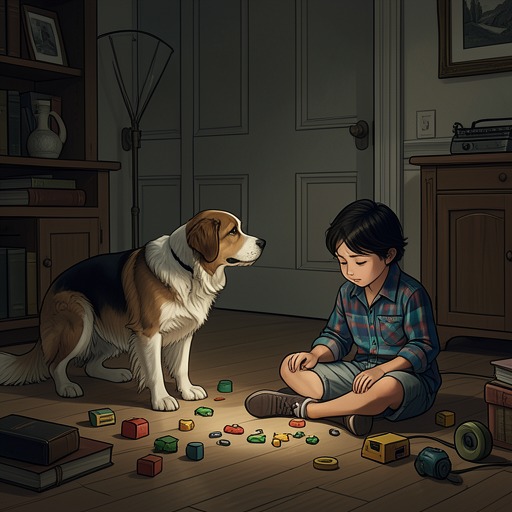
That distinction becomes especially clear when Denny is overwhelmed by his circumstances. Denny says he has tried and has nothing left, and Enzo wishes he could reassure him that the crisis is temporary and that new possibilities remain. The desired message depends on speech: Enzo wants to explain, encourage, and remind Denny of the lessons Denny himself taught him. Instead, Enzo can only look at him. Denny calls Enzo his witness, but Enzo cannot tell him that he is witnessing. The scene makes their closeness real while showing its limit: Enzo understands the emotional stakes, yet Denny cannot hear the response Enzo wants to give.
Sensing What Cannot Be Said
The novel extends Enzo’s communicative problem beyond speech by giving him sensory knowledge that he cannot translate into a warning. While Eve feeds him, he detects an unusual odor that he associates with something wrong inside her head. He believes his nose recognizes the disease before the medical equipment does, but he has no way to tell Eve or Denny what he has sensed. His concern therefore remains private, and his awareness does not become useful information for the people he wants to protect.
This episode sharpens the difference between perceiving and communicating. Enzo believes he has identified a danger, but his knowledge is available to the humans only if they can interpret his behavior—and nothing in the scene gives him a gesture capable of conveying that particular diagnosis. His inability to speak is thus more than a frustration in moments of comfort. It prevents him from turning care into an intelligible warning. The story grants him an unusually rich account of what he notices while keeping the practical consequences of that knowledge constrained by his position as a dog.
Enzo also describes reading human tension through bodily cues he can sense from the kitchen floor, even when he cannot see the people involved. During a conversation about Denny’s time away for racing, he senses Eve’s fear, anger, and anxiety and interprets them as physical responses rather than deliberate performances. This perception helps him understand the atmosphere of a scene, but it does not give him control over it. He can register tension without intervening in the conversation or explaining what he has detected. The contrast recurs throughout the novel: his access to feeling is intimate, while his ability to communicate about it remains uncertain.
Grief as Action
When Eve is absent, Enzo’s grief takes a form that is physical and difficult to reconcile with his usual effort to live by human standards. At a dog park, he leaves the path and runs into the untamed part of the grounds, describing a need to feel and act as an animal again. He kills and eats a squirrel. The episode is not a composed message for another character; Enzo understands it as an act he performs because he misses Eve and cannot bear his grief in the same way a human does.
Afterward, Enzo sleeps in the bushes. Denny finds him, says nothing, and leads him back to the car. The silence between them matters: the scene does not establish that Denny understands the meaning Enzo gives the act. Enzo’s behavior expresses a rupture in his effort to remain aligned with human life, but its meaning is clearest to Enzo himself. Here gesture is not a neat substitute for spoken language. It is an embodied response whose emotional cause the narrative can disclose to readers even when it is not stated between the characters.
Recognition and Intervention
At another low point, Enzo’s presence beside Denny becomes a form of support that Denny appears to recognize. Denny says he has put the alcohol away and is better than that. Enzo concludes that Denny has understood his point. The exchange gives gesture an effect that the earlier scenes often deny it: Denny’s choice changes, and Enzo reads that choice as evidence that his effort to reach him mattered. The account does not specify a single gesture that caused the decision, so the significance lies in the relationship between Enzo’s continuing presence and Denny’s response, not in an invented signal.
The scene continues with Denny watching an old video of Eve, Zoë, and Enzo at Long Beach. Enzo joins him on the couch and watches the family footage. His companionship is quiet and concrete: he sits beside Denny while images recall a time before the family was separated. Denny then speaks about how a race may be lost at its first corner. The memory and the racing principle give the moment a shared language, but Enzo’s part in it remains physical presence rather than verbal reply. His ability to accompany Denny does not erase what has been lost; it makes the bond perceptible within that loss.
Enzo’s most decisive gesture comes when Denny warns him during a tense encounter over papers. Enzo lifts his hind leg and urinates on them. The others laugh, and Denny laughs harder than Enzo has seen him laugh in years before telling him that it is all right. The action interrupts the strain and produces a response that Enzo can observe. Unlike the warning he cannot give Eve or the consolation Denny cannot hear, this gesture changes the immediate atmosphere. Its bodily directness makes it unmistakable as an action, even if its precise intended meaning is not stated.
Meaning and Limits
Across these episodes, gestures do not form a dependable private language with fixed translations. A look may be all Enzo can offer when he longs to speak; his behavior in grief may be meaningful to him without being decoded by Denny; and a physical interruption may draw laughter and recognition. The results differ because expression depends not only on what Enzo intends, but on what other people notice and how they respond.
The concept also shapes the novel’s narrative form. Readers receive Enzo’s thoughts in detail, including words he imagines saying but cannot utter within the events themselves. That arrangement creates an asymmetry: the reader can understand the dog’s account of his motives while the human characters encounter his outward behavior. Enzo is not merely a silent witness to human life; he interprets, loves, worries, and tries to intervene. Yet the gap between that inner experience and its outward signs remains consequential. Gestures are all he has, and sometimes they are enough to reach Denny—but they cannot make every truth, fear, or act of care understood.