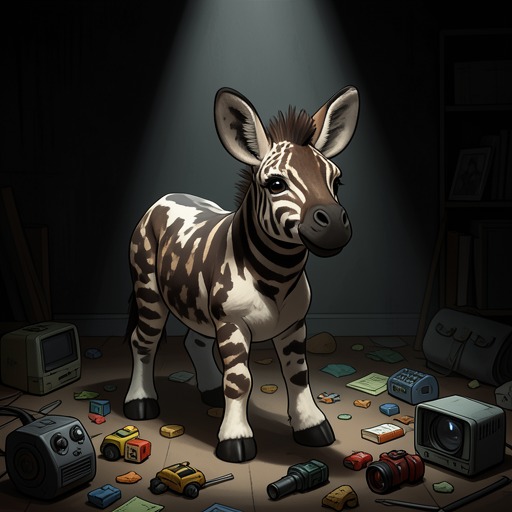
Replacement zebra toy
The Art of Racing in the RainThe Replacement zebra toy is a stuffed animal Zoë places beside Enzo after he has been separated from the family. Its importance comes less from any action it demonstrably takes than from what Enzo believes it can do: he connects it to an earlier, frightening episode and treats its silent presence as the return of a demon. Later, a sliding zebra on a souvenir pen helps reframe the recurring image as an emblem of fear and self-destructive impulses. The toy therefore sits at the junction of Zoë’s ordinary act of care, Enzo’s limited and imaginative understanding, and the story’s larger pattern of turning a familiar object into a source of dread.
Identity and Background
The Replacement zebra is not the original stuffed zebra that Enzo remembers from Zoë’s earlier childhood. That first toy had been sent by Denny’s parents and was one of Zoë’s favorites. During a period when Enzo was alone at home, he thought he saw it moving; later, after Denny found Zoë’s room in disarray, Enzo attributed the damage to the zebra. The account does not establish that the toy actually moved or caused the damage. Enzo himself suspects that hunger and isolation may have made him hallucinate, yet the episode remains vivid in his memory.
The replacement enters the story as a substitute Zoë has chosen for the earlier toy. The text does not give the circumstances of its purchase or explain how long she has owned it. What matters in the scene is the association it inherits: to Zoë it belongs among the stuffed animals she loves, while to Enzo it recalls a past experience he has interpreted as a threat. Its ordinary identity and Enzo’s fearful account of it coexist without the narration confirming that the toy has independent agency.
Zoë’s Gesture of Care
On a Friday, Mike brings Enzo to Zoë, who takes him to her room and plays dress-up with him. That evening, Maxwell takes Enzo outside before he is led to the room, where his bed has been placed because Zoë has asked to sleep with him. The changed sleeping arrangement makes the scene one of companionship: Enzo is no longer expected to rest alone by the back door or in the garage.
Later, with the lights dim, Zoë arranges piles of stuffed animals around his bed. She intends them to keep him company. The many toys form a protective enclosure around Enzo, who understands the gesture as an expression of affection and feels safe enough to fall asleep. The Replacement zebra is part of this collection, but its position changes the meaning of the arrangement for him. Rather than simply sharing Zoë’s comfort, it brings an old fear into the space she has made for his protection.
The Return of the Threat
When Enzo wakes again, the wall of toys is high around his bed. As he shifts position, he notices the zebra on top of the other animals, looking toward him. He recognizes it as the replacement for the toy he associates with the earlier episode and concludes that the demon has returned. In the dark, he believes he sees a glint in its eyes. The account gives these details as Enzo’s perception; it offers no independent confirmation that the stuffed animal is alive.
That distinction shapes the rest of the night. Enzo tries to stay awake because he fears waking amid another scene of destruction. Each time he opens his eyes, he finds the zebra in the same elevated position, watching over the other toys. The arrangement that Zoë made to reassure him consequently becomes, in his interpretation, a vigil maintained by a threatening presence. The toy does not need to move for its place above the bed to dominate his attention. Its stillness gives Enzo room to project the earlier episode onto it, and his anxiety continues into the following day as he anticipates nightfall.
Enzo’s Response
Enzo eventually returns cheerfully to Zoë’s room and settles among the stuffed animals. When Maxwell calls for Trish to clean up after Enzo, the dog looks toward the zebra and growls softly. He interprets the gesture as a warning the demon understands, and concludes that it will not trouble him that night or again. The narrative reports no observable reply from the toy: the change is in Enzo’s own stance toward it, from fearful vigilance to a claim of control.
The resolution is therefore deliberately limited. Enzo does not destroy or remove the Replacement zebra, and the text does not show Zoë changing her affection for it. Instead, he remains in the room she has prepared for him, with the feared object still among her toys. His response marks a small shift in how he meets the remembered threat, even as the story leaves open whether the earlier events were supernatural, imagined, or misunderstood.
Recurrence and Meaning
The zebra image returns later in a materially different form: a plastic zebra slides across a miniature savannah in a souvenir pen from Woodland Park Zoo. That pen is not the Replacement zebra toy, but its moving image prompts Enzo to reinterpret what the recurring zebra means. He concludes that the demon is not an external creature but an image of fear and the capacity for self-destruction. The later interpretation does not prove that the toy’s earlier appearances were real; instead, it makes the difference between a perceived outside threat and an inward struggle central to the motif.
The Replacement zebra thus works on two levels without ceasing to be a toy in the scene. For Zoë, it belongs to a child’s collection and forms part of an affectionate attempt to keep Enzo company. For Enzo, it carries the memory of an unexplained episode and becomes the focus of a night spent resisting sleep. Its later connection to the sliding zebra on the pen extends that private fear into a recurring image, while also encouraging readers to distinguish Enzo’s certainty from what the events establish. The toy’s significance lies in this unresolved gap between an object’s ordinary place in Zoë’s room and the frightening meaning Enzo assigns to it.