Stuffed zebra
The Art of Racing in the RainZoë’s Stuffed zebra is both a specific childhood toy and a recurring image through which the novel tests the limits of Enzo’s understanding. First treasured by Zoë, it becomes the apparent agent of a frightening episode that Enzo cannot explain, then returns in a souvenir pen as a figure for the destructive fears he recognizes within himself. Its changing meaning links a domestic object to the story’s larger uncertainty about what Enzo perceives and what he can know.
A Favorite Toy and a Rival
Denny’s parents sent the Stuffed zebra to Zoë. It was among her favorite possessions: she carried it around and slept with it, and the fabric beneath its velveteen head had worn into small grooves. Enzo regarded the toy as a rival for Zoë’s affection. That rivalry gives the later episode a personal charge, although it does not establish that Enzo’s account of the zebra’s actions is objectively true.
The toy’s presence in Zoë’s room also belongs to the ordinary pattern of family life that Enzo watches closely. He is protective of Zoë and careful not to frighten Eve, who worries that he might hurt the child when she runs. Enzo understands himself as unusually able to resist a dog’s chase instinct, but he has no way to explain that distinction to Eve. The toy, by contrast, is a familiar object in Zoë’s care: carried, slept with, and marked by use. Its transformation in Enzo’s account is unsettling precisely because it interrupts that domestic familiarity.
The Episode During Enzo’s Isolation
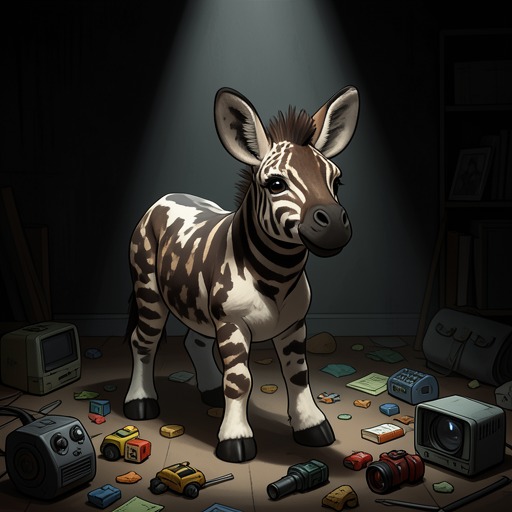
The apparent transformation occurs when Enzo has been alone in the house for days, rationing toilet water and scavenging crumbs. About forty hours into his solitude, after licking old yogurt from the legs of Zoë’s high chair, he thinks he hears something in her bedroom. He describes the Stuffed zebra as moving by itself. The circumstances matter: Enzo himself considers that hunger may be causing hallucinations, even as he feels certain that what he saw was real. The account therefore gives readers both a vivid perception and the reason to question it.
In Enzo’s telling, the zebra performs a grotesque dance and turns its attention to Zoë’s other toys. He approaches it, but before he can act, it stops, stands upright, and tears apart its own seam, gradually reducing itself to fabric and stuffing. Enzo leaves the room shaken, hoping the episode was only a vision but believing that something terrible has happened. The toy’s self-dismantling makes the scene more than a simple story of a favorite possession coming to life: even within Enzo’s uncertain account, the apparent threat ends by destroying itself.
When Denny returns the following afternoon, Enzo is still anxious about the state of the house and the mess near the back door. Later, Denny drags him into Zoë’s room, where her dolls and animals have been torn apart, and angrily blames him. Enzo assumes that the zebra must have reassembled itself and caused the destruction after he left. This explanation is part of his interpretation, not a confirmed account of what happened. The contrast is consequential: Enzo believes he witnessed the toy’s menace, while Denny sees the wreckage and holds Enzo responsible. Eve intervenes when Denny strikes him and moves to protect him.
From Toy to Recurring Fear
The zebra does not disappear from Enzo’s thinking with the episode. As Eve’s health worsens, Enzo describes fear and suffering through a vocabulary of demons, ghosts, and other imagined presences, then insists that the zebra is real and still dancing somewhere. This recurrence keeps the toy’s meaning unresolved: it remains connected to the frightening room in Zoë’s childhood, but it also becomes a name for a threat Enzo cannot simply dismiss. The novel’s presentation preserves the gap between his certainty and the limits of his knowledge.
That gap is important to reading the scene. Enzo is observant about people and their surroundings, yet the narrative is restricted to his perspective. In his account of the trial, he acknowledges that he was not allowed in court and had to piece together events from Denny’s retelling and imagined scenes. That admission clarifies a broader feature of his narration: confidence and vividness do not always amount to direct knowledge. The Stuffed zebra episode likewise asks readers to attend to what Enzo sees, what he infers, and what remains unverified.
The Sliding Zebra and Its Meaning
Much later, Enzo recognizes a zebra on a Woodland Park Zoo Zebra-Slider Souvenir Pen. A small plastic savannah fills the pen’s top, and when Denny tips it, the miniature zebra slides across the scene. The toy’s return is not a literal reappearance of Zoë’s Stuffed zebra; it is a visual reminder that prompts Enzo to revise what the earlier image means. He understands the zebra not as an outside demon but as an expression of fear and self-destructive impulses within people.
This recognition changes the object’s place in the story without settling whether the bedroom episode was a hallucination. The childhood toy remains associated with a danger Enzo once located outside himself; the sliding figure helps him see that the danger can also name an inward struggle. The zebra’s recurrence therefore joins memory to interpretation. What first seemed to be a rival and then a supernatural menace becomes a portable image of the mind’s capacity to turn against itself.