That Which You Manifest Is Before You
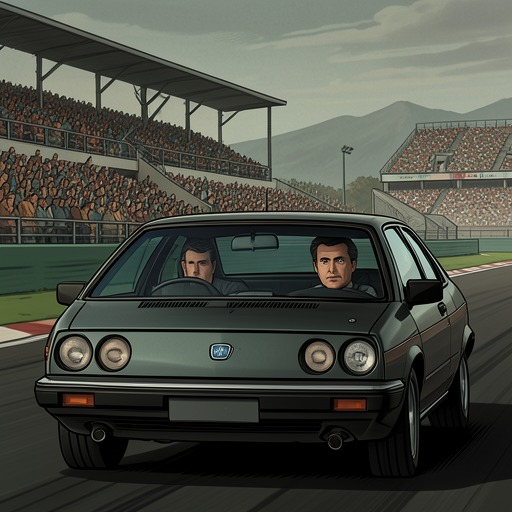
The Art of Racing in the RainThat Which You Manifest Is Before You is a principle Denny learns in the rain and Enzo carries from the track into the household: what a person directs attention and action toward shapes what comes next. Its racing lesson is practical, not magical. A driver cannot prevent every loss of grip, but can anticipate it, initiate a manageable movement, and look toward the open track rather than the wall. Enzo later applies that discipline to his own fear and distance from Eve, treating change in a relationship as something he must help bring about rather than merely endure.
Origin and Meaning
Denny recounts the phrase while he and Eve watch a race in heavy rain. At nineteen, at his first driving school at Sears Point, he and the other students were confused by the instructors’ explanations of wet-weather driving. A fast French student beside him, Gabriel Flouret, offered the saying, and Denny remembers that it made the lesson intelligible. The remembered exchange gives the rule a compact verbal form: instead of mastering a list of separate instructions, a driver can understand that what he brings into being lies ahead of him.
The phrase does not claim that a driver can dictate every circumstance. Rain continues to fall, the track remains dangerous, and a car can behave unpredictably. Denny says that water amplifies mistakes and can make a car handle in ways a driver does not expect; reacting only after the unexpected has happened may be too late. Fear, in that account, has a sound basis. The principle is not to deny danger but to change the driver’s relation to it: anticipate the risk and act before a sudden movement becomes an emergency.
Control Through Anticipation
Denny explains the mechanism by distinguishing an unanticipated slide from one he deliberately starts. If he intentionally makes the car move, he can predict the result; if he gets it a little loose himself, he knows the movement is coming and can correct it before the car spins on its own. His explanation makes manifestation a matter of timing and agency. The driver cannot wait passively for the car to reveal what it will do, then hope to catch up. He must participate in the movement early enough to respond while it remains recoverable.
The race on television demonstrates the point. Denny’s team stays on the track as the rain keeps coming, while other teams enter the hot pits to change to rain tires. The strategic choice is vindicated in the scene: Denny passes the other cars, his rear end steps out, and the car goes sideways. His hands are already turning to correct it. Rather than snapping into a full spin, the car recovers and he continues ahead. The principle is thus shown as practiced judgment, not just an aphorism: a risky movement becomes manageable because Denny has anticipated and met it.
Denny’s later opportunity in France echoes the same confidence under different conditions. During a Formula Renault testing program, a scout asks whether he can drive as fast in the dry as in the wet. Denny answers, “Try me.” He performs well enough to receive a tryout, and then a seat in an enduro at Watkins Glen. The episode does not establish that the saying alone caused his success; rather, its recurrence places his ability in the wet alongside the principle that first helped him understand rain driving. The words return as a concise frame for a talent tested under pressure.
From the Track to Relationships
The rule’s most personal extension belongs to Enzo. After watching Denny explain wet-weather driving, Enzo considers the idea’s broader claim that people help shape their own successes and failures. He turns that thought toward his relationship with Eve. He recognizes that he has resented her involvement in their lives and that she has sensed the resentment, protecting herself by remaining aloof. Even after their relationship changes with Zoë’s arrival, Enzo still perceives distance between them. The reflection makes the principle ethically demanding: it is not enough to identify another person as the source of discomfort when one’s own reserve helps sustain the separation.
Enzo describes Eve as his rain: the unpredictable element he fears. Racing, however, has taught him that fear of rain is not the same as having to surrender to it. He resolves to change his own mood and energy, and believes this allows Eve to regard him differently. The small domestic encounter that follows is modest but consequential to him: Eve calls him sweet and, as she moves around the kitchen, rubs his neck with her bare foot. Enzo understands the gesture as meaningful, while acknowledging that it does not make him master of his destiny. He has experienced only a glimpse of mastery and knows there is still work ahead. The rule therefore describes a beginning in the relationship, not a declaration that all distance has vanished.
Attention, Recurrence, and Significance
The book gives the principle a second racing formulation: “Your car goes where your eyes go.” A driver who cannot look away from the wall while spinning toward it will hit it; one who looks down the track as the tires lose grip has a chance to regain control. This version makes attention central. The driver’s gaze does not erase the skid, but it directs the response toward recovery instead of fixing on the danger. Enzo recognizes it as another way of expressing the same idea, and the phrase recurs as a refrain before the family goes hiking at Denny Creek.
There, the maxim sits beside a scene of ordinary happiness rather than a race. Zoë runs through the woods, while Denny’s success and Eve’s lightness belong to Enzo’s sense of what the family has to be grateful for. Enzo lets himself run wildly through the undergrowth, chase chipmunks, bark at jays, and roll among the fallen leaves and needles. The juxtaposition gives the racing rule a broader, embodied reach: attention and response are not only techniques for surviving a slide but part of how Enzo participates in the life around him. Its repeated movement—from Denny’s lesson, to Enzo’s self-examination, to the family’s shared world—makes the phrase a recurring interpretive key, while leaving its promise appropriately limited. It offers a way to act within uncertainty, not proof that uncertainty can be mastered completely.