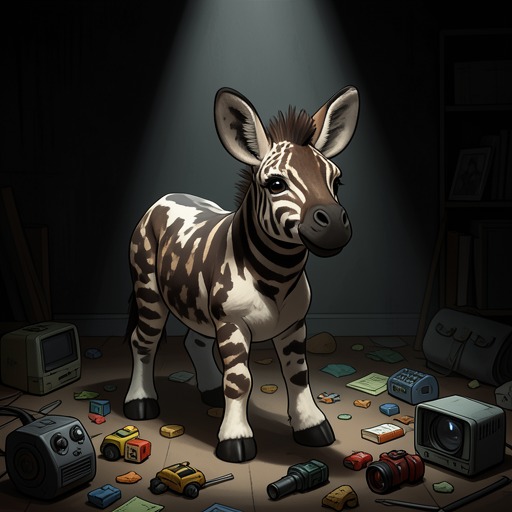
The Zebra: The Inner Demon
The Art of Racing in the RainThe Zebra: The Inner Demon is a recurring image in Enzo’s narration that changes from an apparently supernatural threat into a figure for fear and self-destructive judgment. Its significance lies in that reversal: what Enzo first treats as a creature outside himself eventually becomes a way to understand how terror can take hold within anyone, including Denny. The image returns at a decisive moment, when Enzo believes it is driving Denny toward a choice that would separate him from Zoë, and moves him to act despite his age and pain.
First Appearance and Uncertain Perception
Enzo’s first encounter with the zebra occurs during an extended period alone in the house. After roughly forty hours without company, he thinks he may be hallucinating. He has been licking remnants of yogurt from Zoë’s high chair when a sound from her bedroom draws him there. He sees one of her stuffed animals moving and identifies it as the zebra sent by Denny’s parents. The toy has particular weight in his imagination: Zoë has carried it around and slept with it, and Enzo regards it as a rival for her affection. In the strange scene he reports, the zebra moves among the toys in a disturbing, mocking fashion. The episode is presented through Enzo’s frightened perception, not as independent confirmation that the toy is alive.
That distinction matters when Denny later finds Zoë’s room in disarray. He blames Enzo, drags him into the room, and strikes him before Eve intervenes to protect him. Enzo interprets the disorder as evidence that the zebra has returned and caused the damage. His explanation reveals how completely the imagined menace has shaped his understanding, but it does not establish that the toy acted. The scene instead places two kinds of danger beside one another: Enzo’s frightening conviction and Denny’s anger, which has immediate consequences for the dog. The zebra is thus present first as an explanation Enzo supplies under stress, not as a fact the narration verifies.
Recurrence and the Limits of Enzo’s Account
The zebra reappears much later in a different arrangement. Zoë surrounds Enzo with her stuffed animals so that he will have company while he sleeps. When he wakes in the night, he notices the replacement zebra placed on top of the others. He recognizes it as the successor to the earlier toy and fears that the old menace has returned. Its elevated position, seeming gaze, and repeated presence whenever he opens his eyes keep him awake and anxious. The other animals remain toys in his account; the zebra alone appears to him to possess intention.
The recurrence makes the image feel persistent, but it also makes Enzo’s perspective central to its meaning. His account of other uncertain events is openly limited: he cannot attend Denny’s trial, and he acknowledges that his courtroom scenes are assembled from dreams, Denny’s later retelling, and what he has seen in films and television. That admission does not prove that every perception is mistaken. It does, however, ask readers to distinguish what Enzo observes from what he infers. His conviction that the zebra is a demon belongs to the latter category. The story allows the fear to feel real to him while leaving the toy’s supposed agency unconfirmed.
Recognition in the Souvenir Pen
The image’s meaning changes when Denny holds up a souvenir pen from Woodland Park Zoo. Its plastic top contains a small savannah, and when the pen is tipped, a zebra slides across it. The toy no longer appears in a bedroom at night or above a wall of stuffed animals: it is a small, ordinary moving figure. Yet this modest object prompts Enzo’s recognition that the zebra is not simply an external enemy. He understands it as a figure for fear and for the self-destructive part of a person that can surface in the worst circumstances. The earlier episodes are not erased; they are reread. What looked like a demon acting against Enzo can now be understood as an image through which he has represented distress and danger.
The pen’s movement then acquires immediate significance. Denny is preparing to sign papers concerning Zoë, and Enzo sees the little zebra slide toward the signature line. He interprets the impending decision not as Denny’s true wish but as fear steering him toward giving up time with his daughter and avoiding child-support payments. That interpretation is Enzo’s judgment, rather than independently established knowledge of Denny’s mind. Still, the scene makes clear why the recognition matters: if the zebra represents destructive fear, the threat is not confined to Enzo’s earlier visions. It may also describe the pressure surrounding Denny at a moment of family conflict.
Intervention and Narrative Significance
Enzo acts on that understanding physically. Though old and recently hit by a car, he gets onto Denny’s lap and takes the papers in his mouth. Denny commands him to drop them, but Enzo refuses. The gesture interrupts the signing and gives material form to the insight: Enzo cannot explain what he has realized, so he uses the action available to him to stop the decision as he understands it. The papers become a point of contact between his inward interpretation of the zebra and the family’s practical crisis.
Across these appearances, the zebra marks the gap between perception and knowledge. Enzo can be acutely attentive to what surrounds him, yet his fear can turn an ambiguous event into a story of a demon, and his account does not always distinguish certainty from supposition. The later recognition does not make him all-knowing; it revises his understanding of the image and supplies a new way to read the earlier terror. As a recurring motif, the zebra links childhood toys, Enzo’s anxious nights, and Denny’s custody-related decision. Its final importance is not that an actual monster has been defeated, but that Enzo sees how an inward danger can be mistaken for an outside one—and chooses to oppose what he believes that danger is doing.