Trish
The Art of Racing in the RainTrish is Eve’s mother and Zoë’s grandmother, and, alongside Maxwell, one of the adults whose care and judgment shape the family’s life during Eve’s illness and its aftermath. Her role changes from an insistent critic of Eve and Denny’s household to a claimant in the custody dispute over Zoë. The narrative gives that conflict more than one register: Trish argues for stability and material security, but also cries over Eve’s prognosis and acknowledges Denny’s loneliness.
Family Identity and Household
Trish and Maxwell are introduced as a strikingly coordinated pair whom Enzo calls the Twins. They wear matching clothes, from khaki pants or polyester slacks with sweaters or polo shirts to Bermuda shorts and tall socks. Their habits extend even to sunglasses: when one wears them, so does the other. Their hair has the same artificial color, and Enzo associates their presence with the smell of plastics and petroleum-based hair products. The comic precision of this portrait makes them seem like a unit before their disagreements with Denny come into focus.
The couple live on Mercer Island in a large, wooded property with a view of Lake Washington and Seattle. The narrator contrasts the beauty of their surroundings with their persistent dissatisfaction, describing them as people for whom nothing seems good enough. Trish’s home and its resources later become part of her case for raising Zoë: she presents the grandparents’ household as warm, stable, and able to offer privileges. The setting therefore carries both material comfort and a question the custody conflict cannot settle by itself: which home, and whose care, best serves Zoë?
Early Criticism and Practical Care
After Zoë’s home birth, Trish and Maxwell repeatedly admonish Eve, arguing that childbirth outside an expensive, prestigious hospital endangered the baby and was irresponsible. Eve counters that a healthy mother can give birth safely with experienced licensed midwives, but her parents do not yield. When Denny returns home, their criticism shifts toward him. The narrator’s account emphasizes how quickly the new father becomes the focus of their disapproval, while Denny tries to navigate the household without provoking a confrontation.
Trish’s presence is not limited to criticism. As Eve’s illness advances, she and Maxwell take Zoë for a weekend after Denny has spent weeks managing work, childcare, household tasks, and hospital visits. The offer gives him a brief respite, though he is hesitant to let Zoë go. During a later dinner at the grandparents’ house, Trish cooks while Eve says she feels fat and wants to get in shape; Trish responds that Eve is already thin. The exchange is small but distinct from the custody arguments: here, Trish answers her daughter’s self-criticism with reassurance.
Eve’s Illness and the Family’s Grief
As the family confronts Eve’s condition, Trish’s distress becomes visible. When Denny challenges the assumption that Eve’s future has already been decided, Trish drops her frying pan onto the burner and begins to sob. Maxwell embraces her. She then appeals to the doctor’s estimate of six to eight months, saying he was definite. Her grief is bound to that prognosis, but so is her effort to make the family accept it. The scene gives her certainty and vulnerability at once: she repeats the medical prediction while breaking down under its weight.
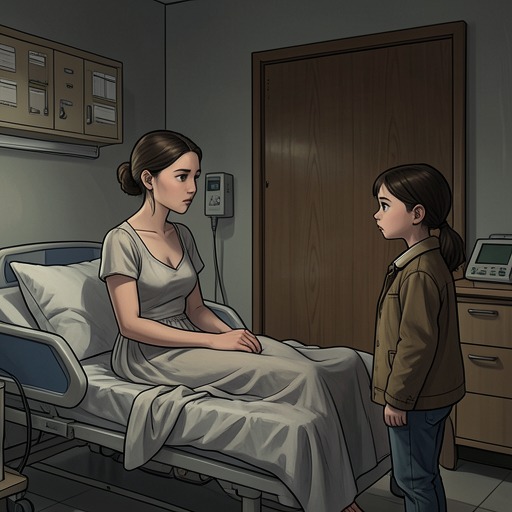
Eve lives beyond the forecast. On May 1, Denny and Enzo visit the grandparents on an unusual Monday evening. Eve is absent, and an empty hospital bed stands in the living room. That night Eve dies. The story frames her death as the end of her painful battle and the beginning of a different one for Denny. For Trish and Maxwell, the loss is both the death of their daughter and the point at which their previously shared care of Zoë becomes a dispute about where the child will live.
The Custody Conflict
After Eve’s death, Trish presents the grandparents’ request for custody as a considered plan. She says that she and Maxwell have discussed the family’s future with one another and with Eve, and argues that they can provide Zoë with a warm, stable upbringing and privileges. She takes care to say that the request is not a judgment of Denny as a person or as a father, but rather what she believes is in Zoë’s best interest. Denny is perplexed. From his perspective, Zoë had been staying with her grandparents so she could be with her dying mother; he had understood that she would return to him after Eve’s death.
When the conversation continues, Trish asks Denny to let Zoë stay while the lawyers work toward a compromise. She points to his earlier agreement that Zoë could live with them. Denny replies that they had begged him to allow it. The exchange exposes the competing meanings of the same arrangement: for Trish, Zoë’s stay can support a longer transition; for Denny, it had been a temporary accommodation made for Eve. Trish’s appeal is personal as well as legal. She asks him to let the child remain with them, but her request cannot erase the circumstances under which he first agreed.
Zoë’s own wishes complicate the adults’ claims. Denny tells her that her mother would like her to stay with her grandparents, and promises that he will visit every day and spend weekends with her. Zoë acknowledges that her grandparents want her too, but also tells her father that she knows he will not leave her there forever. Later, she insists that she wants to live at home with Denny and Enzo, and asks whether her grandparents were responsible for the accusation against her father. Denny denies that they made it, while saying that they know about it. These moments show how the custody conflict reaches Zoë not as an abstract dispute but as a condition she must interpret and endure.
Sympathy and Narrative Role
Trish does not appear only as an adversary. At one point, she intervenes when Denny is in a tense encounter with her brothers, asks him not to stay, and then apologizes, saying she understands that he must be very alone. Denny does not answer; his eyes fill with tears, and Zoë begins crying with him. Trish’s sympathy does not resolve the conflict or withdraw her position, but it briefly recognizes the isolation his struggle has brought him.
Later, when Trish says that the custody arrangement is for the best, she also admits that she feels badly for Denny. Maxwell repeats that it is for the best; Trish answers that she knows, but still feels for him. This private acknowledgment sits beside her public insistence on custody. The contrast keeps her from becoming a simple embodiment of either compassion or control: she can grieve for Denny and continue to support a course that separates him from Zoë. Through Trish, the novel locates the family conflict in the difficult overlap between sincere care, bereavement, and competing ideas of what a child needs.