
The End Justifies the Means
The AxBurke adopts a corporate-sounding moral logic to justify violence, and the narrative repeatedly tests that logic against the people harmed by it.
increasing Bearing strength in each event
 decreasing
Bearing strength in each eventdecreasingA Benevolent Self-Image

A Benevolent Self-Image
The Family as Purpose
Burke tells himself that he is acting for Marjorie, Betsy, and Billy. He wants to work, support his family, and avoid becoming a burden.
Moral Cover
The worthy ends make it easier for him to avoid naming the act itself as murder. His self-image remains that of a provider even while his methods contradict the care he claims to express.
A Victim’s Ordinary Life

A Victim’s Ordinary Life
Everly at the Mailbox
Burke sees Everly collecting bills and magazines outside his home. The mundane setting briefly makes the target’s ordinary life visible.
The Abstraction Wins
Burke shoots him anyway, treating the candidate’s résumé as more important than the person in front of him. The contrast exposes the moral cost of converting competition into permission.
The Society’s Permission

The Society’s Permission
Public Rationalizations
Burke reflects that executives defend layoffs by appealing to the good of the company and its future. He sees the same ends-based reasoning in the language of corporate leadership.
Imitation, Not Escape
Burke condemns the corporate logic yet adopts its form for his own crimes. The resemblance suggests that he is not outside the system he despises; he reproduces its willingness to sacrifice people to a promised outcome.
Fallon as a Fellow Worker
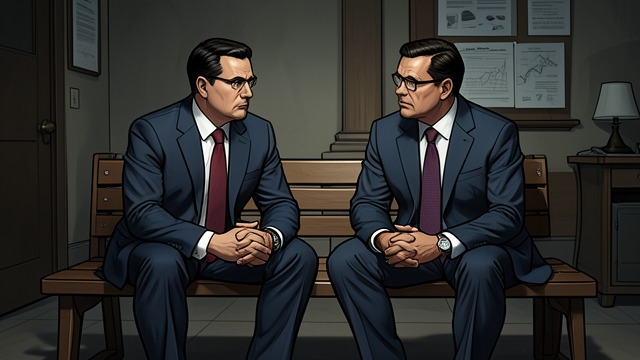
Fallon as a Fellow Worker
Shared Grievance
Fallon and Burke condemn employers who discard workers and talk as experienced managers. Their conversation establishes a real basis for solidarity.
The Justification Fails
Burke kills Fallon despite their common understanding. The act makes the contradiction undeniable: the person Burke calls a necessary obstacle is also a fellow worker who understands his fear.
The Interview Reward

The Interview Reward
Success Appears
Arcadia’s call seems to validate Burke’s belief that his actions have secured a useful result. The employment opportunity gives the moral argument a material payoff.
Consequences Remain
Burton’s investigation interrupts the triumph, and the interview has not yet happened. Burke’s justification depends on an outcome still uncertain, while the deaths he caused are already irreversible.
Early in Burke’s plan
May 8, 1997
Late May 1997
Late June 1997
July 1–3, 1997
